The year 2025 is coming to an end. For Taiwan, it has been a turbulent year. Taiwan achieved breakthrough accomplishments in its economy and diplomacy, yet the Chinese Communist Party’s (CCP) military threats—combined with the cooperation of internal collaborators within Taiwan—have also reached an unprecedented level.
In response to China’s escalating threats toward Taiwan and the Indo-Pacific region, President Lai Ching-te on Nov. 26 proposed two major action plans at a press conference: “Firmly Safeguard National Sovereignty and Comprehensively Build Democratic Defense Mechanisms” and “Strengthen National Defense Capabilities and Build a Comprehensive National Defense–Related Industry.” These initiatives carry extremely important strategic significance.
In this speech, President Lai mentioned the CCP’s “coercive unification” of Taiwan at least three times, yet it did not receive sufficient attention in Taiwan. News anchor Chang Ya-chin reportedly called on the public twice to take note of this new term. President Lai explained “coercive unification” as follows: “While China is accelerating its military preparations for ‘armed unification of Taiwan,’ it is also, internationally, across the Taiwan Strait, and in various domains, intensifying the promotion of so-called ‘coercive unification’ under the guise of false peace, attempting to turn Taiwan into a part under China’s jurisdiction.”
In other words, all forms of threats and inducements short of outright military attack (of course including the most important factor—military intimidation) serve the goal of “coercive unification.” This implies there is no sincere “peaceful unification”; if there were genuine peaceful unification, why would such auxiliary means be necessary?
The advance into Tibet in the 1950s was coercive unification, and the takeover of Hong Kong in 1997 was also coercive unification—both relying on military might combined with sweet-talk and deception. Before 1997, Xinhua News Agency (now the Central Government Liaison Office), which functioned as Hong Kong’s second center of power, constantly intervened to “disrupt British rule.”
Success
You are now signed up for our newsletter
Success
Check your email to complete sign up
The democratic camp that once supported the CCP’s resumption of sovereignty over Hong Kong has now been excluded from the ranks of “patriots,” with political parties not even permitted to exist. Cheng Li-wen hopes the CCP would treat the Democratic Progressive Party the same way—wouldn’t that be courting disaster for herself?

The CCP encircles Taiwan
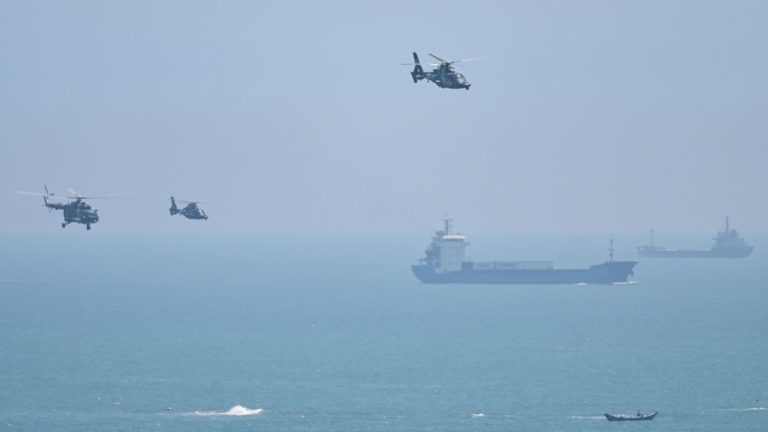
The CCP’s encirclement military drills around Taiwan on Dec. 29 were virtually inevitable for several reasons. First, China’s internal economic difficulties have intensified; many regions canceled New Year’s Eve countdown events out of fear that public dissatisfaction could turn gatherings into protests calling for “Xi to step down.” Second, anti-Japan efforts have failed to deliver results, accumulating public resentment, prompting the regime to redirect hostility toward Taiwan; the CCP cannot go a single day without an external enemy—once there is no external enemy, the Communist Party itself becomes the enemy of the Chinese people.
Third, the PLA’s senior leadership is still undergoing a major purge, leaving everyone uneasy; striking an external enemy is needed to ease internal tensions and to show the outside world that internal infighting has not affected combat readiness.
Taipei Mayor Chiang Wan-an returned to Taipei on the night of the 28th from the Shanghai–Taipei Twin-City Forum, and China announced military drills early on the morning of the 29th. Chiang himself violated the forum’s promise that it would be held “conditionally”; naturally, the CCP would not respect him either, instead treating him as a talking prop—used and then discarded.
It is believed Chiang Wan-an will not learn a lesson and will simply endure the humiliation, because Shanghai is where he decided to enter politics; the string controlling him will not break, and he lacks the courage to挣脱 it.
In the face of coercive unification, aside from the NT$1.25 trillion in military investment proposed by President Lai to strengthen resistance, safeguard peace, and cooperate with allies, the public must also unite, purge internal traitors, and strengthen awareness of resisting the enemy.
If one day the CCP believes conditions are ripe to move against Taiwan, it will surely proclaim that anyone who does not insist on Taiwan independence from that day forward will be granted amnesty, using this to divide Taiwan. At that point, how many people believe the CCP’s words will determine Taiwan’s fate.
This is the model the CCP uses for “unification” with any country or region.