By Li Jingyao, Vision Times
On the final day of 2025, a series of unusually subtle yet telling signals point to Chinese President Xi Jinping’s eroding authority. Observers noted striking changes both at the Chinese People’s Political Consultative Conference (CPPCC) New Year tea reception earlier in the day and in Xi’s nationally televised 2026 New Year address that evening — developments widely interpreted as signs of a deepening power crisis within the Chinese Communist Party’s (CCP) top echelons.
‘Xi core’ no longer at the top
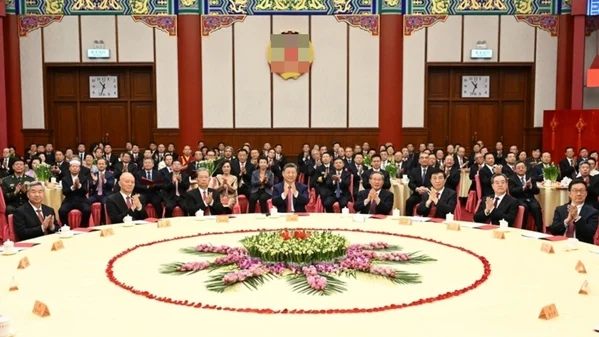
On Dec. 31, 2025, the CPPCC held its customary New Year tea reception at the CPPCC Auditorium. Attendees included Xi Jinping, Li Qiang, Zhao Leji, Wang Huning, Cai Qi, Ding Xuexiang, Li Xi, Han Zheng, leaders of the All-China Federation of Industry and Commerce, representatives of non-Communist parties, and senior officials from central and state organs.
But what drew particular attention this year was the altered seating arrangement. Photos released by state media Xinhua News Agency showed Xi seated at a large round table together with the other six Politburo Standing Committee members and Han Zheng. To Xi’s left sat Li Qiang, Wang Huning, Ding Xuexiang, and Han Zheng; to his right were Zhao Leji, Cai Qi, and Li Xi. The Politburo serves as China’s top ruling body.
RELATED: Xi Jinping Told to ‘Know His Place’ as His Authority Suffers Further Downgrade
Success
You are now signed up for our newsletter
Success
Check your email to complete sign up
This contrasted sharply with the 2023 and 2024 tea receptions, where seating was arranged across three long tables. In those years, Xi sat at the center table alongside Zhao Leji and Li Qiang, a layout that visually emphasized Xi’s status as the undisputed “core” of the leadership.
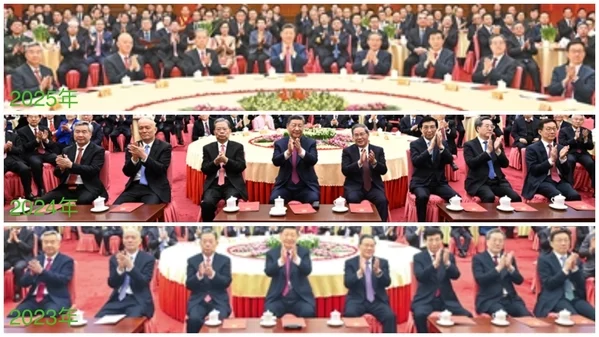
Changes were also evident in the rhetoric of speeches delivered at the event. At the 2023 tea reception, CPPCC Chairman Wang Huning twice cited Xi’s speeches and explicitly referenced “Xi Jinping Thought.” Representatives of the democratic parties likewise invoked phrases such as “the Party Central Committee with Comrade Xi Jinping at its core,” along with the slogans “Two Establishes” and “Two Upholds.”
By comparison, in 2024 and 2025 Wang Huning mentioned Xi’s remarks only once and no longer referred to “Xi Jinping Thought.” Democratic party representatives limited their remarks to “the Party Central Committee with Comrade Xi Jinping at its core,” dropping references to “Two Establishes” and “Two Upholds.”
Political commentator Li Yanming noted that compared with previous years, the 2025 round-table arrangement — with four leaders on one side of Xi and three on the other — visibly diluted Xi’s symbolic centrality. In his view, these anomalies at the New Year tea reception lent further weight to persistent rumors that Xi’s influence is waning.
A lack of confidence
Signs of diminished authority were also evident in Xi’s New Year address broadcast that evening on Xinwen Lianbo. In the roughly 10-minute speech, Xi highlighted China’s overall performance, claiming that the country’s total economic output in 2025 was expected to reach 140 trillion yuan and asserting that China’s economic, technological, national defense, and comprehensive national strength had all reached “new levels.” When addressing difficulties, he offered only a vague reference to “overcoming numerous challenges.”
This marked a notable shift from Xi’s tone in previous addresses. In his 2025 New Year message, Xi had said: “At present, economic operations face some new circumstances, including challenges arising from external uncertainties and pressures from the transition between old and new growth drivers, but these can be overcome through hard work.” Similar acknowledgments appeared in his 2024 address.
Veteran journalist Wang Jian, speaking on his self-media platform, argued that China’s economy sharply deteriorated in 2025 while its diplomatic environment worsened in parallel, placing Xi’s standing within the Party under strain. Against this backdrop, although the structure of Xi’s 2026 address remained unchanged, its language, framing, and priorities differed markedly.
According to Wang Jian, Xi’s 2025 address openly acknowledged economic pressure and external uncertainty, signaling the need for a “combination of policy measures.” In contrast, the 2026 address avoided any mention of risks, pressures, or challenges, instead emphasizing achievements and declaring that China had crossed “new thresholds.”
Wang interpreted this as a deliberate narrative shift: using claims of economic success to obscure persistent structural problems. He argued that such avoidance reflects a lack of confidence—sidestepping issues does not mean they have improved, but rather suggests a defensive posture adopted under mounting pressure.
Emphasizing economic achievements to shore up legitimacy
Wang Jian further observed that in the 2025 address, Xi repeatedly highlighted his own role, implicitly conveying that “all of this was done by me.” In the 2026 address, however, Xi largely abandoned such personalized language, instead saying “we accomplished” or “we advanced,” signaling a conscious lowering of profile amid political headwinds.
Xi also used the CPPCC New Year tea reception to stress economic achievements, expressing confidence in achieving “around 5 percent” growth in 2025 and reiterating that China had taken new steps in reform and opening, strengthened social welfare, and maintained overall stability.
Wang Jian argued that this emphasis goes beyond mere image management and is closely tied to regime legitimacy. Despite widespread skepticism over data manipulation and inflated economic figures, statements from Premier Li Qiang and government agencies still need to underpin Xi’s year-end narrative in order to sustain the CCP’s claim to effective governance.
In Wang’s assessment, Xi’s past year has been far from smooth: close allies have fallen, and he has reportedly lost control over the military. While Xi retains his formal position within the system, his real power has clearly been curtailed. Given that economic performance underpins political legitimacy, Wang concluded that amid continued economic decline, Xi is unlikely to secure another term in office.
Editorial note: Views expressed in this article are the opinions of the author and do not necessarily reflect the views of Vision Times.