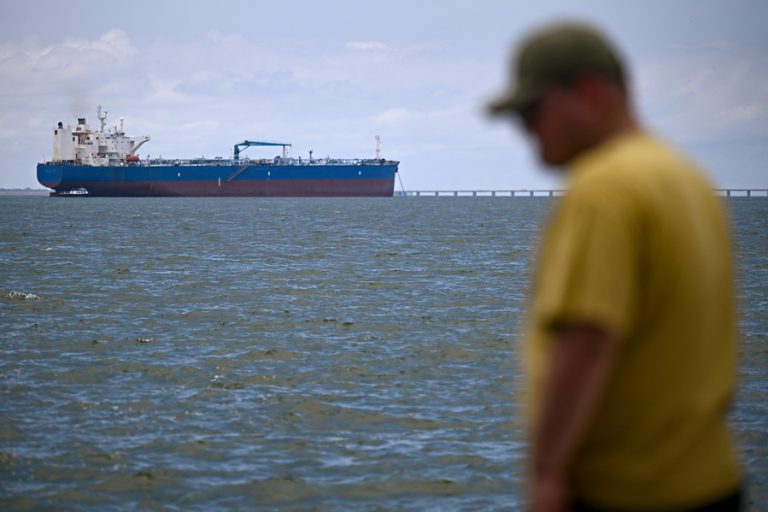
According to a message posted on social media by the U.S. European Command on the morning of Jan.7, the United States seized an oil tanker after tracking it across the Atlantic. The U.S. said the tanker was connected to Venezuela.
The tanker, originally named Bella 1, was sanctioned by the United States in 2024 because it operated as part of a “shadow fleet” transporting illicit oil. Reuters first reported the seizure on Wednesday and, citing two sources, said the operation was carried out by the Coast Guard and the U.S. military.
According to a U.S. official, before the U.S. seized the tanker, the Russian military had begun moving naval assets and a Russian submarine to protect Bella 1. But the sources said it was unclear how close those vessels were to the tanker when it was seized on Wednesday.
According to the vessel-tracking website MarineTraffic, the tanker seized by the United States was located in the North Atlantic, about 190 miles south of Iceland’s coast. The website showed that shortly before and after reports of the seizure appeared, the tanker suddenly turned south.
U.S. Southern Command announced on the X platform that the United States separately seized another vessel in the Caribbean on Wednesday. Southern Command said the ship was considered “stateless” and claimed it “was engaged in illicit activity.” Secretary of Homeland Security Kristi Noem confirmed the action on social media, saying: “Criminals of the world, take notice. You can run, but there is nowhere to hide. We will never give up on our mission to protect the American people and disrupt the financing of narco-terrorism wherever we find it.”
Success
You are now signed up for our newsletter
Success
Check your email to complete sign up
The US attempted to seize the Bella 1 last month
Last month, the U.S. Coast Guard attempted to seize the Bella 1 tanker in waters near Venezuela, but after the ship turned around and fled, U.S. forces did not board it. According to publicly available flight data, the tanker then sailed northeast and the United States continued tracking it.
The U.S. deployed a P-8 surveillance aircraft from RAF Mildenhall in Suffolk, U.K., to monitor the tanker for several days until it was seized. During that time, the tanker sailed north, passing along the U.K. coastline.
Noem wrote on social media that the Coast Guard cutter Munro had been tracking the tanker “on the high seas and through treacherous storms,” “standing vigilant and defending our nation with the determination and patriotism that makes Americans proud.”
During the pursuit, the tanker’s crew painted a Russian flag on the hull, claiming the ship was under Russian protection. Shortly afterward, the ship appeared under a new name, Marinella, in the official Russian ship registry.
Last month, Russia issued a formal diplomatic note demanding that the U.S. stop pursuing the ship. Because the vessel claimed Russian nationality, the legality of seizing the tanker became more complicated. But two people familiar with the matter said the Trump administration did not recognize this status and considered the ship stateless.
US says Russia cannot claim ownership
According to a person familiar with the briefing, during a Monday briefing with key lawmakers, Marco Rubio said the United States believed Russia could not simply claim ownership of the tanker. Rubio discussed the matter only briefly and did not make clear whether this information had been directly conveyed to the Russian government.
Reports state that before seizing the tanker, the United States redeployed military assets to the United Kingdom. Between Jan. 3 and 5, at least 12 U.S. C-17 transport aircraft landed at RAF Fairford and RAF Lakenheath, many of them arriving from airports in the United States.
In recent days, V-22 Osprey tilt-rotor aircraft have also been active over the U.K., with flight data indicating they appeared to be conducting training missions based out of RAF Fairford in eastern England. On Sunday, two AC-130 gunships arrived at RAF Mildenhall.
According to the U.K. Ministry of Defence, Britain provided support to the United States. In a statement, the MoD said: “At the request of the United States for assistance, U.K. Armed Forces provided pre-planned operational support to U.S. forces to intercept the Bella 1 tanker in the waters between the U.K., Iceland, and Greenland, including basing support.”
The statement also said that the Royal Fleet Auxiliary tanker Tidesurge provided support for U.S. “pursuit and interception” of the tanker, and that the Royal Air Force “provided airborne surveillance support.” The last time the United States employed special operations forces and equipment to help intercept a sanctioned tanker was on Dec. 1.
Key questions:
Who owns the Bella 1?
The Bella 1 is Russian-owned and was seized by the U.S. while operating under a Russian flag.
Why did the U.S. consider the ship “stateless” despite its Russian flag and registry?
The U.S. considered the ship “stateless” because it did not recognize the validity of its claimed Russian registration.
What are the potential economic and diplomatic consequences for Venezuela, Russia, and global oil markets?
The seizure could sharply reduce Venezuela’s oil exports, straining its economy, while Russia faces higher transport risks and heightened U.S. tensions; globally, it may increase insurance and shipping costs for sanctioned oil, subtly reshaping trade flows and adding market volatility.