By Vision Times TV
“Have you noticed how Shenzhen feels emptier and emptier? So many apartments can’t be rented out this year, and the streets are noticeably quieter,” says a blogger as she pans to empty streets. “The only jobs that still seem ‘hot’ are ride-hailing drivers and food-delivery couriers. Some of the wages are shockingly low, 4,000 yuan a month. After rent and utilities in Shenzhen, what’s even left?”
She adds, “This is Shajing in Shenzhen. It used to be bustling, especially after work, packed so tightly people could barely move. Now it’s desolate.”
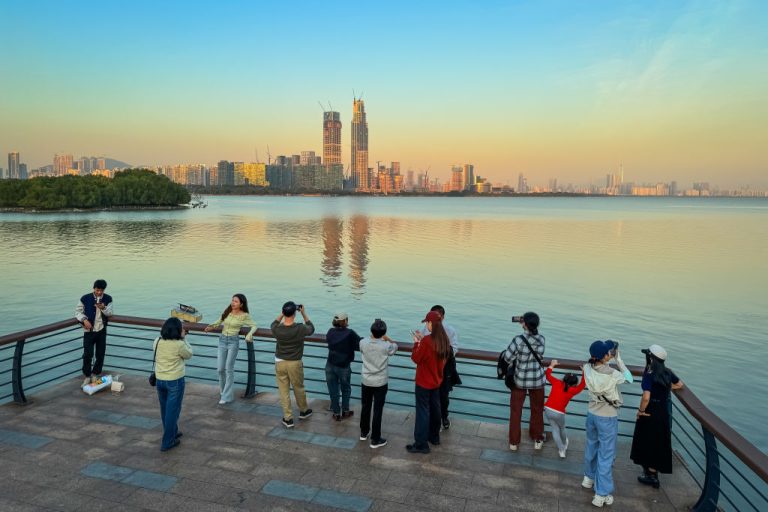
Once celebrated as China’s most dynamic boomtown, Shenzhen is now showing unmistakable signs of decline and financial hardship. Foreign firms and outside capital are pulling out, commercial districts are hollowing out, and residents lament that in a city of 18 million people, “there’s no one in the streets, no one in the malls, no one in restaurants, no one in office buildings, no one in factories, even the countryside feels empty. Where did everyone go?”
RELATED: How China’s Youth Are Redefining Success By Embracing ‘Lying Flat’ and ‘Resignation Parties’
Empty streets, desolate stores
Success
You are now signed up for our newsletter
Success
Check your email to complete sign up
Since it became a city in 1979, Shenzhen’s population and economy grew explosively. Over one decade, its permanent population jumped by 7.13 million, nearly 70 percent, the fastest growth in the country. “So why did it suddenly lose its appeal last year?” the blogger asks.
Industry insiders estimate that in the second half of 2025 alone, nearly 1,000 restaurants across the Pearl River Delta shut down, with some hotels closing less than five years after opening.
“I finally went bankrupt. I invested 10 million yuan in a hotpot restaurant at MixC World in Shenzhen. Today it’s basically all been torn down. This isn’t staged for clicks; it’s a real shutdown,” she says. “All online platforms are closed, the barriers are up, furniture and appliances removed, hard fixtures demolished. From opening on Nov. 11, 2022, to closing on Jan. 28, 2025, just over two years.”
Shuttered mall strips
In one shopping mall on Longhua Street, a single walk past ground-floor storefronts reveals a hair salon, a northeastern Chinese restaurant, a cold-noodle shop, a Korean barbecue place, and multiple clothing and food outlets, all marked “prime location for transfer.” The person filming noted that this was only one side of one floor; including the upper levels would be even more shocking.
RELATED: From Industrial Heartland to Economic Void: Why China’s Northeast Is Vanishing
On the final day of 2025, videos circulated widely on WeChat and Douyin (popular social media and blogging apps in China) showing workers standing silently in shuttered factories. “Yesterday we were still at work. Today the factory is closed and the boss has run off.”
Some bloggers admit they cannot speak too plainly for fear of repercussions, but insist that Shenzhen’s downturn is already obvious to the naked eye.
Six factors now defining Shenzhen
Observers summarize Shenzhen’s transformation into six troubling patterns:
- Once dubbed a “city of money” that thrived on migrant labor, Shenzhen is now seeing workers leave after the Lunar New Year, and not return.
- Formerly vibrant commercial districts are increasingly empty, as brands withdraw and storefront vacancies multiply.
- Once untouchable housing prices are now sliding repeatedly; new developments cut prices, while second-hand listings surge.
- More companies are relocating out, leaving office buildings and commercial towers largely vacant.
- Wages are falling, with 4,000 yuan a month becoming common. But even so, many graduates cannot find jobs and turn to food delivery.
- More women have joined food delivery work, but order volumes are shrinking, and couriers complain of platforms “stealing time,” eroding already meager earnings.
Delivery workers under strain
“In Shenzhen now, running deliveries during off-peak hours gets you maybe 40 or 50 yuan. Making 100 yuan feels impossible. It’s all 2.3-yuan orders — tons of them. At 2.3 yuan per order, you can’t pay rent, you can’t even afford food.”
China’s broader economy is under unprecedented strain. Since November 2025, conditions have worsened sharply: retail sales growth slowed for six consecutive months; producer prices fell 2.2 percent year-on-year; and the Producer Price Index has been negative for three straight years, locking the economy into deflation.
RELATED: China’s Economic Model Shows Signs of Breakdown as Hardship Looms
The average urban surveyed unemployment rate for the first 11 months of 2025 stood at 5.2 percent—a figure that excludes hundreds of millions of migrant workers. For decades, migrant laborers powered China’s infrastructure and property booms. Now, with investment declining and real estate collapsing, joblessness among migrant workers and surging youth unemployment are converging, making life in 2026 increasingly difficult for ordinary Chinese.
“Look at how brutal this is — delivery drivers with crippled legs, on crutches, still delivering food. Look at this society, what has it turned people into? I can’t even bear to watch,” the blogger notes. Many came to “Great Shenzhen” with dreams. Some ended up sleeping on the streets. Others became part of a new generation of “lying-flat” youth — exhausted, disillusioned, and struggling to survive, she notes.
The term “lying flat” refers to a growing group of young people in China who, after repeated economic setbacks and dwindling opportunities, consciously opt out of relentless competition, choosing minimal work, low consumption, and emotional withdrawal as a form of quiet resistance to a system they no longer believe will reward their effort.