By Li Jingyao
Editor’s Note: This article is based on reporting by overseas Chinese-language media outlets and political commentators citing unnamed sources within Beijing’s elite political circles. Allegations regarding internal Communist Party meetings, elite power struggles, and misconduct have not been independently verified and are presented as claims attributed to those sources.
The fifth plenary session of the 20th Central Commission for Discipline Inspection (CCDI) of the Chinese Communist Party (CCP) opened on January 12 and is scheduled to conclude on January 14. According to multiple sources familiar with internal political dynamics, the atmosphere within Zhongnanhai has grown unusually taut—described by one insider as heavy with “the stillness before a decisive confrontation.”
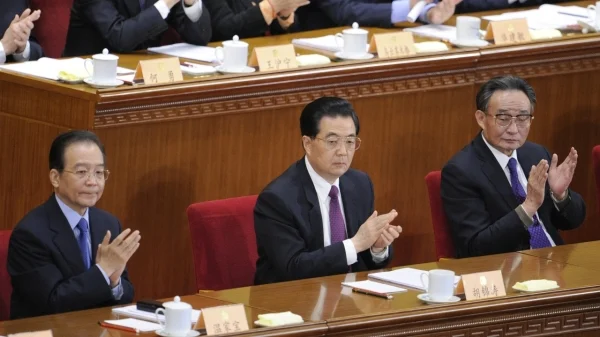
Several overseas commentators have gone further, portraying this year’s CCDI plenum as a potential political “judgment day,” driven by what they characterize as an unexpected and forceful reemergence of former Premier Wen Jiabao.
A Discipline Meeting With Unusual Weight
Within the CCP’s political calendar, the CCDI plenum is typically a choreographed affair, designed to reaffirm central authority and highlight the party’s anti-corruption credentials. This year, however, overseas outlet GuanView reports that the gathering has taken on a far more ominous character.
Success
You are now signed up for our newsletter
Success
Check your email to complete sign up
Citing multiple independent sources in Beijing’s political circles, GuanView describes the January 12 session as a moment that could decisively shape the future direction of Zhongnanhai. The catalyst, according to these accounts, lies in a dramatic shift that began weeks earlier—during a closed-door Politburo “democratic life meeting”—and in Wen Jiabao’s sudden decision to step back into the political arena.
The December 25–26, 2025, meeting was initially expected to follow the familiar script of ritualized loyalty and formulaic self-criticism. Instead, insiders say, it evolved into something far more consequential, prompting comparisons to the 1935 Zunyi Conference that reshaped CCP leadership during the Long March.
According to these sources, Wen intervened in an extraordinary capacity—as head of what was described as a “Central Decision and Coordination Mechanism,” a special supervisory body reportedly established through a compromise between retired party elders and the current leadership. The mechanism is said to exist for moments of exceptional crisis, when the party’s top leadership is believed to have strayed dangerously off course.
Rules That Changed the Dynamic
Ahead of the meeting, Wen is said to have met individually with every Politburo member, imposing a set of stringent conditions that fundamentally altered the tone of the proceedings.
Participants were reportedly barred from turning the session into a ceremonial exercise. Praise and formulaic rhetoric were explicitly discouraged; members were instructed instead to confront substantive problems directly and without evasion.
Each Politburo member was required to deliver a detailed self-criticism. More strikingly, participants were also ordered to openly criticize at least one other member by name—a demand that, according to sources, shattered the culture of caution and deference that had prevailed since Xi Jinping’s consolidation of power.
All remarks had to be delivered from prepared written statements. These documents were collected and preserved without the possibility of revision or withdrawal. One source likened the process to the creation of a permanent political record, intended for future accountability. Scrutiny extended beyond officials themselves to their families, with participants required to account for relatives’ business activities and any alleged abuse of political influence.
Xi Jinping Under Fire
Under these conditions, the meeting took an unexpected and dramatic turn. On the second day, all state media reporters were asked to leave, and the session entered what insiders described as a “vacuum mode.”
What followed, according to multiple accounts, stunned those present. Xi Jinping—who had exercised near-absolute authority for more than a decade—became the central target of collective criticism and was compelled to engage in self-criticism.
Much of the criticism focused on what participants described as Xi’s construction of a “family-centered” power structure. Relatives, including his wife Peng Liyuan and his brother Xi Yuanping, were accused of leveraging political privilege to build expansive business interests.
The discussion then turned to Xi’s impact on internal party norms. Several participants accused him of dismantling collective leadership by cultivating personal factions—a transformation they said hollowed out the CCP’s traditional decision-making mechanisms and concentrated power in Xi’s own hands.
Military representatives raised a separate and especially sensitive charge. They accused Xi of systematically purging rivals within the armed forces, arguing that the People’s Liberation Army had been transformed from what is formally described as “the Party’s army” into a personal power base.
A Succession Shadow and Pandemic Profits
Sources say Xi’s critics arrived armed with two particularly damaging lines of attack: a looming succession crisis and allegations of profiteering during national emergencies.
Attention reportedly centered on Qi Mingzheng, Xi’s nephew, whom insiders viewed as a potential third-generation figure in the Xi family’s political lineage. Qi, whose career path appeared carefully managed, was assigned to a county-level post in Hebei in 2022 before abruptly disappearing from public view in March 2023. His sudden absence was widely interpreted as evidence that Xi’s succession plans had faltered.
Even more explosive were allegations involving Qi’s wife, Xie Qirun—a member of the founding family of CP Group and an alleged behind-the-scenes shareholder in Sinovac Biotech. According to the claims, a portion of vaccine-related profits—funded through China’s national health insurance system during the COVID-19 pandemic—ultimately flowed to accounts linked to the Xi family through complex ownership arrangements.
Li Xi’s Position Becomes Pivotal
According to GuanView, the CCDI plenum has now become the decisive arena for this confrontation, with CCDI Secretary Li Xi emerging as a pivotal figure.
Sources say Li had already begun to shift his stance during the Politburo meeting, publicly reflecting on issues of family conduct and directing criticism toward what were described as elite “spouse networks.” Speculation surrounding Li’s position had circulated earlier, including rumors that his absence from a late-2025 Politburo session was connected to an investigation involving Xinjiang Party Secretary Ma Xingrui.
Converging Accounts From Separate Sources
The GuanView report closely aligns with earlier disclosures by political commentators operating under the name “Ordinary People Inside the Wall,” who likewise described the December meeting as unusually confrontational.
According to that account, former CCP leader Hu Jintao instructed Wen Jiabao and Wang Yang to meet individually with all 22 Politburo members ahead of the session. Participants were reportedly required to prepare written self-criticisms of no fewer than 5,000 words, followed by extended collective evaluations in which ritualized praise was strictly prohibited.
The commentator claimed that criticism of Xi extended to his closest allies. Li Xi was said to have raised concerns about Peng Liyuan and Xi Yuanping, while senior military figure Zhang Youxia accused Xi of cultivating loyalists within the armed forces at the expense of institutional integrity.
Several senior officials reportedly argued that Xi bore primary responsibility for major policy failures since the 20th Party Congress and should step aside. Others trained their fire on key allies, accusing Wang Huning of distorting party theory through the promotion of “Xi Jinping Thought,” and Cai Qi of fostering a personality cult that contributed to strategic misjudgments.
Echoes of Past Party Reckonings
Political analyst Li Dayu argues that the reported structure and tone of the meeting follow a familiar pattern in CCP history.
Moments in which senior leaders are subjected to collective denunciation, he notes, rarely target marginal figures. Historical precedent suggests that the party’s top leader is often the only plausible object.
Li draws a parallel to the January 1987 Politburo meeting that forced then–General Secretary Hu Yaobang to accept responsibility for “bourgeois liberalization” and ultimately resign.
Whether the current CCDI plenum will yield concrete political consequences remains uncertain. What is clear, according to multiple commentators, is that the party’s most powerful disciplinary body has become a focal point for unprecedented elite tension—raising the possibility that the Chinese Communist Party may be approaching another moment of internal reckoning.