By Jingyao Li
The Chinese Communist Party quietly established a body known as the Central Decision-Making and Deliberation Coordination Institution in late 2025. Despite its sweeping title, who actually runs the institution—and how—remains opaque. Recent disclosures from overseas sources claim that the CCP’s day-to-day governance has already been transferred to this body, whose core figures reportedly include former premier Wen Jiabao, former Politburo Standing Committee member Wang Yang, and retired general Liu Yuan.
On June 30, 2025, the CCP Politburo convened a meeting to review the Regulations on the Work of the Party Central Committee’s Decision-Making and Deliberation Coordination Institution. According to the official communiqué, the institution was created to strengthen the Central Committee’s “centralized and unified leadership over major work” and to ensure the execution of “major tasks.” The statement said the body would be responsible for “planning major matters, deliberating major issues, and grasping major work,” and would exercise overarching coordination over what it defined as the Party’s most important affairs.
More than half a year after it reportedly began operating, the institution’s membership has not been publicly disclosed. Its internal structure and personnel arrangements continue to be treated as Party secrets.
Some overseas analysts interpret the creation of this institution as a sign that Xi Jinping’s authority is being systematically hollowed out. Sources described as well-placed claim that Xi began losing substantive power as early as April 2024, and that several subsequent attempts to reassert control failed. According to these accounts, while Xi remains formally in office and continues to appear at official events, real decision-making authority has already shifted to other figures—most notably Wen Jiabao and Central Military Commission Vice Chairman Zhang Youxia. Xi, they say, remains on stage in name only, pending an eventual formal announcement.
Success
You are now signed up for our newsletter
Success
Check your email to complete sign up
Wang Yang said to assist Wen Jiabao
A political commentator using the online moniker “An Ordinary Person Inside the Firewall” recently published four disclosures on social media, the first of which concerned the internal operation of the Central Decision-Making and Deliberation Coordination Institution.
According to this account, the CCP now conducts its daily governance through this institution, which is said to stand above the seven-member Politburo Standing Committee. The reported internal arrangement places Wen Jiabao at the top, with Wang Yang assisting the elderly former premier in handling routine affairs. Wang’s office, the source claimed, is located within the General Secretary’s office compound in Zhongnanhai, a detail that has drawn attention among observers of elite CCP politics.
The same source asserted that Liu Yuan—son of former president Liu Shaoqi—has been entrusted with a role equivalent to chairman of the Central Military Commission. He is said to oversee military affairs from an office in the August 1 Building, the headquarters of the People’s Liberation Army. Although his nominal authority would place him above Zhang Youxia, Liu is described as lacking personal political ambition. Instead, he is said to be acting on behalf of Wen Jiabao, leaders from the Hu-Wen era, and Zhang Youxia to manage the day-to-day work of the military.
Reports claim Xi has withdrawn from the institution
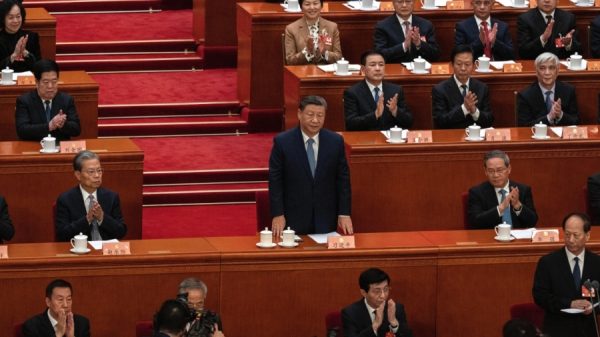
The second disclosure asserted that Xi Jinping has already exited the Central Decision-Making and Deliberation Coordination Institution. According to “An Ordinary Person Inside the Firewall,” Xi “completely withdrew from the institution after last year’s Fourth Plenum.”
As circumstantial evidence, the commentator pointed to changes in Xi’s New Year addresses in 2025 and 2026. In previous years, Xi’s speeches were typically filmed in the General Secretary’s office, with visible bookshelves, telephones, and other furnishings associated with active governance. In the past two years, however, the addresses were delivered against a stark gray-toned image of the Great Wall, with no visible office setting—an absence the source interpreted as symbolically significant.

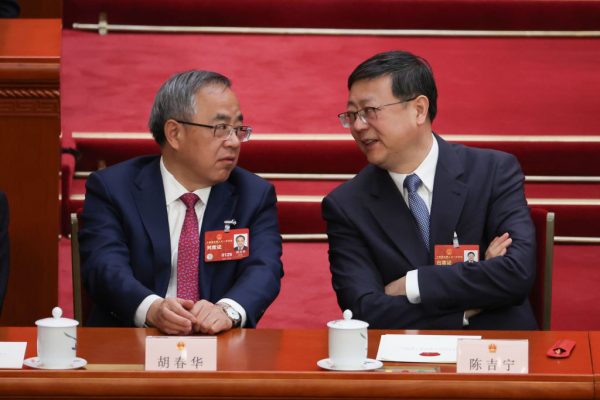
Hu Chunhua reportedly pre-selected for succession
The third disclosure claimed that Hu Chunhua has “already been internally designated to enter the succession lineup.” According to the source, Wang Yang is preparing the political groundwork to ensure a smooth transition, with the goal of positioning Hu as a representative of the CCP’s so-called sixth generation of leadership. The source said the decision may not be formally announced until the Party’s 21st National Congress.
The fourth disclosure addressed internal disagreements among anti-Xi factions over how to handle the case of former premier Li Keqiang, whose sudden death continues to provoke controversy.
According to the account, Li Keqiang’s wife and daughter have repeatedly met with Wen Jiabao and Wang Yang, urging a reopening of the investigation into Li’s death. This effort is said to have the backing of some senior figures. However, a “well-known elder” is reportedly opposed, arguing that reopening the case would undermine Xi Jinping’s “dignity” and should be postponed until after Xi’s death. Li’s family, unwilling to wait, has created a stalemate within the elite, the source claimed.
The authenticity of these disclosures cannot be independently verified. However, they partially align with recent reporting from GuanView, which stated that Wen Jiabao is serving as the head of the Central Decision-Making and Deliberation Coordination Institution. GuanView described the body as a special supervisory mechanism formed through compromise between retired Party elders and current leaders, designed to correct deviations at the apex of power under extraordinary circumstances.
GuanView also reported that Wen Jiabao intervened directly in the Politburo’s democratic life meeting held on Dec. 25–26, 2025. According to the outlet, his intervention led to a dramatic reversal during the session, with Xi Jinping coming under criticism from other Politburo members.
Political commentator Tang Jingyuan has similarly argued that the power structure established at the Fourth Plenum now centers on the Decision-Making and Deliberation Coordination Institution. In his assessment, the body has effectively supplanted—and hollowed out—the traditional Politburo Standing Committee. Tang noted that earlier reports identifying Wen Jiabao as group leader and Wang Yang as executive deputy leader have since been corroborated through multiple channels.
Veteran journalist Guo Jun said on the Elite Forum program that, following the Fourth Plenum, the idea of “Xi stepping down and Hu Chunhua stepping up” has become an open secret within Beijing’s senior political circles. He compared the current situation to the sidelining of Hua Guofeng, in which formal titles remained intact even as real authority disappeared.
According to Guo, the most visible change since the Fourth Plenum is that the CCP no longer operates under a single core leader. Instead, multiple centers of power have emerged, marking what he described as the beginning of a regency era. He said a temporary central decision-making and coordination group has formed within the Party, chaired by former general secretary Hu Jintao, to manage daily decision-making and personnel arrangements.
“In a situation where Xi still retains some public support,” Guo said, “real power has already shifted to a group of Party elders.” He named Hu Jintao, Wen Jiabao, Zhang Youxia, Zeng Qinghong, Wang Yang, and Liu Yuan as key figures—each representing distinct factions and interest groups within the CCP.