By Li Jingyao
With the Chinese Communist Party (CCP) scheduled to convene its 21st National Congress in 2027 to select a successor, Beijing’s political trajectory this year has drawn intense scrutiny. Analysts now argue that Xi Jinping is no longer the system’s true manager—and that an unprecedented internal purge is accelerating. This campaign, they warn, may climb higher than before, potentially reaching even the Politburo Standing Committee. The so-called “Xi faction” is entering what insiders describe as a “period of tribulation.”
Xi Jinping no longer governs directly
Veteran journalist Guo Jun stated on the political affairs program Elite Forum that the CCP is simultaneously confronting three structural crises. The first is a political crisis rooted in succession uncertainty. The second is an economy already trapped in deflation and a mounting debt spiral. The third is a hostile external environment that has taken on a long-term, structural character. In her view, 2026 will not be a year of stability; sustained turbulence is unavoidable.
Guo noted that the Party has delayed convening the Fifth Plenum not because it lacks urgency, but because the internal “cleanup” is incomplete. At present, she argues, the CCP is not truly selecting a successor. Instead, it is clearing the field, bargaining behind the scenes, and buying time. Within this context, Hu Chunhua has emerged as a compromise candidate acceptable to multiple factions.
According to Guo, “Xi Jinping effectively withdrew from hands-on governance after the Third Plenum.” Since then, Xi has increasingly functioned as a political overseer rather than an operational decision-maker. Such a role shift, she explained, typically occurs under only two conditions: either power has been forcibly curtailed, or health and stamina no longer permit sustained high-intensity control.
Success
You are now signed up for our newsletter
Success
Check your email to complete sign up
The steady downfall or marginalization of Xi’s personally promoted loyalists reflects a rapid collapse in the standing of his entire faction. Within the Party, assessments of Xi have shifted from “strongman” to “source of systemic risk.” When economic management falters, factional cohesion breaks down, and Xi himself retreats from concrete governance, power inevitably migrates elsewhere. As Guo put it, this year’s political struggle in Beijing will not only be fiercer—it will be more dangerous.
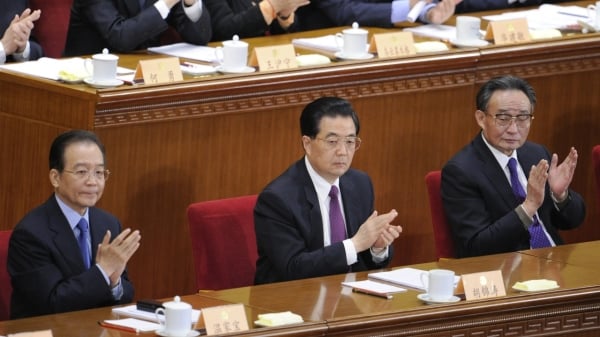
Has the anti-corruption apparatus ‘changed its surname’ to Hu and Wen?
As Xi steps back from day-to-day control, authority over the anti-corruption system appears to have shifted as well—away from Xi and toward the political legacy of former leaders Hu Jintao and Wen Jiabao. This shift is evident in recent rhetoric from Li Xi, head of the Central Commission for Discipline Inspection (CCDI).
At the CCDI’s Fourth Plenum in January 2025, Li Xi emphasized that Xi’s speech had “set forth clear requirements for resolutely winning the tough, protracted, and overall battle against corruption.” At the Third Plenum in January 2024, Li similarly cited Xi’s speech as laying out nine concrete directives for anti-corruption work.
Yet at the Fifth Plenum, Li made no reference to Xi issuing any explicit requirements.
U.S.-based political commentator Chen Pokong argues that Xi has effectively lost the authority to issue such instructions. The reason, he says, is straightforward: those now being brought down are overwhelmingly Xi’s own appointees. Every full general removed from the military belonged to the Xi faction. Xi personally promoted more than seventy generals—and more than seventy have fallen. The same pattern holds in the Party and state apparatus.
Independent filmmaker Li Jun interprets this silence as revealing. “It shows that neither the overall objectives nor the operational direction are being set by Xi anymore,” he said. “That’s why Li Xi doesn’t say it—and Xi doesn’t say it either. There is no longer a target to announce. The CCDI has effectively changed its surname to Hu and Wen.”
Within the CCP system, Li explained, genuine authority is marked by specificity. Those who truly hold power issue concrete, practical instructions—clear guidance on what to do and how to do it. The absence of such directives is itself a signal that real control has shifted.
Indeed, before and after the Fourth Plenum, sweeping purges across the military and local governments were aimed squarely at Xi’s direct political lineage. The CCDI’s change in orientation was already visible last year.
The commentator known as “An Ordinary Person Inside the Wall” added that Li Xi has reinvented himself—from Xi’s feared enforcer into Hu and Wen’s blade. By taking down Ma Xingrui last year, Li effectively submitted a political “pledge of loyalty” to the new center of power. This year, the commentator predicts, Li Xi will strike even harder, seeking to secure his own political survival.
Li Jun went further: “Last year, the purge reached the level of Politburo members. This year, whether it climbs to the Standing Committee is the question everyone is watching.”

Is Cai Qi in immediate danger?
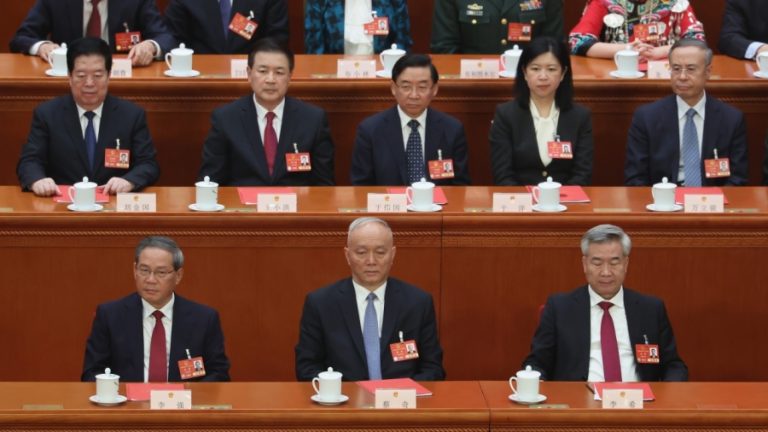
If the purge does extend to the Standing Committee, who would fall first? Current signals suggest that Cai Qi—Xi Jinping’s closest confidant—may be in serious jeopardy. The work of the Central Secretariat, which Cai oversees as First Secretary, was quietly criticized at the Jan. 8 meeting of the Politburo Standing Committee.
Li Jun noted that the Standing Committee explicitly praised the work of the Party leadership groups of the National People’s Congress, the State Council, the Chinese People’s Political Consultative Conference, the Supreme People’s Court, and the Supreme People’s Procuratorate. The summary of the Central Secretariat’s performance, however, stood out.
“On the surface it reads like praise,” Li observed, “but between the lines it is unmistakably critical.”
The 2024 communiqué stated that the newly formed Central Secretariat had “acted proactively and earnestly fulfilled its duties,” and that it had carried out “a large amount of effective work” in implementing central decisions.
The 2025 communiqué removed some of this emphasis, stating only that the Secretariat had “fulfilled its duties and acted proactively,” and had done “a large amount of work.”
By 2026, the language was further diluted. The Secretariat was said merely to have “implemented Party Central Committee decisions and actively fulfilled its duties,” completing assigned tasks and doing “a large amount of work.”
As Li Jun pointed out, the deletions matter. “Proactive” loses its initiative. “Earnestly” disappears. “Effective” vanishes entirely. The message, he said, is clear: not proactive, not serious, and not effective.
Formally, overall responsibility for the Secretariat rests with Xi Jinping, while Cai Qi serves as First Secretary. The implicit question, then, is whether the criticism is aimed at Xi himself—or at Cai Qi’s execution of Xi’s will.
The timing is telling. The 2024 communiqué was issued before the Third Plenum, when Xi still exercised consolidated power. The 2025 and 2026 statements came after the Plenum, when the Secretariat’s work suddenly appeared sluggish and uninspired. This, Li suggested, lends weight to the idea that real authority has shifted to newly empowered “central deliberative and coordinating bodies.”
In a system obsessed with language, a few missing characters can signal a major political verdict.

A knife turned inward
Guo Jun concluded with a stark assessment. For the past decade, the anti-corruption knife was firmly in Xi Jinping’s hand. Now, the blade has turned inward. Xi’s political camp is entering a period of reckoning.
Whether the purge stops with figures like Cai Qi and Public Security Minister Wang Xiaohong—or continues upward toward the core of the CCP elite, even including Xi himself—will depend on how far Hu Jintao and Wen Jiabao’s camp chooses to go.