By He Zi
When people think of the Soviet Union’s collapse, they often picture the fall of the Iron Curtain or the grand chessboard of great-power rivalry. But zoom in closer and the scene looks less like epic history and more like a hastily staged gangster farce that forgot to rehearse.
In 1991, the world witnessed the implosion of a massive political system. It also witnessed a series of moments so absurd they could have put Hollywood screenwriters out of work.
A coup fueled by fear and confusion
On the morning of Aug. 19, 1991, Soviet citizens turned on their televisions expecting to see the arrival of a hardline new era. Instead, they stumbled into a political crash scene shaped by panic, hesitation, and visible disorder.
The coup, launched in the name of “saving the Union,” was orchestrated by senior Communist Party officials who styled themselves as men of order. According to later accounts, some of the plotters spent the hours before the announcement sequestered inside the Kremlin, struggling to steady their nerves as the plan unfolded.
Success
You are now signed up for our newsletter
Success
Check your email to complete sign up
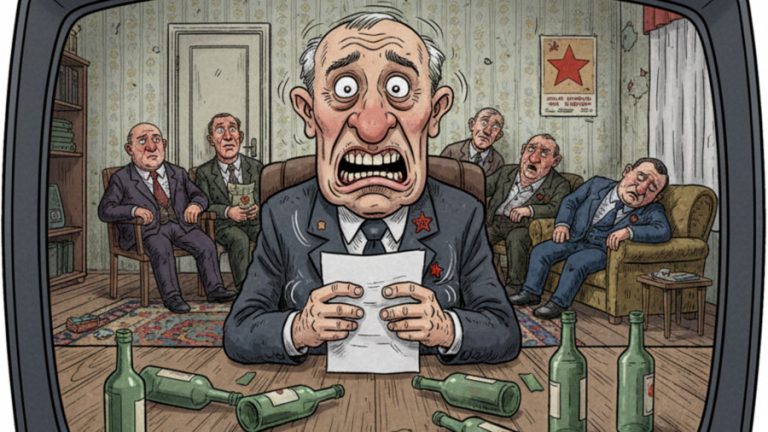
When Vice President Gennady Yanayev appeared at a press conference later that day, history delivered one of its most revealing images. Under the glare of international cameras, his hands shook so violently that he could barely hold his prepared statement. The tremor did more than expose personal nerves. It shattered whatever residual awe the Soviet public still held for the system itself.
A biting joke quickly spread through Moscow. People asked, “Why are Comrade Yanayev’s hands shaking so badly?” The punchline followed: “Because he’s spent his whole life just raising his hand to approve decisions. Today is the first time he’s had to act on his own.”
Across the country, viewers watched this trembling stand-in for supreme authority and arrived at the same bleak conclusion: this was the final line of defenders of the empire.
When Swan Lake plays, someone is finished
As tanks rolled through Moscow streets, Soviet state television reverted to an old reflex. With the plotters unable to agree on how to explain themselves to the public, broadcasters defaulted to endless reruns of Tchaikovsky’s ballet Swan Lake. For several days, regardless of what was happening outside, television screens showed white-clad dancers circling the stage.
The effect lingered long after the coup collapsed. A dark saying took hold: in the Soviet Union, you did not need a clock. If ballet appeared on television, it meant the leader was gone or the country itself was falling apart. For many Russians, the sight of ballet became an emergency signal. Turn off the TV. Go buy flour and potatoes.
The cosmonaut left behind
Amid the chaos, perhaps the most forlorn figure was Sergei Krikalev, a cosmonaut stationed aboard the Mir space station. He launched into orbit in May 1991 as a celebrated Soviet hero. Six months later, he looked down at Earth to find his country had vanished from the map.
Ground control was paralyzed by financial collapse and political disputes. Kazakhstan, home to the primary launch facilities, had declared independence. Officials argued over who should pay to bring him home. In the confusion, the man orbiting the planet was nearly forgotten.
Krikalev remained in space for an additional ten months. A grim joke circulated below: he was the Soviet Union’s last remaining territory, the only place that had not yet signed the dissolution documents. He departed as a Soviet citizen and returned holding a Russian passport. He witnessed the disintegration of an empire in zero gravity and nearly lost his salary because the state that owed it to him no longer existed.
Power handed over like secondhand goods
When authority finally shifted from Mikhail Gorbachev to Boris Yeltsin, the scene was awkward rather than ceremonial. Yeltsin reportedly declined to receive power in Gorbachev’s Kremlin office. Control of the nuclear briefcase, linked to tens of thousands of warheads, was transferred quietly by two officers in an ordinary corridor.
On the day the red flag was lowered from the Kremlin, no replacement was ready. The flagpole stood empty for an uncomfortable stretch before Russia’s tricolor was finally raised.
Warships for soda, underwear for potatoes
Life after collapse took on the logic of surrealism. As the ruble disintegrated, barter replaced money. In one widely cited episode, the Soviet government, unable to settle accounts with Pepsi, transferred decommissioned submarines and warships as part of a deal. Journalists later joked that the arrangement briefly made a soft-drink company one of the world’s largest naval powers.
On the streets, daily life unraveled into punchlines. One joke described a man who waited three days in line for meat, finally snapping and shouting that he would go to the Kremlin to kill someone. He returned half an hour later. Asked if he had succeeded, he replied that the line there was even longer.
Factories paid workers with whatever they produced. Shoe plants issued shoes. Lingerie factories handed out bras. In Moscow, men waved lace underwear in open-air markets, hoping to trade it for potatoes.
Gorbachev’s shadow
In the summer of 1989, Gorbachev visited Beijing, promoting his ideas of political reform. Students greeted him like a rock star. He left behind a remark, later widely quoted, that without political reform, economic reform would eventually fail.
He met with Zhao Ziyang during the visit. Soon after Gorbachev returned to Moscow, Zhao was forced from power.
Xi Jinping has repeatedly cited the Soviet collapse as a cautionary lesson, criticizing the absence of resistance within the system when it fell. In Chinese Communist Party internal discussions and educational materials, Gorbachev is often portrayed as the leader who squandered an inherited political order.
Xi has long sought to project a strongman image associated with Vladimir Putin. Yet one detail is often overlooked. Putin resigned from the Communist Party the day after the failed August 1991 coup. Gorbachev, late in life, said his greatest regret was not leaving the Party sooner.
History has a habit of making its worst jokes at the most solemn moments. When rumors swirl inside a rigid system, when names of powerful generals become sensitive words, when people whisper about who has been detained or disappeared, the atmosphere begins to feel familiar. It is the sound of collective unease, the background noise that often precedes collapse.