New York drivers can expect to face tougher penalties under a revamped state DMV point system set to take effect this February, with higher point values for common violations and an easier path to license suspension.
State officials say the changes are aimed at improving roadway safety and reducing dangerous driving behaviors. The overhaul traces back to Gov. Kathy Hochul’s 2023 State of the State agenda that was formally introduced in the July 2024 New York State Register before being finalized the following November.
Beginning February 2026, several violations will carry steeper point penalties. Minor speeding— one to 10 miles per hour over the limit—will rise from three to four points while cell phone use behind the wheel will increase from five to six points, and failing to yield to a pedestrian will jump from three to five points.
More serious offenses will see the sharpest increases. Reckless driving and illegally passing a stopped school bus will both carry eight points, up from five. New point penalties will also apply to failure to move over for emergency vehicles (three points), illegal U-turns (two points), obstructing traffic (two points), and equipment violations (one point each).
The threshold for license suspension is also changing. Currently, drivers can be suspended after accumulating 11 points within 18 months. Under the new rules, suspension may occur with 10 points accrued over a 24-month period.
Success
You are now signed up for our newsletter
Success
Check your email to complete sign up
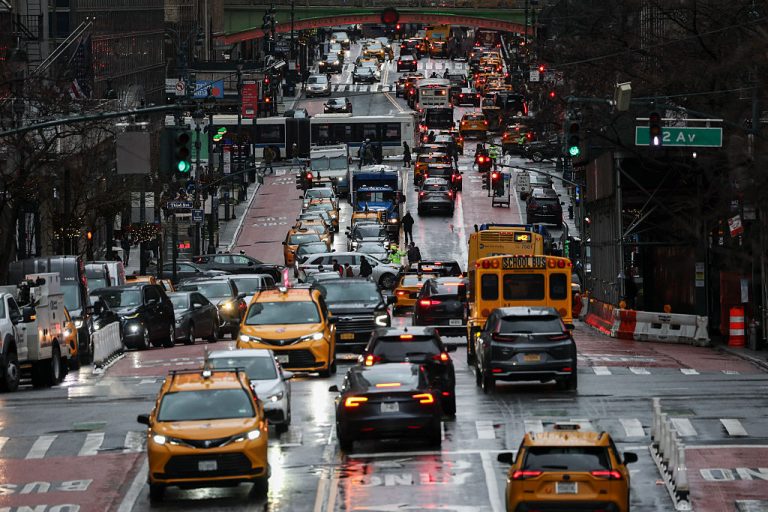
In New York City, the impact could be magnified as speed enforcement ramps up. The city’s Department of Transportation is expected to complete speed limit reductions in 250 zones by the end of 2025, increasing the likelihood of violations under the stricter point system.

Speed enforcement program expanded
Governor Hochul is moving to permanently expand New York’s automated speed enforcement program, proposing additional cameras on major bridges and higher fines for repeat offenders.
The initiative began as a pilot program two years ago, using mobile speed cameras in highway work zones to automatically ticket vehicle owners caught exceeding posted limits. The cameras rotate weekly among construction sites in an effort to slow traffic where crews are working.
According to the Governor’s office, since its launch, the program has issued more than 425,000 tickets statewide. Data shows that roughly 38,000 drivers have been flagged as repeat violators.
Under the current structure, a first violation carries a $50 fine. A second offense within 18 months results in a $75 penalty, while each subsequent violation during that period increases to $100.
Governor Hochul has defended the program’s effectiveness, citing a decline in speeding violations at locations where cameras have been redeployed multiple times. This week, marking the program’s anniversary, she announced plans to make automated enforcement permanent as part of the state’s proposed 2026 Executive Budget.
The expanded plan will extend speed cameras beyond work zones to include bridges and tunnels across the state.
Hochul is seeking approval to install cameras on crossings operated by the New York State Bridge Authority, including the Bear Mountain, Newburgh-Beacon, Mid-Hudson, Kingston-Rhinecliff, and Rip Van Winkle bridges. The proposal would also allow similar enforcement on bridges and tunnels maintained by the Metropolitan Transportation Authority.
State officials say the expansion is intended to improve safety and protect highway workers, particularly in high-traffic areas.