By Li Deyan
A Climate of fear in Beijing after the fall of Zhang Youxia
Following the reported downfall of Zhang Youxia, Vice Chairman of the Central Military Commission (CMC), and Liu Zhenli, Chief of the PLA General Staff, the political atmosphere within the Chinese Communist Party (CCP) has grown increasingly tense. In late January, Beijing officially announced the removal of Wang Xiangxi, Minister of Emergency Management, in a process strikingly similar to Zhang’s case: rumors circulating among the public, fragments of evidence pieced together online, and only then an official confirmation—after the story could no longer be contained.
Compounding the unease, three senior People’s Liberation Army (PLA) generals died around the time of Zhang Youxia’s reported arrest. Two of them were Zhang’s former superiors. In an unusual break from precedent, the CCP delayed public announcements of their deaths, further fueling speculation.
The dramatic downfall of Emergency Management Minister Wang Xiangxi
On Jan. 31, the website of the Central Commission for Discipline Inspection (CCDI) and the National Supervisory Commission announced that Wang Xiangxi, Party Secretary and Minister of Emergency Management, was under investigation for “serious violations of discipline and law.” He became yet another sitting ministerial-level official to fall at the start of 2026.
The circumstances surrounding Wang’s downfall were notably theatrical—and suspicious.
Success
You are now signed up for our newsletter
Success
Check your email to complete sign up
A day earlier, on Jan. 30, the State-owned Assets Supervision and Administration Commission (SASAC) published a notice stating that SASAC and the Ministry of Emergency Management had jointly convened a national video conference on workplace safety for central state-owned enterprises on Jan. 29. SASAC Director Zhang Yuzhuo and Song Yuanming, Vice Minister of Emergency Management and Deputy Director of the State Council’s Work Safety Committee Office, both attended and delivered speeches.
Conspicuously absent from the report was Wang Xiangxi himself.
As Vice Chairman of the State Council Work Safety Committee and Minister of Emergency Management, Wang had attended similar high-level safety meetings for the past two years without exception. His sudden absence strongly suggested that something had gone seriously wrong.
That afternoon, Li Weiao, a mainland Chinese investigative journalist known for breaking exclusive political stories, posted on Weibo: “The minister is gone. A meeting that was scheduled was suddenly changed half an hour before it began.” Although Li did not name the minister, rumors that Wang Xiangxi had been taken away for investigation were already spreading rapidly online.
Users on X (formerly Twitter) soon followed, posting statements such as: “Emergency Management Minister Wang Xiangxi is under investigation,” “The news is confirmed—he’s been taken away,” and “He was taken three hours before the meeting; a replacement was rushed in.”
By Jan. 31, Beijing could no longer keep the lid on. The official announcement followed.
According to public records, Wang Xiangxi was born in August 1962 in Xiantao, Hubei Province. He was a member of the CCP’s 20th Central Committee and concurrently served as Minister of Emergency Management, Party Secretary of the ministry, Vice Chairman of the State Council Work Safety Committee, Director of its office, and First Political Commissar of the National Fire and Rescue Administration.
The pattern of Wang’s downfall—rumors first, unexplained absences, online fact-gathering by the public, and finally a forced official confirmation—mirrors almost exactly the cases of Zhang Youxia and Liu Zhenli. It also underscores the growing disorder and lack of control within the CCP’s internal power structure.
Three senior generals die around Zhang Youxia’s arrest
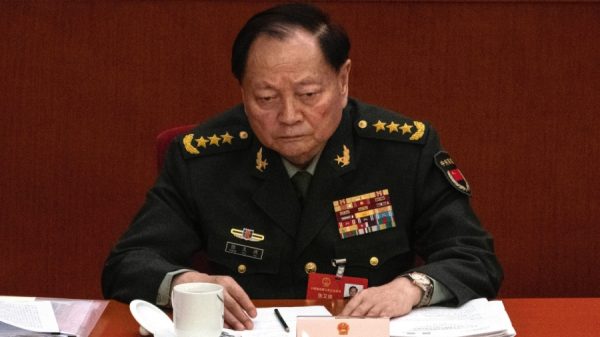
Multiple sources indicate that Zhang Youxia was arrested on Jan. 19, 2026. Around that date, three senior PLA generals died in quick succession. In each case, the CCP delayed public disclosure, an anomaly that has not gone unnoticed.
On Jan. 30, state news agency Xinhua reported that Wei Fulin, former Deputy Chief of the PLA General Staff, had died in Beijing on Jan. 15 at the age of 88 after “failed medical treatment.”
Wei’s career was extensive. He served as regiment commander, division chief of staff, division commander, army chief of staff, Deputy Director and Director of the Operations Department of the General Staff, Assistant Chief of the General Staff, and Commander of the Chengdu Military Region. He was promoted to lieutenant general in 1994 and to full general in 2000.
Notably, in 1994 Wei was Commander of the Chengdu Military Region. That same year, Zhang Youxia was promoted to Deputy Commander of the 13th Group Army, which at the time fell under the Chengdu Military Region. From 1994 to 1995, Zhang served directly under Wei.
Given the sensitivity surrounding Zhang’s downfall, the CCP’s decision to wait more than two weeks before announcing Wei Fulin’s death immediately raised suspicions.
As early as Jan. 21, US-based independent commentator Cai Shenkun revealed on X that Zhang Youxia had been arrested, adding that “General Wei Fulin has passed away, and the wreath sent by Zhang Youxia was ordered to be removed at the last minute.”
Liao Xilong: another ‘old superior’ gone
Another of Zhang Youxia’s former superiors also died abruptly after Zhang’s reported arrest.
On Jan. 29, Xinhua announced that Liao Xilong, former CMC member and former Director of the PLA General Logistics Department, had died of “serious illness” on Jan. 23 at the age of 85. His body was cremated the same day at Babaoshan Revolutionary Cemetery in Beijing.
Liao, like Zhang, was a veteran of the Sino-Vietnamese War and widely regarded as a key patron who helped advance Zhang’s military career.
On Jan. 26, Cai Shenkun disclosed further details: Zhang Youxia was arrested on January 19; on Jan. 20, Liao Xilong’s son and brother were both detained. Liao reportedly made numerous phone calls but could not determine which authority had taken them away. He died suddenly on Jan. 23.
According to insiders cited by Cai, Liao did not die of illness but was “scared to death—or angered to death.” As with Wei Fulin, Beijing waited six days before making the death public.
Both of Zhang’s former superiors died suddenly in their eighties. While advanced age alone is not unusual, netizens noted that for CCP elites accustomed to the highest standards of medical care, such abrupt deaths are far from ordinary. Many suspect undisclosed circumstances behind them.

Wang Zheng: a younger general’s mysterious death
On the same day Zhang Youxia was reportedly arrested—Jan. 19—Xinhua also announced that Wang Zheng, former Vice Political Commissar of the PLA Navy, had died in Beijing on Jan. 3 at the age of 64 after “failed medical treatment.”
Wang’s career spanned both the Air Force and Navy. He was promoted to major general in the Air Force in 2013 and to lieutenant general in the Navy in 2019. His posts included Deputy Secretary-General of the Air Force Political Department, division political commissar, Director of the Air Force Political Department’s Propaganda Department, Director of the Jinan Military Region Air Force Political Department, Director of the Northern Theater Command Air Force Political Work Department, and Director of the Navy Political Work Department.
Wang’s death at 64 was itself unusual. More striking was the CCP’s decision to delay announcing it by more than two weeks—and to omit any specific cause of death—deepening suspicions that his passing was not simply medical.
‘The army is not the nation’s army, but the leader’s’
Zhang Youxia’s fall has generated extensive analysis abroad.
Yu Maochun, Director of the China Center at the Hudson Institute and Visiting Fellow at Stanford University’s Hoover Institution, wrote on X that Zhang’s fate reflects the deeper logic of communist power politics.
“In a communist system, the army is not the nation’s army—it is the Party’s army, and more precisely, the supreme leader’s army,” Yu wrote. “There is only one iron rule for staying on the throne: military power must remain firmly in your own hands.”
“The people closest to power are the most useful—and the most dangerous,” he continued. “The more capable you are, the more likely you are to be seen as a threat. The more prestige you have, the more likely you are to be viewed as a potential rival.”
Yu described the position of CMC vice chairman as “one of the most dangerous seats in the country.”
“You hold real power and sit closest to the supreme leader, breathing every day next to his paranoia,” Yu wrote. “In the eyes of a dictator, the greatest threat is never foreign enemies. It is the military commander closest to him—the one who knows best how to give the order to fire.”
“Ultimately, purges within the PLA are never about anti-corruption,” Yu concluded. “They are an institutional reflex of self-preservation. Dictators are not governing a country; they are managing fear. They are not building a strong military; they are ensuring that the guns never turn toward themselves.”
“This is the deepest absurdity of the communist system,” he wrote. “It boasts of stability, unity, and discipline, yet lives permanently in the delusion that someone is plotting against it. The closer you are to the core, the more dangerous you become. The more capable you are, the more likely you are to be eliminated. The more loyal you appear, the more suspicious you become. Under this logic, Zhang Youxia will not be the last. The next one will not be surprising.”