By Cai Siyun
The arrest of Zhang Youxia, Vice Chairman of the Chinese Communist Party’s Central Military Commission (CMC)—the Party body that exercises absolute control over the armed forces—is the most consequential political earthquake to strike China in some time. Its aftershocks have rippled through the CCP’s power structure, the People’s Liberation Army (PLA), China’s unified military force, and the Party’s propaganda system, producing a series of anomalies that are impossible to ignore.
On Jan. 24, China’s Ministry of National Defense announced that Zhang Youxia and Liu Zhenli, Chief of Staff of the CMC Joint Staff Department—the PLA’s operational command organ—were under investigation for “serious violations of discipline and law.” This is the highest-ranking purge of PLA generals since the 1971 Lin Biao incident, when Mao Zedong’s designated successor died while fleeing China after an alleged coup attempt. The announcement stunned political and military observers both inside and outside the country.
On Feb. 3, the prominent political commentator “New Heights” (新高地), a widely followed overseas Chinese analyst, wrote on X that Zhang—long regarded as Xi Jinping’s most reliable enforcer within the military—had been swiftly taken away under the familiar anti-corruption formula. But the scope and implications of the move, he argued, far exceed any normal disciplinary case. What is unfolding is a shock with systemic consequences.
According to “New Heights,” Zhang Youxia’s fall has produced seven unmistakable abnormal signals in China’s political environment.

An unprecedented breakdown in official messaging
Success
You are now signed up for our newsletter
Success
Check your email to complete sign up
The initial disclosure of Zhang Youxia’s arrest was delivered in the briefest possible form by the Ministry of National Defense, China’s external-facing military spokesperson. The Central Commission for Discipline Inspection (CCDI), the CCP’s top internal enforcement and anti-corruption organ, followed with a single line on its website—just eight characters stating that Zhang was “suspected of serious disciplinary and legal violations.”
This near-total absence of detail represents a sharp rupture with established practice. In recent years, the CCDI has typically accompanied the downfall of senior officials—especially top military figures—with immediate, lengthy reports combining official notification, political framing, and retrospective “case analysis.”
Even more striking has been the silence of core Party media. People’s Daily, the CCP’s flagship newspaper, and Xinhua News Agency, the state’s primary news service, have offered no authoritative commentary, no interpretive editorials, and no effort to define the political meaning of the event. Such fragmentation in messaging strongly suggests unresolved disagreement at the highest levels over how Zhang’s arrest should be characterized—or whether it can be safely characterized at all.
Coded dissent in PLA Daily
In the days following Zhang’s detention, PLA Daily, the official newspaper of the Chinese military, published editorials repeatedly invoking phrases such as “rebirth through transformation,” “rising from the ashes,” and “phoenix nirvana.”
In isolation, such language might be read as boilerplate exhortation. In context, however, it has been widely interpreted as thinly veiled criticism—hinting that the current leadership’s purges have gone too far, cutting into the muscle and bone of the military itself.
These metaphors are exceptionally rare in PLA Daily. When paired with Zhang Youxia’s long dominance over the CMC’s Equipment Development Department—the body overseeing weapons procurement and modernization—and his role at critical junctures of military reform, they point to simmering resentment within sections of the officer corps toward what is perceived as excessive political cleansing.

Abnormal troop deployments across multiple regions
Images and videos circulating in recent days show heavy PLA equipment moving at night through Beijing, the Northeast, South China, and the eastern coastal regions. Tanks have appeared on urban streets, and multiple theater commands—the PLA’s regional warfighting structures—have reportedly undergone rapid redeployments.
The authorities have offered no confirmation. Yet footage shared on overseas social media platforms and within military enthusiast networks indicates that both the scale and frequency of these movements far exceed routine exercises or standard readiness drills. The Southern and Eastern Theater Commands, responsible for the South China Sea and Taiwan-facing regions, in particular, have shown repeated signs of unusual activity.
Analysts widely interpret these deployments as internal control measures aimed at preventing instability within the military itself. As “New Heights” notes, such large-scale movements are not a sign of strength, but a visible indicator of political insecurity.
Deafening silence from the military and provincial leadership
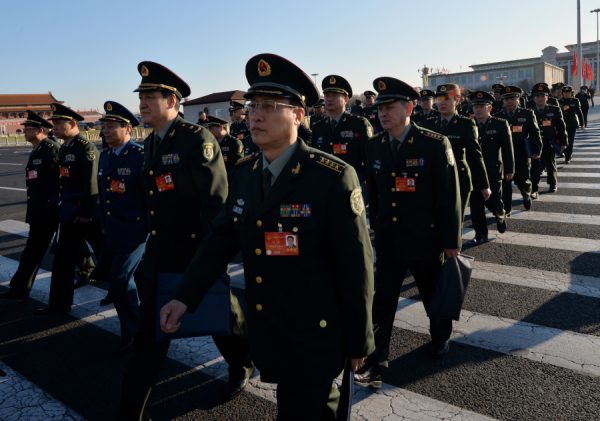
Following Zhang Youxia’s fall, none of the commanders or political commissars of the PLA’s five theater commands—the military’s highest regional authorities—has publicly expressed support for the Central Committee’s decision. Nor have the top leaders of the army, navy, air force, or rocket force issued statements of loyalty.
This silence represents a radical departure from precedent. In previous cases involving senior military figures, public declarations of allegiance have arrived almost immediately, often in carefully choreographed unison.
The pattern extends beyond the military. At recent high-level meetings, provincial Party secretaries—the CCP’s top officials at the regional level—have largely avoided mentioning Zhang’s case at all, relying instead on vague invocations of “absolute loyalty” and the slogan that “the Party commands the gun.”
This collective refusal to take a clear stance reflects a pervasive wait-and-see attitude among the CCP’s upper echelons.

Red families withhold their endorsement
Zhang Youxia is a textbook member of the hong er dai, the “red second generation” descended from revolutionary elites. His father, Zhang Zongxun, was a founding general of the PLA, giving the family deep ties to China’s revolutionary aristocracy.
Since the arrest, these so-called red families have fallen conspicuously silent. No prominent figure has publicly defended the leadership’s actions or stepped forward to legitimize the purge. According to information circulating through non-public channels, some veteran revolutionaries have privately voiced anger, arguing that “one of our own” should not have been treated in this manner.
The collective muteness of the red aristocracy functions as a form of implicit resistance to Xi Jinping’s current mode of power consolidation.
Propaganda control falters online
Under reports published by central and local Party media, comment sections have repeatedly filled with messages expressing sympathy for Zhang Youxia and open doubt about the official narrative. Phrases such as “a battle-tested general,” “a pillar of the military,” and “this is no way to treat a contributor” have appeared in large numbers.
Many of these comments remained visible for hours—sometimes longer—before being deleted or censored, far beyond the normal response window of China’s online monitoring system. This delay points to partial breakdowns in grassroots propaganda enforcement and reveals a depth of dissatisfaction that extends into institutional circles.
A rapid escalation of purges and unexplained deaths
Zhang Youxia’s arrest has not been an isolated event. In the ten-plus days that followed, additional senior military figures—including Liu Zhenli—were reportedly taken in for investigation. At the same time, the Party-state apparatus has been rocked by reports of vice-ministerial and vice-provincial officials—senior ranks just below the national leadership—dying suddenly from “illness,” perishing in accidents, or disappearing altogether.
This compressed convergence of purges and unexplained deaths surpasses the intensity and velocity of any previous anti-corruption campaign. The result has been widespread panic within the bureaucracy and a measurable decline in administrative and military efficiency.
According to “New Heights,” the simultaneous emergence of these seven abnormal signals makes one conclusion unavoidable: the Zhang Youxia case is not a routine corruption investigation. It is the first falling domino in a broader systemic shock.
Military silence, media paralysis, internal troop movements, the aloofness of elder families, public anger breaking through censorship, and a cascade of elite downfalls—taken together, these phenomena indicate that the stability of the CCP’s core power structure is under strain in ways not seen in decades.
In the weeks and months ahead, how Xi Jinping—China’s top leader and chairman of the Central Military Commission—responds to these anomalies will determine whether the country is witnessing a contained political earthquake or the opening phase of a far deeper structural crisis.