Step into Costco’s refrigerated meat section and you’ll see abundance engineered to overwhelm: endless rows of steaks and cuts, uniform lighting, deep reds and glossy whites, all designed to trigger impulse. Most shoppers respond predictably. They judge by color, visible fat, and price per pound.
That’s a mistake.
Seasoned buyers—chefs, serious home cooks, and longtime Costco regulars—scan none of that first. They look straight at the label. Specifically, they look for letters and grades that function as beef’s real passport. Learn to read them, and you can reliably choose exceptional meat within your budget. Ignore them, and you’re gambling.

USDA beef grades: the system that actually matters
At Costco, the overwhelming majority of American beef is graded by the U.S. Department of Agriculture (USDA). This grading system evaluates beef using two core criteria:
- Marbling (intramuscular fat distribution)
- Maturity (the age of the animal)
Although the USDA formally recognizes eight grades, Costco almost exclusively stocks the top tier—because that’s where consistent quality begins.
Success
You are now signed up for our newsletter
Success
Check your email to complete sign up
Blue label: USDA choice
This is Costco’s volume leader and the backbone of its beef program.
Choice-grade beef contains moderate marbling and a firmer texture than premium cuts.
Professional judgment: This is the best value category in the store. While it lacks the extreme fat content of higher grades, Choice beef already outperforms what most conventional supermarkets sell. For everyday cooking—pan-searing, braising, roasting, or stir-frying—it delivers reliable flavor and structure.
What to buy: Choice short ribs, chuck, or sirloin. Technique matters more than fat here, and good cooking closes most of the gap.
Red label: USDA prime
Prime is the highest USDA grade—and genuinely rare.
Less than three percent of all beef produced in the United States qualifies as Prime. It’s the standard used by high-end Western steakhouses for a reason.
Professional judgment: Dense marbling, superior tenderness, and consistently high moisture retention. This is beef engineered to be forgiving: it stays juicy, tolerates high heat, and delivers richness without effort.
Why Costco matters: At Costco, Prime beef often sells for a fraction—sometimes a third—of what the same cut costs at a steakhouse.
How to spot it: A clearly marked red label reading “USDA PRIME.”

The letter that signals the absolute top: A
If you encounter beef labeled with a prominent “A” at select Costco locations, you’ve reached the top of the hierarchy: Japanese Wagyu.
Costco occasionally sells imported A5 Wagyu from Japan, the highest grade recognized under Japan’s official beef classification system. The system works differently from the USDA’s:
- “A” = yield grade (how much usable meat the carcass produces)
- “5” = meat quality (the highest possible score)
Why A5 is in a different category entirely
- Extreme marbling: A5 Wagyu typically scores 8–12 on the Beef Marbling Standard (BMS). This isn’t marbling as garnish—it’s structural.
- Low melting point: Wagyu fat melts below human body temperature. The result is a rapid release of aroma and a texture closer to butter than steak.
- The buying logic: At tens—or hundreds—of dollars per pound, A5 Wagyu is not casual food. But compared with elite Japanese restaurants, Costco’s pricing makes it one of the few ways ordinary consumers can legally access true top-grade Wagyu without distortion or substitution.
Hidden risks: what the label doesn’t advertise loudly
Reading grades isn’t enough. Experienced buyers also know where Costco’s convenience practices introduce trade-offs.
1. ‘Blade tenderized:’ read this before cooking rare
Many Costco steaks include the phrase “Blade Tenderized” in small print. This means the meat has been mechanically pierced to break down muscle fibers and increase tenderness.
Why it matters: The process can push surface bacteria into the interior of the meat. As a result, blade-tenderized beef should not be eaten rare.
Safety standard: Cook to at least 145°F (63°C)—roughly medium-rare to medium—to reduce risk.
2. ‘Whole subprimal:’ where insiders actually shop
If you have a vacuum sealer and a sharp knife, skip pre-cut steaks entirely.
Costco sells large, uncut whole subprimal sections sealed in heavy vacuum packaging.
Why insiders prefer them:
- Typically $3–5 cheaper per pound
- Not blade tenderized
- Full control over thickness, portioning, and doneness
- Better suited for rare or high-heat cooking
This is where Costco quietly rewards competence.
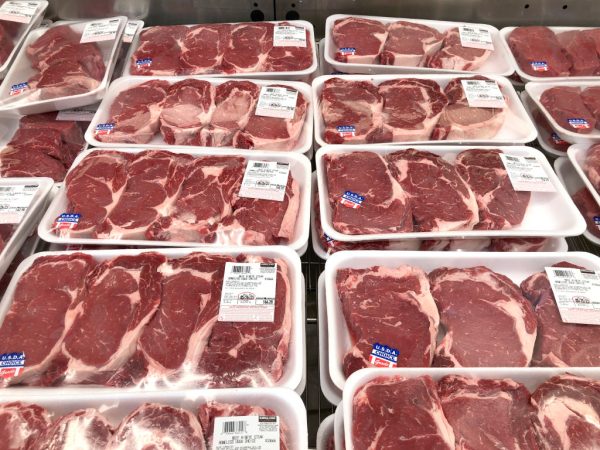
Choosing with intent: a practical decision guide
| Situation | What to Look For | Why It Works |
| Weeknight meals, braising | USDA Choice | Affordable, strong beef flavor |
| Entertaining, pan-seared steaks | USDA Prime | Rich marbling, forgiving texture |
| Special occasions, luxury | A5 Japanese Wagyu | Ultra-rich, melts instantly |
| Ingredient purity, sourcing | Organic | No antibiotics, mostly grass-fed |
The point of all this
Costco sells volume. But quality is still encoded—if you know where to look.
The next time you’re standing in front of the meat case, don’t let bright color or thick cuts decide for you. Read the label. Is it Choice, Prime, or A5? Blade tenderized or whole subprimal?
Those letters tell you more than appearance ever will.
Good cooking begins with good ingredients. Knowing how to identify them is not elitism—it’s basic competence.