By Jian Yi
“There was a very well-written report that quoted a businessman saying I make money because I’m ‘unpredictable’—and that this is one of my strengths.”
“As a leader, I also know that sometimes you must keep your cards close and never let others see them.”
Donald Trump revealed this governing philosophy in his book Make America Great Again. It helps explain many seemingly contradictory political behaviors—especially when viewed alongside his dealings with Xi Jinping.
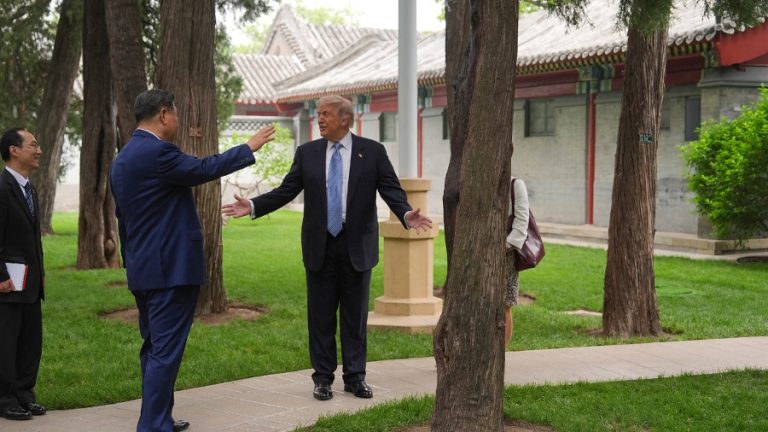
On Feb. 4, Xi Jinping and Trump spoke by phone, immediately triggering intense debate across Chinese-language media and political commentary circles.
Success
You are now signed up for our newsletter
Success
Check your email to complete sign up
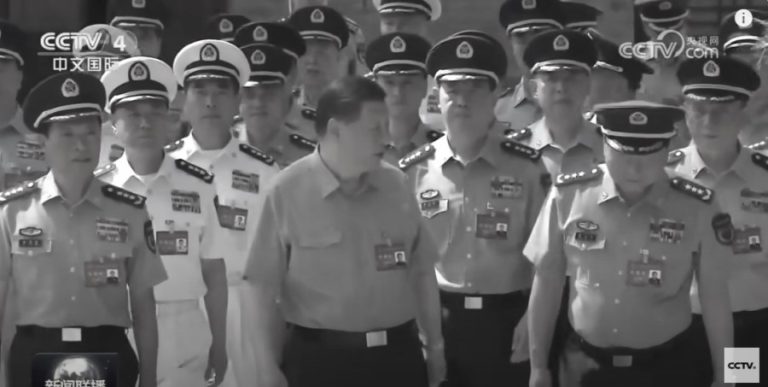
Almost simultaneously, a senior U.S. military figure offered a sharply dissenting interpretation of recent upheavals at the top of the People’s Liberation Army (PLA), including the reported downfall of Zhang Youxia and Liu Zhenli. His conclusion was blunt: Xi Jinping’s latest military purge is not evidence of consolidated power, but a manifestation of strategic anxiety—an anxiety deliberately shaped by sustained U.S.-led pressure.

The Xi–Trump call and Beijing’s propaganda theater
The Feb. 4 phone call between Xi Jinping and Trump quickly became a Rorschach test for observers.
Some noted that the Chinese Communist Party’s official Xinhua readout conspicuously omitted the phrase “at the invitation of,” a signal—by Beijing’s own diplomatic conventions—that Xi may have initiated the call. Others, comparing Xi’s language to past statements, detected an unusual degree of caution.
Another strand of commentary focused on Trump himself, predicting that the call would once again make him a political target.
Trump’s own account, published on Truth Social, described a wide-ranging and upbeat exchange:
“We discussed many important topics, including trade, the military, my upcoming visit to China in April (which I am very much looking forward to!), Taiwan, the war between Russia and Ukraine, the current situation in Iran, China’s purchase of oil and natural gas from the U.S., expanded agricultural purchases—including raising soybean imports to 20 million tons this season and a possible 25 million tons next quarter—aircraft engine deliveries, and many other issues. Overall, it was very positive.
“The relationship with China, and my personal relationship with President Xi, remain very good. Both sides recognize the importance of maintaining this relationship. I believe that over the next three years of my presidency, many positive outcomes will emerge in our dealings.”
Xinhua’s version told a different story—and its structure revealed the CCP’s familiar sleight of hand.
The official readout consisted of three paragraphs. The first two opened with ritualized formulations—“Xi Jinping pointed out” and “Xi Jinping emphasized.” Only in the third did Trump appear, and even then he merely “expressed” views.
The message was unmistakable. Through subtle linguistic hierarchy, the CCP sought to elevate Xi as a commanding global leader while reducing Trump to a reactive interlocutor—an exercise in domestic propaganda rather than diplomacy.

When Beijing’s diplomatic deception backfired
This tactic was not new. It echoed a diplomatic embarrassment Beijing would rather forget.
On Jan. 24, 2025, Chinese Foreign Minister Wang Yi spoke by phone with newly appointed U.S. Secretary of State Marco Rubio. The Chinese-language Foreign Ministry readout claimed that Wang had told Rubio he “hoped he would conduct himself properly.”
Rubio publicly contradicted the claim.
In an interview with Megyn Kelly, Rubio explained: “They play two games. They release an English version and a Chinese version—and they don’t always match.”
Such discrepancies are not translation errors. They are deliberate attempts to mislead domestic audiences.
Rubio added: “They said in Chinese that I was ‘warned not to overstep.’ That never happened. If it had, I would have said the same thing right back to them.”
He dismissed the episode as “stupid and irrelevant,” emphasizing that what truly matters are future strategic decisions—not propaganda theater.

The real story: US strategic pressure, not Xi’s personal control
While the CCP focused on manipulating language and optics, former U.S. National Security Advisor General Michael Flynn amplified a far more consequential analysis on X—written by his brother, General Charles Flynn.
Charles Flynn previously served as Commander of U.S. Army Pacific and spent years confronting Chinese military posture across the Indo-Pacific.
His assessment directly challenges the dominant interpretation found in academia, elite media outlets such as Foreign Affairs and The New York Times, and mainstream policy think tanks.
“Nearly all commentary treats Xi Jinping’s purge of the PLA as proof that he is tightening his grip on the Party and the military. This interpretation is wrong. The core issue is not what Beijing is confirming internally—it is what the United States and its allies are doing externally to the Chinese Communist Party.”
For the first time in decades, Flynn argued, the strategic environment is no longer bending in Beijing’s favor.
“Sustained, multi-domain competitive pressure is quietly eroding the CCP’s confidence in its own trajectory. Xi’s purges are not demonstrations of unchallengeable authority; they are symptoms of strategic doubt.
Authoritarian systems purge when they no longer trust their own institutions, fear miscalculation, and sense that the external environment is closing in. That doubt has been intentionally shaped by U.S.-led strategy.”

Why US strategy—not CCP politics—explains Xi’s PLA purge
Flynn detailed the concrete elements of this pressure:
- Strengthening self-reliance and resilience among Indo-Pacific partners—especially Taiwan, Japan, the Philippines, and Australia—while pressing NATO allies to assume greater responsibility.
- Rebuilding U.S. industrial capacity, supply chains, and economic resilience, particularly through critical minerals and rare earth development that strips Beijing of leverage.
- Rebalancing trade through targeted tariffs to protect American workers and strategic industries.
- Demonstrating credible hard power through operations such as “Midnight Hammer” and “Absolute Resolve,” proving the ability to strike decisively and control escalation.
- Deregulating the U.S. energy sector to unleash innovation and secure energy independence.
- Competing aggressively in artificial intelligence while investing heavily in science, healthcare, and defense technologies to revive American innovation.
Flynn grounded this assessment in lived experience:
“I spent years watching American soldiers in combat. In their DNA is an instinct to improvise, innovate, adapt faster than the enemy, and build solutions under pressure.”
That unleashed capacity for innovation, he argued, is precisely what terrifies Xi Jinping, the Chinese Communist Party, and authoritarian regimes more broadly.
“When this spirit is fully unleashed—across every domain and by every American—our adversaries will see nothing but our taillights.”

Taiwan, deterrence, and why Xi Jinping hesitates
This reality carries direct implications for Taiwan.
A CCP leadership that doubts its own military competence, fears escalation it cannot control, and increasingly recognizes the cohesion of U.S. alliances is far less likely to gamble on invasion.
“When the costs are high, the risks opaque, and confidence is eroding, military adventurism becomes a bet they cannot afford.”
The conclusion, Flynn insisted, is unavoidable:
“The real story is not that Xi Jinping’s control is growing stronger. It is that U.S. and allied strategy is working—shaping an environment where aggression becomes harder, riskier, and profoundly unattractive.”
As online debate fixates anxiously on the optics of a Xi–Trump phone call, this assessment cuts through the noise.
While Xi Jinping indulges in linguistic games and internal purges, the United States is playing a strategic game he increasingly does not understand.