By Li Jingyao
With advances in technology, creating an “unmanned hellscape” in the Taiwan Strait to deter a Communist Chinese invasion may soon become a reality. It is reported that a new-generation unmanned combat aircraft developed by U.S.-based Shield AI — the “X-BAT” — could help make this strategy feasible, as it does not require a runway. However, this approach would still require Taiwan to independently build one-way attack drones to operate in coordination.
‘X-BAT’ accelerates the realization of an ‘unmanned hellscape’
A year and a half ago, Admiral Samuel Paparo, Commander of the U.S. Indo-Pacific Command, said that thousands of unmanned vehicles could be deployed in the Taiwan Strait to create an “unmanned hellscape” to deter the Chinese Communist Party’s (CCP) military ambitions. With technological progress, this strategy may now be achievable.
Newtalk News cited Nikkei Asia as reporting that artificial intelligence (AI) is reshaping U.S. military strategy, the defense industry, and even the nature of war and peace.
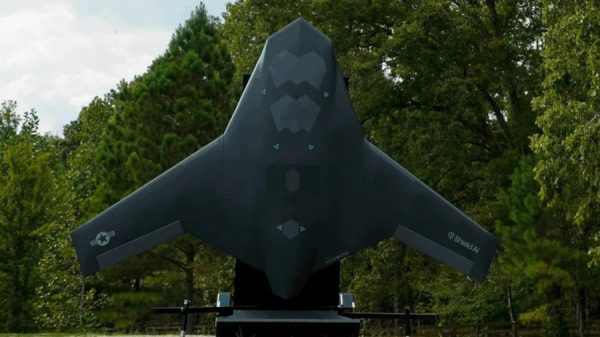
According to the report, Shield AI unveiled its next-generation combat aircraft, the “X-BAT,” in Washington, D.C. in October 2025. It is the world’s first unmanned combat aircraft that does not require a runway. The aircraft is autonomously controlled by an “AI pilot” and can operate without GPS or external communications.
Success
You are now signed up for our newsletter
Success
Check your email to complete sign up
The X-BAT can be equipped with various weapons for aerial combat and ground attacks. Its manufacturing and operating costs are only one-tenth those of a new fifth-generation fighter such as the F‑35.
Because there are many uninhabited islands around Taiwan, the runway-free X-BAT could be deployed on these islands — locations where it has previously been very difficult to station airpower.
Shield AI reportedly plans to conduct test flights of the X-BAT in 2028 to demonstrate its mission capabilities. In September 2025, the company is also set to cooperate with Taiwan’s major defense and aerospace firm AIDC to enhance Taiwan’s defensive capabilities.
Taiwan must produce one-way attack drones
Former U.S. Deputy Assistant Secretary of Defense Michael C. Horowitz pointed out that the “unmanned hellscape” plan requires not only X-BAT drones, but also the development of “AI-enabled unmanned surface and underwater vehicles, as well as one-way long-range attack drones.” He believes that if the United States and its allies invest aggressively, “AI-enabled weapons could be deployed in combat within the next two years,” which would significantly increase the difficulty of a CCP invasion.
Stacie Pettyjohn, a senior fellow at the Center for a New American Security (CNAS), said that X-BAT drones alone would not be sufficient to “flood the Taiwan Strait with unmanned systems.” Large numbers of drones with varying ranges and capabilities would also be required.
Pettyjohn recommended that Taiwan independently develop autonomous drones and unmanned surface and underwater vehicles capable of withstanding heavy electronic interference. She argued that Taiwan should produce one-way attack drones, as relying on U.S. supplies of expendable systems like the X-BAT would be too costly for Taiwan.
She also noted that, in addition to the United States, the CCP is aggressively advancing military applications of AI. China’s “collaborative drones” also pose a threat. In February 2025, China’s state-owned defense conglomerate China North Industries Group (NORINCO) unveiled a military vehicle capable of autonomously carrying out combat support missions at speeds of up to 50 kilometers per hour. She said, “China is developing a wide variety of unmanned systems and continues to focus on collaborative unmanned operations [swarm warfare], which is concerning.”
The report noted that AI could launch attacks without hesitation, potentially causing casualties on a scale that human armies would not be able to sustain. Neither the United States nor China is willing to establish international rules to regulate AI weapons. Kevin Desouza of the Brookings Institution said that current governments are not very transparent about the military use of AI.

Producing 210,000 drones in the coming years
According to a report by the Liberty Times on April 12, 2025, Taiwanese military officials said that the U.S. military’s so-called “hellscape” in the Taiwan Strait refers to creating a deterrent environment across air, shore, surface, and underwater domains using unmanned vehicles that require minimal manpower but can attack and disable enemy vessels. These include aerial loitering munitions and attack drones; surface attack unmanned boats; underwater semi-submersible unmanned attack craft; and the most destructive land-based anti-ship missile systems. Through command-and-control systems, these assets could conduct full-spectrum saturation attacks on key targets or coordinate firepower to allow attack drones to penetrate enemy defenses for precision strikes.
Military officials noted that based on real-world combat experience abroad, offensive unmanned systems are consumed at a very high rate on the battlefield. Hundreds or even thousands are insufficient; instead, ample readiness and stockpiles are required. Most importantly, Taiwan must establish production capacity for components, explosives, guidance, and control systems for offensive drones.
They said the military has already purchased more than 1,000 Switchblade 300 and Altius 600M‑V attack drones from the United States and plans to double procurement in the future. In addition, for domestically produced systems, Taiwan’s armed forces plan to acquire four types of attack unmanned vehicles:
- Short-range systems capable of directly striking enemy forces;
- Loitering munitions that can circle in the air, lock onto targets, and carry out suicide attacks;
- Advanced models capable of vertical takeoff and landing and changing flight posture;
- Missile-like unmanned vehicles with lower costs.
In light of growing drone demand and the importance of a “non-red supply chain,” Taiwan’s Aerospace Industrial Development Corporation (AIDC) is transforming into a drone integration platform and a bridge between Taiwanese and U.S. supply chains. AIDC is leading efforts to develop military attack drones within a “non-red supply chain” by establishing the “Taiwan Excellence Drone International Business Opportunity Alliance” (TEDIBOA), bringing together domestic and international defense giants to strengthen indigenous technology.
AIDC will focus on drone design, manufacturing, and avionics systems, developing military drones with reconnaissance and strike capabilities to meet national defense needs. According to Business Media, Taiwan’s defense budget review has entered a critical stage. The Ministry of National Defense plans for Taiwan to domestically produce approximately 210,000 drones of various types and more than 1,000 unmanned surface vehicles over the coming years. The estimated output value could reach NT$400 billion (US$12 billion), creating around 90,000 jobs.