On June 28, 2026, former Tsinghua University professor Zheng Yuhuang was teaching a paid business seminar in Beijing when an attendee reported the session to police. Officers entered the lecture, took him aside for questioning, and allowed the class to continue after several minutes. Within days, Zheng’s social media accounts, which had attracted more than one million followers across major Chinese platforms, had been wiped clean.
Police interrupt a paid seminar
Zheng, a former associate professor and doctoral supervisor in the marketing department at Tsinghua University’s School of Economics and Management, earned his doctorate from Columbia Business School. After leaving Tsinghua about two years ago, he founded the CMSI Scientific Marketing Institute, which offers paid executive education courses.
On June 28, Zheng was teaching a session titled “Future Trend Analysis” at the Hilton hotel near Beijing Capital Airport as part of a two-day seminar.
During the lecture, Zheng described China’s economic outlook as one of “macro pessimism paired with micro optimism,” arguing that while the broader economy faced long-term structural challenges, opportunities would continue to exist for individual entrepreneurs and businesses. He compared China’s situation with Japan’s so-called “lost decades,” a comparison that has become politically sensitive in China.
According to videos and accounts published after the event, two officers from a local police station entered the seminar room and questioned Zheng for several minutes before allowing the lecture to resume. Afterward, Zheng said in a video posted to his WeChat account that police had informed attendees the seminar had been reported as an “illegal gathering.”
Success
You are now signed up for our newsletter
Success
Check your email to complete sign up
Growing concerns over classroom surveillance
Following the incident, screenshots circulating on Chinese social media showed one attendee writing in a group chat that someone had called police during Zheng’s lecture and that “he really didn’t say anything out of line.”
The episode renewed discussion about political surveillance in Chinese higher education. In recent years, Chinese universities have expanded systems of student “information officers” and other political reporting mechanisms intended to monitor ideological developments on campus, according to university notices and previous media reports. Critics argue that such systems encourage students to report politically sensitive remarks made by classmates and instructors, creating a chilling effect on classroom discussion.
Although Zheng’s seminar was held at a commercial hotel rather than on a university campus, the incident underscored concerns that politically sensitive speech can still draw official attention even in privately organized educational events.
READ MORE:
- Tsinghua Professor Removed From Lecture After Student Reports Comments Critical of China’s Economy
- After Lam Wing-kee’s Death, Reporters Without Borders Urges Sweden to Free Gui Minhai from China
Why a comparison with Japan is politically sensitive
Comparisons between China’s economy and Japan’s “lost decades” have become politically sensitive because they challenge the Communist Party’s narrative of long-term economic resilience.
Zheng’s remarks were intended as a structural economic assessment rather than a political statement. Nevertheless, the official response illustrated the sensitivity surrounding publicly pessimistic assessments of China’s economic outlook.
When Japan’s asset bubble burst in the early 1990s, the country had already reached developed-economy status, with per capita GDP approaching US$40,000. Japanese companies held substantial overseas assets, while the country’s pension, healthcare, and social welfare systems were well established. Despite decades of slow growth, Japan’s technology sector and internationally recognized brands remained globally competitive.
China faces a different set of circumstances, often described by economists as “growing old before growing rich.” A prolonged property downturn has placed many local governments under severe fiscal strain, while weak consumer confidence, sluggish private investment, and persistent youth unemployment have weighed on the broader economy. Analysts have also pointed to tighter Party control over the private sector and policies favoring state-owned enterprises as factors affecting business confidence.
Many economists argue that, unlike Japan, China entered its property downturn before achieving high-income status and without the same level of social welfare protections, making a prolonged slowdown potentially more difficult to manage.
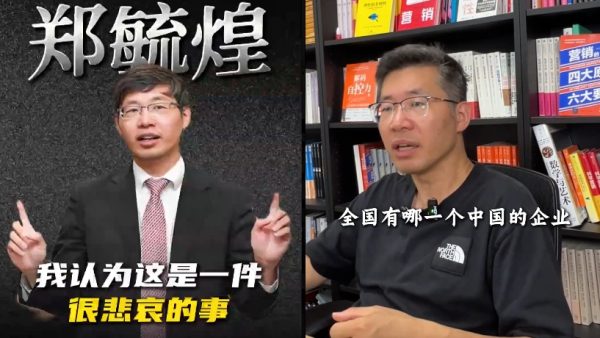
From a fifteen-day suspension to a complete online purge
After the incident, Zheng defended himself in a video posted to his WeChat Channels account.
“A 15-day ban couldn’t stop me, and I’ll keep saying what needs to be said,” he said. Referring to the police intervention, Zheng added that someone had reported the seminar as an “illegal gathering.” “People’s hearts can be truly wicked,” he remarked.
The remarks referred to an earlier incident in late 2025, when Zheng was temporarily suspended from posting after criticizing Chinese universities for keeping their campuses closed to the public while comparing them with Harvard University.
Within days of the June seminar, Zheng’s WeChat Channels account had been emptied of all content, and his accounts on Douyin, Weibo, and other major Chinese platforms also disappeared.
Around the same time, Ming Jinwei, a former Xinhua News Agency reporter known for his pro-Party commentary, published an article accusing Zheng of “worshipping America, flattering America, and belittling China.” Ming argued that Zheng’s comments were intended primarily to attract online traffic and promote his commercial training courses.
Neither Chinese authorities nor the major social media platforms publicly explained the removal of Zheng’s accounts.
A case that resonated beyond one lecture
Although Zheng was allowed to return to the podium after only a few minutes of questioning, the consequences extended well beyond the seminar itself.
The incident has become another widely discussed example of the narrowing space for independent public discussion of China’s economy. It also highlighted how quickly remarks viewed as politically sensitive—even those delivered at a privately organized business seminar—can lead to both police intervention and the disappearance of a public figure’s online presence.