By Li Jingyao, Vision Times
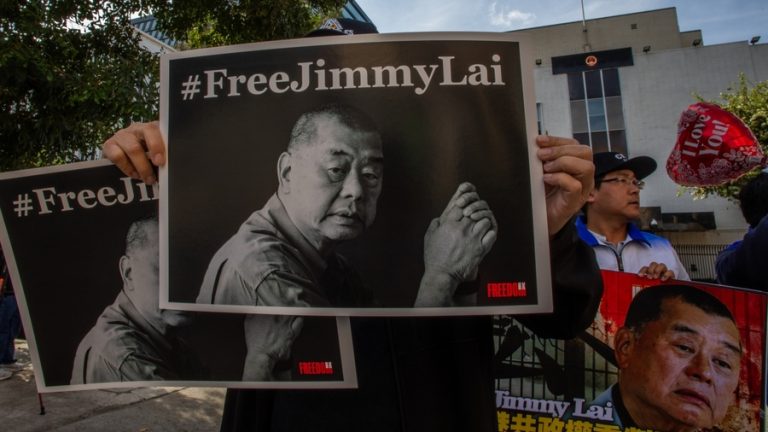
On Feb. 9, Hong Kong media tycoon and pro-democracy publisher Jimmy Lai, founder of pro-democracy outlets “Next Digital” and “Apple Daily,” was sentenced to 20 years in prison under the city’s sweeping National Security Law. The ruling has drawn sharp condemnation from overseas governments and human rights groups who have called the verdict “effectively a death sentence” for the 78-year-old.
Veteran journalist Ho Leung-mau told Vision Times in an exclusive interview that the case represents far more than the punishment of one man. Echoing international editorials, Ho argued the sentence is also a political message from Beijing aimed at Taiwan, showing “what life under Chinese Communist Party (CCP) rule looks like.”
MORE ON THIS: ‘Effectively a Death Sentence’: Jimmy Lai Handed 20-Year Term as Critics Condemn Verdict
A reckoning in Hong Kong
According to Taiwan’s “Central News Agency,” Hong Kong’s High Court delivered the sentence using the West Kowloon Magistrates’ Courts building for the hearing. Lai, along with nine defendants and three former “Apple Daily” companies, had earlier been convicted of violating the National Security Law.
Success
You are now signed up for our newsletter
Success
Check your email to complete sign up
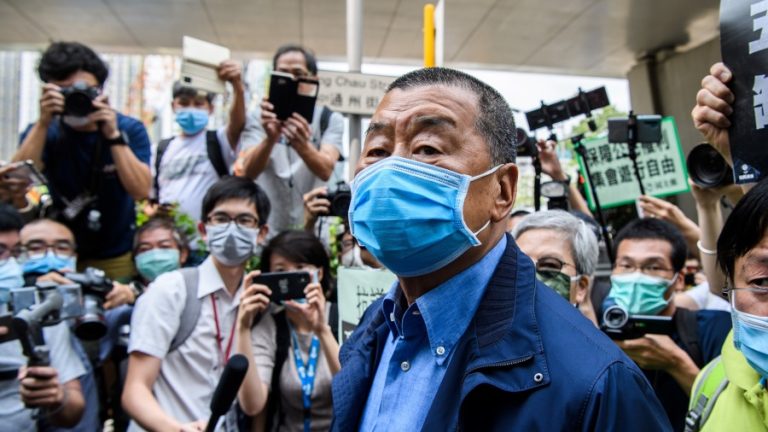
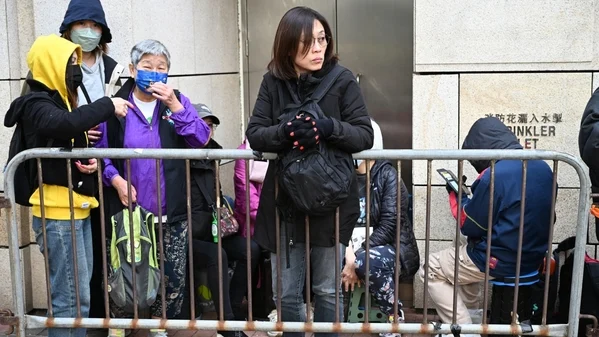
As judges read out the ruling at 10 a.m., shouting erupted inside the courtroom, while supporters outside voiced anger and disbelief. Ho described the punishment as effectively a life sentence for Lai who is almost 80 years old. “20 years in prison for a 78-year-old Jimmy Lai is essentially a disguised life imprisonment,” he said.
Ho emphasized that Hong Kong has experienced multiple waves of democratic activism, including the 2019 anti-extradition protests, the 2014 Occupy Central movement, and the 2012 demonstrations against national education reforms. “So the sentencing of Jimmy Lai is not aimed at Lai alone, nor is it aimed only at Apple Daily,” Ho said, adding, “It is a punishment and a total reckoning against the people of Hong Kong.”
‘One country, one system’
Ho argued that Beijing’s handling of Lai’s case is meant to declare that Hong Kong’s promised autonomy is over. “This verdict tells the international community that Hong Kong is no different from any mainland city,” he said. “The so-called Basic Law and special administrative region are basically nonsense. In reality, Hong Kong is under the tight rule of the CCP, especially Xi Jinping’s.”
RELATED: Right to a Jury Denied in Hong Kong’s First National Security Law Trial
Ho said the case reflects Hong Kong’s transformation into what he called a political colony, and that Lai has become a symbol of broader political repression. “Jimmy Lai is a representative political prisoner,” he said, noting that other major prosecutions, including the “47 democrats” case, are also political trials.
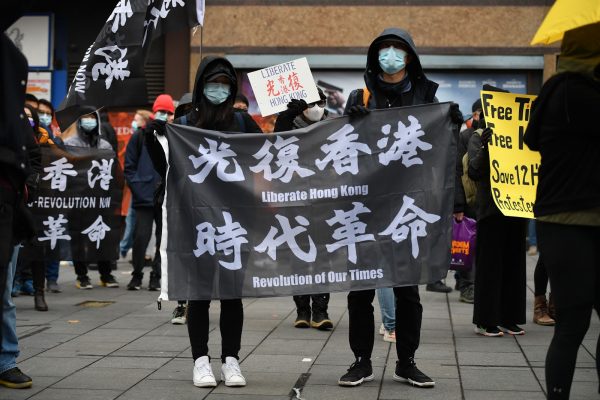
“True Hong Kong people will believe Jimmy Lai is innocent. The guilty party is the CCP,” Ho said. “This verdict shows the CCP is persecuting Hong Kong people. It is a transnational criminal group.” Ho added that Hong Kong itself has served as a kind of mirror exposing the regime’s nature, and Lai is now “imprisoned on behalf of Hong Kong.”
Growing international outrage
Governments and rights organizations responded swiftly. Britain urged Hong Kong authorities to “end the inhumane treatment Jimmy Lai has suffered,” calling for his release on humanitarian grounds so he can reunite with his family. London also announced an expansion of pathways for Hong Kong residents to relocate through BN(O) visas.

The European Union (EU) condemned the heavy sentence and called for Lai’s “immediate and unconditional release,” describing the case as “political prosecution” that further damages Hong Kong’s reputation and press freedom.
U.S. Secretary of State Marco Rubio called the ruling an “unjust and tragic outcome,” urging Hong Kong to grant Lai humanitarian parole. Rubio said the decision “shows the world that Beijing is willing to take extraordinary measures to silence those advocating basic freedoms in Hong Kong,” and that it “abandons Beijing’s international commitments under the 1984 Sino-British Joint Declaration.”
Australia’s Foreign Minister Penny Wong warned the prosecution creates a chilling effect on speech and media freedom, while Taiwan’s Mainland Affairs Council likewise condemned the sentence as political persecution, saying it aims to create a cross-border atmosphere of fear. Reporters Without Borders said Hong Kong’s press freedom decline is “shocking,” describing the 20-year sentence as “equivalent to a death sentence.”
WSJ: ‘A warning to Taiwan’
A “Wall Street Journal” editorial argued that Lai’s conviction marks the end of Hong Kong’s dream of maintaining freedom under Chinese rule. Ho highlighted the editorial’s warning: “20 years for Jimmy Lai is no different than sentencing him to death. Beijing has clearly delivered a message to Taiwan about what life under CCP rule will look like.”
RELATED: Zhou Manzhi Convicted of CCP-Linked Infiltration in Taiwan, Faces 8-Year Sentence
The editorial recalled the uncertainty surrounding the 1984 Sino-British Joint Declaration and quoted its own past skepticism. “The essence of this declaration,” the paper wrote, “is that the future of five million people who have largely enjoyed freedom will soon be in the hands of a totalitarian government not known for tolerance or stability.”
“Jimmy Lai’s experience proves our fears have come true,” the editorial concluded with. “Beijing’s message to Taiwan could not be clearer.”
Ho warned that Taiwan must take the lesson seriously. “If the Kuomintang and Zheng Liwen still want to collude with the CCP,” he said, “Taiwan’s fate will be even worse than Jimmy Lai’s.” For Ho, Lai’s imprisonment is not only a personal tragedy, but a defining symbol of Hong Kong’s collapse into authoritarian rule, and a warning Beijing intends the world, and especially Taiwan, to heed.