A leaked Beijing municipal budget showing millions of dollars paid to American-born athletes who compete for China has collided with a wave of nationalist anger on both sides of the Pacific, transforming freestyle skier Eileen Gu and figure skater Alysa Liu into proxy figures in the broader US-China confrontation. The controversy erupted during the 2026 Milan-Cortina Winter Olympics and has drawn in politicians, celebrities, and conservative media on both sides.

Beijing budget documents revealed millions in payments to American-born athletes
A municipal budget published by Beijing’s sports bureau in early 2025 disclosed funding arrangements for Eileen Gu, the American-born freestyle skier who represents China, and Zhu Yi, an American-born figure skater who also competes for the Chinese team. The document, first reported by the Wall Street Journal and later covered by the New York Post, showed that the two athletes received approximately $6.6 million in combined funding in 2024 alone. Over the preceding three years, total disbursements reached nearly $14 million, roughly 100 million yuan. The most recent allocation was linked to qualification for the 2026 Winter Olympics.
The names were scrubbed from the public document shortly after the figures attracted attention. The Wall Street Journal reported that the deletion deepened public skepticism about how China’s government spends money on recruited foreign-born athletes.
The numbers spread rapidly on Chinese social media, where users voiced frustration over the sums. Discussion threads were subsequently removed. In a country where censorship of politically sensitive commentary is routine, the disappearance of the posts only amplified suspicion.
Gu’s commercial profile adds another dimension. Forbes estimates her off-field endorsement income at approximately $23 million, with competition prize money of about $100,000. Her brand partners have included Tiffany & Co., Louis Vuitton, Porsche, Red Bull, and IWC Schaffhausen. The 2026 Milan-Cortina Games are her second Olympics. At the 2022 Beijing Winter Olympics, she won gold in the big air and halfpipe events and silver in slopestyle.

Success
You are now signed up for our newsletter
Success
Check your email to complete sign up
Two American-born athletes turned into opposing symbols online
The BBC reported that the dispute quickly moved beyond questions of government funding and became a social media confrontation over identity and national loyalty.
Gu was born in California to a Chinese mother and grew up traveling between Beijing and San Francisco. She first skied at Lake Tahoe at age three, joined the Northstar California Resort ski team at eight, and announced in 2019 that she would compete for China. She said at the time that she hoped to inspire “millions of young people in Beijing.” The decision won widespread praise in China and provoked lasting criticism in the United States.
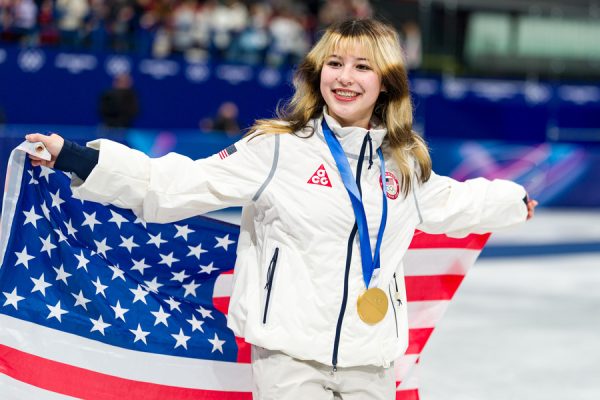
Alysa Liu offers a starkly different story. Also born and raised in America, Liu is the daughter of Arthur Liu, who participated in the 1989 Tiananmen Square protests in Beijing before leaving China. Liu became the youngest women’s national figure skating champion in U.S. history at age 13. During the 2026 Olympic cycle, she helped the U.S. team win a team event gold medal.
On the social platform X, users framed the two athletes as opposing archetypes: Gu as the athlete who “chose China for money,” Liu as the “patriotic American.” The framing collapsed the complexities of both women’s lives into a binary that served political narratives on each side.

US domestic politics intensified the backlash against Gu
The controversy escalated further when it intersected with domestic American political disputes. Hunter Hess, an American Winter Olympic athlete, said publicly that he felt “conflicted” about certain domestic policy debates. Former President Donald Trump responded by saying Hess should not have been selected for the national team. Several athletes rallied behind Hess. Gu expressed sympathy for “athletes caught in the crossfire,” a comment that drew immediate criticism from conservative figures in the US.
Enes Kanter Freedom, a former NBA player and outspoken critic of authoritarian governments, called Gu a “traitor” on X, questioning why she has not spoken out on Chinese human rights issues. Matt Whitlock, a Republican communications operative, also publicly targeted her. The Chinese government has consistently denied Western allegations concerning Xinjiang, Tibet, and other human rights concerns, calling them internal affairs.
Yinan He, a professor at Lehigh University, told the BBC that the intensifying U.S.-China rivalry, often described as a “new Cold War,” has raised public expectations of national loyalty and reduced tolerance for people who hold dual identities. Richard King, a professor at Columbia College Chicago, argued that media coverage has cast the two athletes as archetypes of the “good immigrant” and the “bad immigrant,” a framing that extends far beyond sport.

Class, race, and the limits of Asian American public life
He, the Lehigh professor, added that criticism of Gu is partly rooted in perceptions of class. Her private-school background and Stanford education lead some commentators to interpret her decision to compete for China as a calculated business move by a member of the elite. Liu’s family history of political dissent, by contrast, has won her a more sympathetic reception among American audiences.
Simu Liu, the Chinese-Canadian actor, said publicly that he was “proud of Eileen Gu.” The comment drew online backlash, including xenophobic attacks telling him to “go back to China.” Stanley Thangaraj, a professor at Stonehill College, said the reaction illustrates the difficult position Asian Americans occupy when they engage in public political expression.
Badiucao, a Chinese-Australian dissident artist, published a cartoon placing Gu and Liu in opposing symbolic positions. The Daily Caller, a conservative American media outlet, ran an article labeling Gu “the Winter Olympics villain.”
Gu said she feels the weight of two countries after losing gold in Milan
After failing to win gold in the women’s slopestyle event at the Milan-Cortina Games, Gu told reporters that she felt as though she was “carrying the weight of two countries.” Supporters called the remark a moment of candid vulnerability. Critics countered that she represents only one country, the one printed on her jersey.
As the Games continue, the athletic competition itself has receded behind the political spectacle. As He observed, two young athletes with similar ethnic backgrounds have been conscripted into a political narrative they did not write.
From budget documents to social media, from luxury endorsements to international geopolitics, the Eileen Gu and Alysa Liu story has become a concentrated expression of the tensions running through US-China relations, immigrant identity in both countries, and the volatile intersection of sport and nationalism.