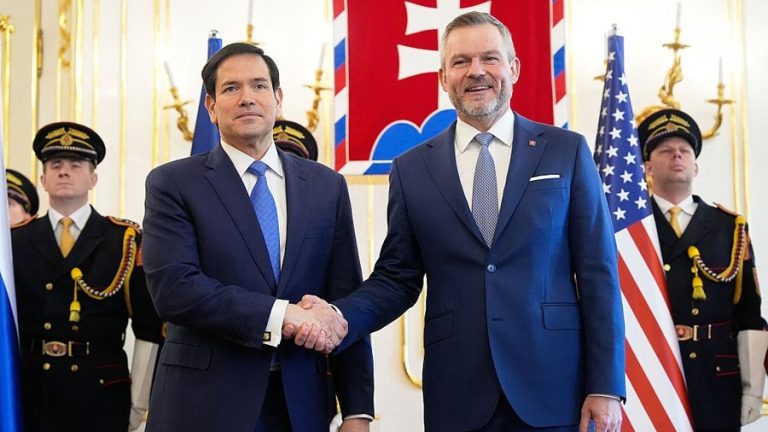
U.S. Secretary of State Rubio visited Eastern Europe on Feb. 15, signaling the Trump administration’s emphasis on key policies in its second term. During his participation in the Munich Security Conference, Rubio chose to visit Slovakia and Hungary beforehand, a trip with clear strategic significance, reflecting Washington’s prioritization of its European allies and its proactive engagement with a network of conservative-leaning international partners.
Strategic choice by the Trump administration
The timing of Rubio’s visit was carefully calculated. The Munich Security Conference has always been an important platform for coordinating U.S. foreign policy, and U.S. secretaries of state typically visit allied nations like Germany and France after the conference. By choosing two countries that often take independent stances within the alliance, Rubio sent a signal that U.S. foreign policy is no longer solely reliant on traditional European powers, but seeks closer ties with nations that align ideologically and strategically with Washington.
According to the U.S. State Department, the main topics of the visit included cooperation, bilateral relations, and NATO commitments. Rubio indicated beforehand that these countries maintain “solid and reliable” relations, and he hoped to use this opportunity to strengthen ties with two nations he had not previously visited. This demonstrates that Washington is reassessing its European alliances.
Political landscape of the two Eastern European countries
Slovak Prime Minister Fico and Hungarian Prime Minister Orban play independent “dissenting” roles within the alliance. Their conservative policies often diverge from Brussels’ mainstream positions, making them attractive allies for the Trump administration in Europe.
Although Fico leans left economically, his political style shares similarities with Trump, especially regarding nationalism and governance. Notably, Fico recently met with Trump in Florida last month, indicating active engagement at multiple levels. On the Ukraine conflict, Fico’s government has advocated halting military aid to Ukraine and pursuing peace talks—a stance controversial within the alliance, yet aligning with Trump’s interest in ending the Russia–Ukraine conflict.
Success
You are now signed up for our newsletter
Success
Check your email to complete sign up
Orban, meanwhile, is seen as a clear Trump ally in Europe. His “illiberal democracy” philosophy aligns ideologically with Trump’s “America First” policy. In domestic governance, Orban’s hardline approach to gender ideology and defense of traditional values offers a model of conservative governance. Rubio explicitly stated, “Trump has consistently supported us, and we do the same,” sending a clear ideological message to Budapest and Bratislava.
Energy and geopolitical considerations
Energy security is a likely key agenda item for Rubio’s visit. Slovakia and Hungary remain dependent on Russian energy—a vulnerability for the U.S. and other allies. While other NATO countries have shifted toward alternative suppliers, these two nations continue to purchase Russian natural gas and oil, a practice that both undermines sanctions and provides Moscow with leverage.
From a geopolitical standpoint, this dependency limits these countries’ willingness to take a hard line against Russia. Rubio indicated discussions on energy supply issues would occur, though he did not disclose specifics, highlighting the strategic importance of the topic. For the U.S., reducing European reliance on Russia is both a geopolitical necessity and consistent with America’s economic interests as a major energy producer.
However, Slovakia and Hungary’s geography and existing infrastructure make immediate energy diversification difficult. Rubio’s visit may explore ways to respect these countries’ needs while promoting alternatives—possibly including more competitive U.S. energy pricing, infrastructure upgrades, or technological cooperation.
Impact on European allies
Rubio’s visit underscores the Trump administration’s increasingly value-driven approach to choosing allies. This ideological alignment signals a significant shift in U.S. foreign policy. Traditionally, U.S. policy in Europe was based more on institutional alliances and shared interests than ideology.
From the Trump administration’s perspective, leaders who are more aligned politically can better preserve institutional alliances. On issues like tradition, defense of conventional values, and questioning supranational authority, these leaders resonate ideologically with Washington. This alignment may result in greater U.S. flexibility toward these countries on certain policy matters.
NATO commitments
NATO obligations were another key topic. During Trump’s first term, he criticized European allies for underfunding defense, urging them to meet the 2 percent of GDP benchmark. This criticism intensified during his White House tenure.
Hungary and Slovakia, as NATO members, have varying levels of contribution, making this a point of discussion. Hungary often takes a softer stance toward Russia, complicating alliance cohesion, while Slovakia is cautious about providing military aid to Ukraine, which has sparked debate within NATO. Rubio must balance maintaining alliance unity with respecting these countries’ individual constraints, ensuring they meet obligations without undermining their strategic interests.
Trump 2.0 long-term strategy
The timing of Rubio’s visit is also notable. Hungary will hold national elections in April, and polls show the incumbent facing challenges. A visit by a high-level U.S. official during this period may carry implicit political support.
Although Rubio emphasized this was a “bilateral visit” to downplay interference concerns, visits by senior U.S. officials before elections inevitably carry political weight. For Washington, Trump’s reelection is crucial for maintaining U.S. strategic interests in the Middle East and ensuring continuity of influence in European policymaking. A loss could weaken America’s presence and influence in the alliance.
Rubio’s Eastern European trip, while limited to two mid-sized countries, reflects a broader strategic approach by Washington—treating the alliance not as a monolithic bloc but focusing on selective bilateral engagement with members that share ideological alignment and strategic interests.
With Hungary facing a challenging election and the Ukraine conflict evolving, agreements and signals from Rubio’s visit will have far-reaching implications for future geopolitics in Europe and the Middle East. This visit represents not just diplomacy, but a major strategic deployment of Trumpism in Europe, providing insight into the future trajectory of U.S. foreign policy.