Stone-faced officials turned a holiday celebration into a wake
On Feb. 14, the Party held its annual Spring Festival reception in Beijing’s Great Hall of the People. Li Qiang, the CCP’s prime minister, presided over the event. Xi Jinping read out a speech, and the remaining members of the Politburo Standing Committee, the Party’s seven-member inner circle, all attended: Zhao Leji, Wang Huning, Cai Qi, Ding Xuexiang, and Li Xi.
State broadcaster CCTV’s footage told a different story than the occasion demanded. Xi and the other Standing Committee members forced smiles as they walked in. Xi’s gait remained visibly unsteady, his face puffy. Once seated, the smiles vanished. The rest of the audience, hundreds of senior Party officials, sat expressionless, exchanging uneasy glances. Hu Chunhua, a vice chairman of the CCP’s rubber-stamp political advisory body who was once considered a potential successor to Xi, and Liu He, a former vice prime minister and Xi’s longtime economic adviser, both looked openly despondent.
Cai Shenkun, a U.S.-based independent political commentator, wrote on X that the reception followed an established pattern: retired leaders at the very top “full national” rank are barred from attending, and even those at the rank just below are selectively invited. The reason, Cai argued, is straightforward. Xi does not want to share a room with certain retired leaders, particularly Hu Jintao, the former CCP general secretary whom Xi’s security guards hauled out of the 2022 Party Congress on live television. To avoid that encounter, all retired leaders of equivalent rank are shut out, and their names appear only on a published list.
Cai identified 19 retired former Politburo members who did attend, calling it a list that “looks safe.” Among them: former vice prime ministers Liu Yandong, Ma Kai, and Sun Chunlan; former security chief Meng Jianzhu; and former top diplomat Yang Jiechi. Two other retirees, Zhang Chunxian and Liu Qibao, also attended but were ranked by the posts they held before retirement, as vice chairmen of the Party-controlled legislature and advisory body respectively, rather than as former Politburo members.
Chinese internet users mocked the spectacle. “Every face was frozen stiff, like wooden puppets on display. Not a trace of holiday cheer,” wrote one. “If you took away the red decorations, you’d think it was a funeral,” said another. “Put a couple of memorial wreaths next to them and you’d swear the State Council had relocated to the Babaoshan cemetery.”
Success
You are now signed up for our newsletter
Success
Check your email to complete sign up
One widely shared post on X, by an account called “Finding Where the Heart Belongs,” described the scene this way: the man on stage read his script while the “public servants” in the audience performed an advanced form of acrobatics, sitting rigid as bronze bells, standing straight as pine trees, their nerves wound tight as startled birds. Their eyes darted without purpose. Their hands were folded with the precision of freshly delivered wax figures. This was a large-scale immersive disciplinary inspection session, the author wrote, dressed up as a holiday party.
The same author noted that the number of young men in black suits wearing earpieces outnumbered the waitstaff. Sentries stood every few paces. The author called it a “defensive-mode reception” that sent an unmistakable signal: power in this system is handled like fragile porcelain, sealed under glass and surrounded by two hundred bodyguards. The more the regime emphasizes “security,” the more it reveals how thin its confidence has become.

Xi abandoned ‘Belt and Road’ rhetoric and struck a defensive tone
Tang Jingyuan, another U.S.-based political commentator, analyzed the content of Xi’s speech and found a sharp retreat from the rhetoric of just twelve months ago.
At the 2025 Lunar New Year reception, Xi had spoken expansively about the “Belt and Road Initiative,” “global governance,” and the CCP’s ambitions to reshape the international order. All of that was gone from the 2026 speech. In its place, Xi fell back on cautious, inward-looking Party slogans: “seeking progress while maintaining stability” and “striving for a good start to the Fifteenth Five-Year Plan,” the CCP’s latest economic planning cycle. The speech focused almost entirely on domestic issues. The old bluster about “surveying the globe” and “pointing the way for the world” had vanished.
On economic matters, Xi also pulled back. He dropped the phrase “warming up and trending positive” that he had used the previous year to describe the economy. Tang argued that the shift reveals a leader who cannot project strength even at his own Party’s ceremonial events. Xi’s performance, Tang said, looked nothing like the image of a strongman who has “swept aside all opposition” and rules with unchallenged authority.
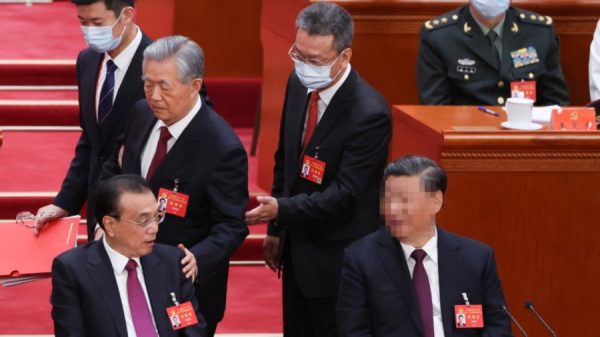
Xi bars all top retired leaders from the reception to avoid facing Hu Jintao
Beyond Xi’s subdued speech, every single retired leader holding the Party’s highest rank was excluded from the reception. Tang explained that this has become Xi’s established practice: before the Lunar New Year, the current leadership dispatches delegations to call on retired top leaders individually, keeping them away from any event where they might be seen or heard collectively.
On Feb. 13, the Party’s official Xinhua News Agency published the annual list of 125 living retired leaders at the vice-national level and above who received such visits or greetings. The names of former CCP general secretary Hu Jintao, former prime ministers Zhu Rongji and Wen Jiabao, and former chairman of the CCP’s political advisory body Li Ruihuan appeared near the top.
Tang found that, compared to the 2025 reception, five former Politburo members who had previously attended were missing in 2026: Tian Jiyun, Chi Haotian, Wang Zhaoguo, Zeng Peiyan, and Wu Yi. Their absence could reflect health problems or political disfavor. Tang did not speculate further.
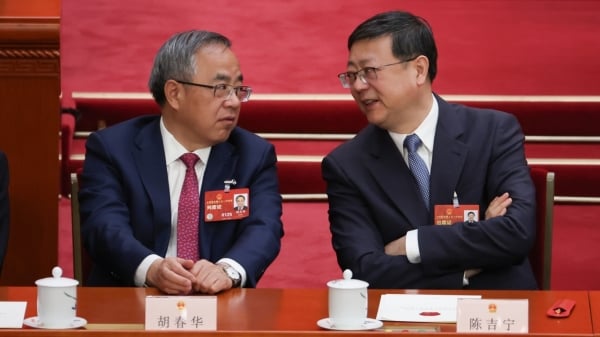
A deflated successor, a grim personnel chief, and a relaxed rival: three officials revealed the state of Xi’s power struggle
Among those who did attend, three figures drew particular attention from political observers.
Hu Chunhua, a vice chairman of the Chinese People’s Political Consultative Conference who was once widely regarded as a potential successor to Xi, appeared listless and deflated. Hu’s political standing serves as a barometer for the broader balance of power within the CCP. He is widely seen as the figure whose latent authority poses the greatest potential challenge to Xi.
Shi Taifeng, the head of the Party’s Organization Department, the organ that controls all senior personnel appointments across the CCP, looked grim-faced and tense. Rumors had circulated in recent weeks that Shi had been purged after missing several public appearances. His presence at the reception suggests he remains in his post, though his demeanor offered little reassurance. Which faction controls the Organization Department is itself a signal of where power lies within the Party’s internal warfare.
Li Yuanchao, a former state vice president with ties to the Communist Youth League faction, a rival power center that Xi has spent years dismantling, appeared comparatively relaxed.
Tang concluded that Xi has held off from moving against figures like Hu Chunhua and Shi Taifeng while he is still tightening his grip over the military. Until Xi finishes dealing with the cases of Zhang Youxia, the former vice chairman of the CCP’s top military commission, and Liu Zhenhli, the former chief of the military’s Joint Staff Department, both of whom were swept up in the regime’s ongoing military purge, these civilian officials appear to have a temporary reprieve.
This article represents only the author’s personal position and views and does not necessarily reflect the views of Vision Times.