By Li Muzi, Vision Times
As China entered the Lunar New Year holiday season, a time traditionally marked by the giving of red envelopes filled with cash and families getting together to ring in the new year with home-cooked meals, online reports surfaced that many citizens were unable to withdraw money on New Year’s Eve. The mishap has fueled widespread anger and concern over the stability of China’s financial system.
On Feb. 16, which coincided with Lunar New Year’s Eve, social media users across multiple provinces claimed that ATM machines operated by China’s four major state-owned banks were either out of service or out of cash, leaving depositors unable to access funds at one of the most cash-dependent moments of the year. Instead, they were greeted with alarming messages that read: “Unable to dispense cash.”
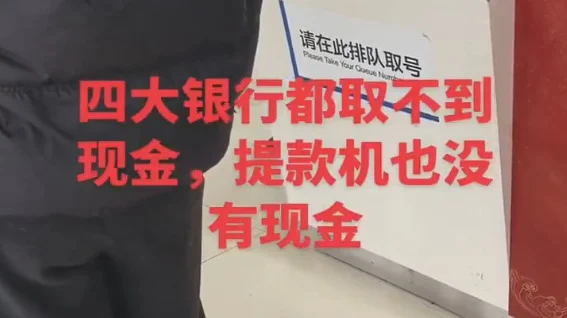
Online commentary suggested that the situation had become a symbolic warning sign: A breakdown in everyday liquidity during the Spring Festival, when millions of households rely on cash for holiday gifting, travel, and family gatherings.
RELATED: Henan Gala Livestream Abruptly Cuts Off Across China: ‘What Is the CCP Afraid Of?’
Success
You are now signed up for our newsletter
Success
Check your email to complete sign up
Some users described the episode as a growing indicator of deeper financial strain. In response, citizens reportedly began organizing informal cash exchanges by transferring money digitally while swapping physical bills in person to complete urgent withdrawals.
‘Machine only accepts deposits’
Several videos circulating online appeared to show ATM notices indicating withdrawals were unavailable. In one clip, an ATM at a Bank of China location displayed a sign reading: “This machine can only handle deposit services.”
A man in the video expressed frustration after visiting multiple branches: “Today I went to 10 Bank of China locations, and none of them could dispense cash. This is the kind of heartless thing state-owned institutions do to ordinary people. I don’t even know how this should be handled.”
Another video showed a depositor confronting bank staff as ATMs remained empty: “All four major banks can’t dispense cash. The machines have no money.” The man could be heard shouting at employees: “Why can’t I get money from the counter either?”
In one bank lobby, multiple customers reportedly began exchanging cash among themselves, using mobile transfers to compensate for the lack of withdrawals.
Furious customers
One widely shared clip showed a woman standing before a China Construction Bank ATM, visibly angry: “I’ve run to several banks in a row, and they all show no cash available. I want to ask the banks: What does this mean? Did you all agree on this? If you have no cash, how are parents supposed to give red envelopes to their children?”
The inability to withdraw cash during such a culturally significant holiday sparked an outpouring of disbelief online, especially among those trying to provide traditional New Year gifts to children and relatives.
On the same day, numerous Douyin creators (a popular video-sharing and blogging app similar to TikTok) posted videos describing similar experiences. One blogger said: “There were especially many people withdrawing cash today. After waiting in line forever, the ATM machines were completely out of money.” Another added: “It’s New Year’s, everyone needs cash. This is honestly unbelievable.”
Others described running between multiple banks without success: “Tonight is New Year’s Eve. I wanted to withdraw some cash to give lucky money, but I went to several Agricultural Bank and Construction Bank branches and couldn’t withdraw anything.”
One user called it an unprecedented experience: “This is the first time I’ve ever encountered something like this. It’s beyond ridiculous. Elderly people were carrying their bank cards to countless banks.”
A sign of collapse?
Netizens from Ningxia, Henan, Shandong, Xinjiang, and Shaanxi also posted comments expressing alarm: “This afternoon I went to three banks and couldn’t get any cash. The ATM just shows a display that reads: ‘Unable to withdraw cash.'”
“Unbelievable. I ran to several banks and none had money,” wrote another netizen. “It’s urgent, and you still can’t withdraw during the New Year.” One user questioned whether the outage signaled an imminent financial crash. “What’s going on, are they about to go bankrupt?” Another noted, “No cash. This is not a good omen.”
The episode has amplified public anxiety at a time when China’s banking sector is already undergoing rapid contraction.
A sputtering financial sector
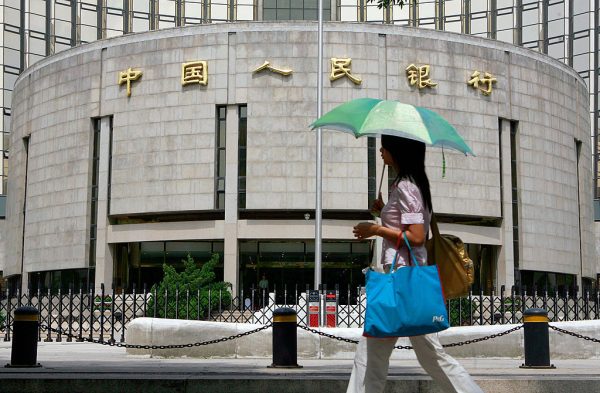
Beyond the holiday cash shortage reports, China’s physical banking infrastructure has been shrinking dramatically. According to a report by Jiemian News, as of Dec. 8, 2025, a total of 377 banks had been deregistered during the year due to mergers or dissolutions, nearly double the roughly 190 closures recorded in all of 2024.
Meanwhile, traditional brick-and-mortar branches are vanishing at an unprecedented pace. More than 9,000 bank outlets were approved for closure in 2025, representing an increase of over 200 percent compared to the 2,533 outlets shut down the previous year. By Dec. 8, 2025, 9,661 bank branches had officially ceased operations. Rural commercial banks were hit hardest, accounting for approximately 5,400 closures, while major state-owned banks closed 962 branches.
Among the 377 deregistered banks, village and township banks made up the majority, with 218 closures, nearly 60 percent of the total. Rural commercial banks and credit cooperatives followed, with 79 and 70 closures respectively.
The accelerating disappearance of banking access points, combined with reports of holiday cash shortages, has raised new questions about liquidity pressures and public confidence in China’s financial system.