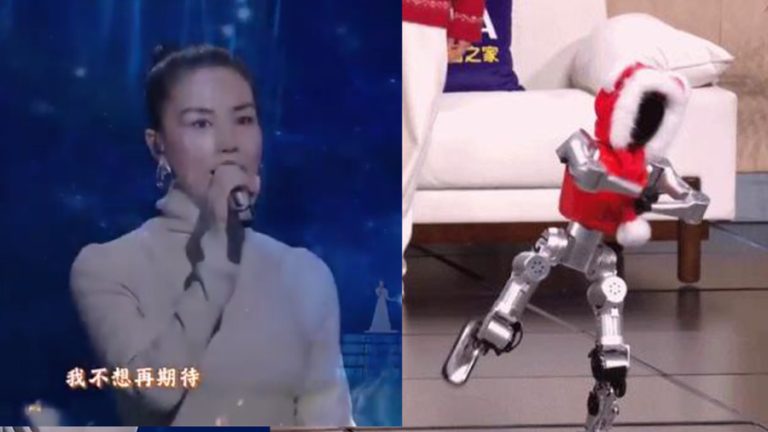
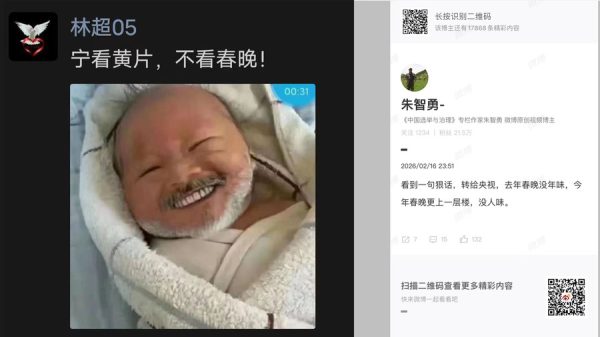
The Chinese Communist Party’s flagship television network made a revealing choice for the most-watched broadcast of the year: it filled the 2026 Lunar New Year gala with dancing robots, AI demonstrations, and a skit instructing grandparents to give up traditional culture. Chinese audiences responded with widespread boycotts, open mockery, and a single devastating verdict that swept the internet: “Last year’s gala had no holiday spirit. This year’s went a step further: it had no human spirit.”
On the same night, Henan province, the symbolic birthplace of Chinese civilization, aired a rival gala built around cultural revival that viewers immediately compared to Shen Yun Performing Arts, the traditional Chinese dance company that the CCP has spent years trying to suppress. The dueling broadcasts have become the defining cultural confrontation of the Year of the Horse, exposing the chasm between the Party’s vision for China and the values of the people it claims to govern.
The Spring Festival Gala, historically the single most-watched television event on Earth, devoted four major segments to robotics and artificial intelligence. The message, intentional or not, was unmistakable: Xi Jinping’s “New Era” has arrived at its logical destination, an age in which obedient machines replace thinking citizens.
For Western observers familiar with debates about automation displacing workers, the CCP version carries a darker edge. The Party is not worried about robots taking jobs. It is celebrating the arrival of subjects that never protest, never think, and never demand rights.
“Grandma’s Favorite” brought veteran actress Cai Ming back to the gala in a robot role for the first time in 30 years. The skit’s message to older Chinese citizens who still cherish traditional culture was blunt: abandon your traditions if you want to survive.
Success
You are now signed up for our newsletter
Success
Check your email to complete sign up
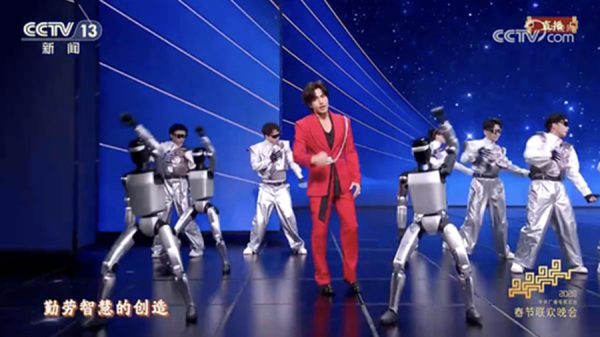
“Wu-BOT” featured humanoid robots built by Unitree Robotics, a company drawing heavily from the CCP government’s massive subsidy pipeline. Beijing has poured more than $20 billion into robotics and AI industries, and Unitree used the gala stage as a high-profile audition for continued patronage. Its machines performed martial arts kicks, parkour, single-leg backflips, and rapid formation changes, a spectacle designed to dazzle audiences whose capacity for critical thought has been eroded by decades of Party control over education and media.
“Intelligent Future” placed robots alongside human dancers, urging audiences to stop seeking human warmth and instead embrace a cold existence on the lunar surface, dancing with dust and machines.
A short promotional film presented robots performing household tasks as “life skills assistants” and “caring companions.” The segment amounted to a mockery of human connection, reducing concepts that Chinese civilization has valued for millennia to marketing copy for appliances. The underlying logic was hard to miss: a machine that cannot think requires no ideological conditioning. Manufacturing obedient subjects becomes simple and fast.
Beijing’s obotics push reveals the CCP’s fear of independent thought
What the CCP dictatorship under Xi Jinping, China’s top leader and CCP general secretary, truly wants is a population of quiet, obedient workers. Robots will never fight for human rights. They will never speak up for freedom. They will never demand democracy or imagine a better way of life.
In Western democracies, the debate about artificial intelligence centers on economic disruption and ethical guardrails. In Communist China, the regime has skipped past those concerns entirely. It sees in robotics the perfection of authoritarian control: a workforce that produces without questioning and obeys without limit.
Chinese viewers boycotted CCTV’s 2026 Spring Gala and mocked its copyright crackdown
The backlash was immediate and widespread. Viewers boycotted the broadcast in large numbers. “We’re not watching the Spring Gala!” became a rallying cry across Chinese social media.
Before the broadcast, CCTV issued strict intellectual property restrictions, banning reposting, third-party apps, independent livestreams, and derivative content of any kind. The edict was meant to protect revenue, but it produced the most celebrated punchline of the holiday season: “They’ve padlocked the toilet. Who’s going to steal the sewage? Thank you, CCTV, for this decision. We’re finally free from being bothered by the Spring Gala.”
The copyright crackdown achieved what years of audience erosion had not. It gave Chinese viewers official permission to ignore the broadcast entirely.
Henan Province’s 2026 Spring Gala celebrated traditional culture while CCTV promoted robots
On the same night that CCTV celebrated its robotic future, Henan province went in the opposite direction, airing a gala built around the revival of traditional Chinese culture. The contrast was so stark that it read as open defiance.
Many viewers who had attended performances by Shen Yun Performing Arts, the New York-based traditional Chinese dance company, recognized the resemblance immediately. “They’re imitating Shen Yun,” audiences remarked, though the two productions remain far apart in artistic depth. The CCP has waged a years-long campaign to discredit and suppress Shen Yun performances worldwide, which made a provincial gala echoing its aesthetic all the more striking.
The message was unmistakable: traditional Chinese culture, not Party ideology, is the only viable path to national renewal.
Hanfu, the flowing garments associated with the Han dynasty and earlier periods of Chinese civilization, became the visual emblem of the broadcast. Several segments were pulled by censors during the live airing, but even the surviving performances carried the spirit of the deleted material.

Henan’s centerpiece performance was read across China as a declaration against CCP rule
The most electrifying segment was “Long Night, Final Embers,” a visual spectacle that viewers across the country interpreted as a direct challenge to the regime. Its opening declaration, “The seasons turn, the long night collapses,” carried an unmistakable political charge. Chinese audiences understood the “long night” as the decades of CCP dictatorship, and the “final embers” as the regime’s approaching end.
The performance sharpened from there: “In the silence where ten thousand horses stand mute, who carries the torch alone?” The phrase “ten thousand horses standing mute” is a classical Chinese expression for total political suppression, as recognizable to Chinese-speaking audiences as “the emperor has no clothes” is in the West. The implied answer was equally clear. The torchbearers walking alone through the darkness are the dissidents, the authors of the “Nine Commentaries on the Communist Party,” a landmark 2004 editorial series that systematically dismantled the CCP’s ideological claims, and every individual who has worked to expose and resist the regime’s tyranny.
“Even in the depths of the long night,” the segment proclaimed, “there are those who carry the resolve to break the dawn.” Generation after generation of those who have fought to bring the CCP to an end were honored in this single line.
Henan’s authorities grew nervous. The broadcast was interrupted. Several segments were abruptly cancelled and replaced with commercial breaks. The spirit of the gala had already traveled far beyond the censors’ reach.
Why Henan’s cultural defiance threatens the CCP more than other provinces
Henan’s gala carried political resonance that extended well beyond its content. The province sits at the heart of the Central Plain, the region where Chinese civilization first took root thousands of years ago. In Chinese political tradition, Henan holds roughly the same symbolic status as the American heartland does in U.S. political mythology: it represents the authentic core of national identity. Throughout Chinese history, the stability or instability of this region has been treated as a barometer for the health of the entire political order. When the heartland rebels, the dynasty is finished.
For Chinese viewers steeped in this tradition, Henan’s 2026 gala was a tremor at the empire’s core.
Faye Wong’s 2026 Spring Gala performance became an unintended reminder of CCP impermanence
The CCTV gala’s final act offered an unintended counterpoint to the Party’s triumphalism. Faye Wong, one of the most recognizable voices in Chinese pop music, closed the broadcast with “A Moment You and I Are Living Through,” a meditation on impermanence and the vastness of time. In any other context, it would have been an innocuous philosophical ballad. On this night, for audiences already primed by Henan’s gala and disgusted by CCTV’s robots, the song’s themes landed with political force.
The lyric that resonated most: “A hundred-year river is merely a moment that you and I are living through.” One hundred years is roughly the lifespan of the Chinese Communist Party, founded in 1921. For dissident audiences, the implication was electric: the entire arc of CCP rule, all its violence, propaganda, and ambition, amounts to a fleeting instant in the sweep of Chinese civilization.
Another line deepened the point: “People have existed since a time far before memory.” This is the core conviction of China’s dissident movement distilled into a single lyric. China is not the Chinese Communist Party. Chinese civilization has endured for millennia. The CCP is a brief, violent interruption.
Whether Faye Wong intended any political reading is beside the point. In a society where direct dissent is forbidden, Chinese audiences have become expert decoders of ambiguity. The censors approved the song. The audience heard what it needed to hear.
The 2026 Spring Festival Galas exposed the CCP’s deepening cultural irrelevance
The two 2026 Spring Festival Galas arrived at the same destination from opposite directions. Henan’s gala proclaimed a new dawn, a return to the deep roots of Chinese civilization that predate the Party by thousands of years. CCTV’s gala, with its robots and its contempt for tradition, inadvertently confirmed what Henan declared: the CCP has nothing left to offer the Chinese people.
One broadcast celebrated rebirth. The other broadcast the death rattle of a regime that has replaced human beings with machines because it can no longer inspire, persuade, or even entertain them.
More and more Chinese viewers understood the message. The CCP’s frantic spectacle is the last glow of a regime burning out.
By Jin Tao Pai An
Editor’s Note:In Chinese dissident commentary, state-produced cultural events are never just entertainment. They are political signals, and audiences across the Chinese-speaking world have long practiced the art of reading between the lines. This article follows that tradition, interpreting both galas as competing statements about the future of China under the CCP.