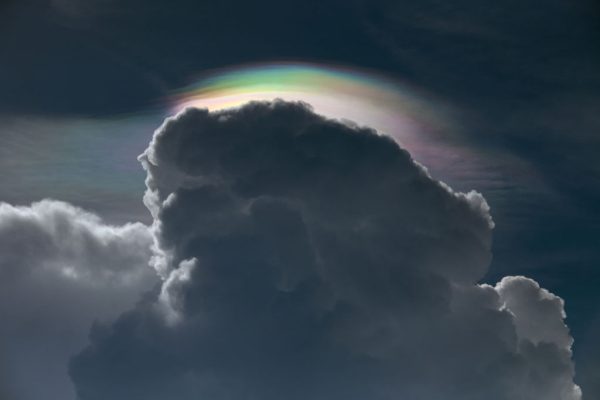
A band of color appears without warning, suspended high in thin summer clouds. It glows in layered reds, oranges, greens, and violets, sharp and luminous against pale blue sky. For a few minutes, it looks as if the atmosphere itself has caught fire.
The name that circulates online is “fire rainbow.” It is memorable but not precise.
The phenomenon is formally known as a circumhorizontal arc — a rare optical display that belongs to the ice halo family. It forms not from rain, but from ice: flat, hexagonal crystals drifting in high cirrus clouds. When sunlight enters these crystals at a steep angle and exits at just the right geometry, white light separates into a clean horizontal spectrum.
That geometry aligned in May 2025 above Gallipolis, Ohio. Residents noticed a long, multicolored ribbon extending into wisps of cloud. Photographer Rusty Mittendorf described the scene on Facebook as “flames igniting over Gallipolis” and shared the image with NBC4. Online viewers responded with curiosity and cultural comparisons — some saw the glowing “Nexus” from Star Trek: The Next Generation, others the blazing trail of the DeLorean in Back to the Future.
Meteorologist Dave Mazza of NBC4’s Storm Team 4 later explained that a thin veil of ice-crystal clouds had refracted sunlight at a high angle, producing a vivid band. The American Meteorological Society classifies such events as ice halos, optical phenomena created when light interacts with suspended ice crystals rather than water droplets.
Success
You are now signed up for our newsletter
Success
Check your email to complete sign up
A similar scene unfolded on July 2, 2025, over Vernon, British Columbia. Photographs showed a bright spectral strip embedded in high clouds, its edges appearing almost serrated. The Weather Network Canada noted that while circumhorizontal arcs are less frequent in Canada than in lower latitudes, they are not unprecedented. The display is unrelated to wildfire smoke, despite the name, and has no connection to rain showers. Often, it fades as quickly as it forms.
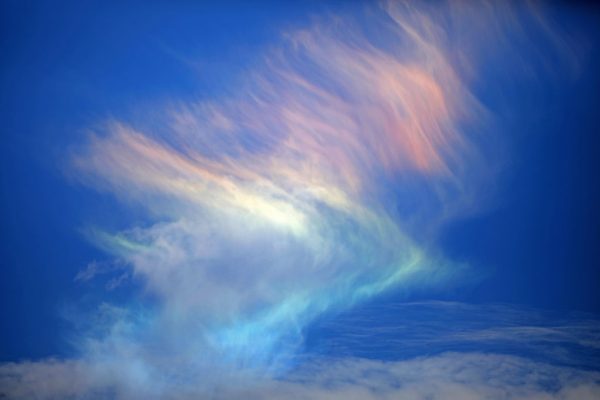
A decade earlier, in August 2015, observers in North Carolina photographed multicolored cloud shapes that resembled wings stretching across the sky. Shared widely on social media, the images were again labeled “fire rainbow.” Reports at the time emphasized how narrow the atmospheric margin truly is.
For the arc to appear, the sun must stand high — at least 58 degrees above the horizon. Sunlight must pass through cirrus clouds filled with large, flat, hexagonal ice crystals. Those crystals must be aligned horizontally. If their orientation shifts, even slightly, the colors dissolve back into ordinary light.
From a physical standpoint, the process is exact. Light enters one vertical face of a horizontally oriented crystal and exits through a nearly horizontal lower face. The angle between entry and exit approaches 90 degrees, separating wavelengths distinctly. When complete, the arc forms parallel to the horizon, roughly 46 degrees below the sun, with red along its upper edge. Partial cloud cover may reveal only fragments of the spectrum. Though moonlight can theoretically produce the same geometry, it is rarely bright enough to make the colors visible.
Geography influences how often the phenomenon can be seen. Because the sun must reach a steep elevation, circumhorizontal arcs occur more frequently in lower latitudes during summer. In London, the sun exceeds 58 degrees for roughly 140 hours each year, mostly between mid-May and late July. In Los Angeles, the window extends to approximately 670 hours annually, from late March through late September. Beyond about 55 degrees latitude north or south, the sun seldom climbs high enough for the arc to form.
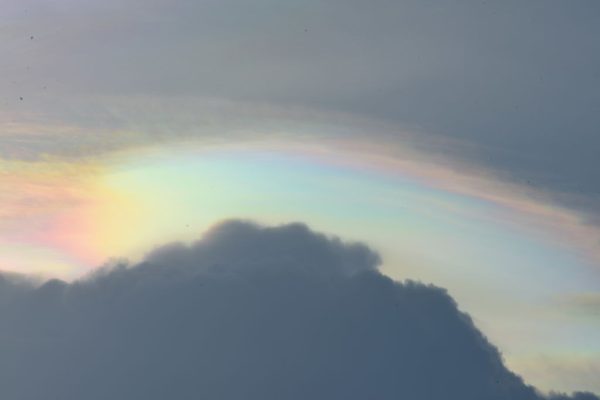
The display is sometimes mistaken for cloud iridescence, but the two differ in both appearance and origin. A circumhorizontal arc occupies a fixed position relative to the sun and forms a horizontal band with clearly separated spectral colors. Cloud iridescence results from diffraction, producing softer hues that follow the contours of clouds without rigid geometry. Other ice halo phenomena — including sun dogs and circumzenithal arcs — appear in different positions and can usually be distinguished by their placement in the sky.
The phrase “fire rainbow” entered popular usage around 2006, likely inspired by the flame-like streaking that appears when the arc intersects scattered clouds. The label endured despite its inaccuracy. Rainbows arise through reflection and refraction within water droplets. Circumhorizontal arcs result solely from refraction within ice crystals. They share color, but not mechanism.
A related effect can even be recreated at a small scale. Experiments documented in the 1920s showed that shining light at a steep angle through a nearly full cylindrical glass of water produces a double refraction. A hyperbolic band of color appears on a nearby surface, echoing the geometry that unfolds miles above in cirrus clouds.
In Ohio, in British Columbia, in North Carolina, the pattern of reaction was nearly identical: a pause, a glance upward, a photograph taken before the colors faded. The spectacle does not resist explanation. It depends on precise alignment — sunlight, crystal, angle — meeting for only a short time.
Then the light shifts, the crystals drift, and the sky returns to blue.