On Thursday, Feb. 19 former U.S. House Speaker Nancy Pelosi delivered a speech via video at the Berlin World Forum, stating that the Taiwan issue is not only regional but global, and that isolating Taiwan would trigger a worldwide disaster. During the forum’s Taiwan workshop, Taipei City Councilor Miao Boya said Taiwan aims to convey to the international community its desire to establish partnerships with the world.
Pelosi: isolating Taiwan would trigger a global disaster
The Berlin World Forum, organized this week by the Berlin-based Cinema for Peace Foundation, focuses on democracy, peace, and global security.
According to Central News Agency, this year the forum established a Taiwan workshop, inviting lawmakers from Europe and the U.S., as well as civil society representatives, to discuss Taiwan’s role in global security. Former U.S. House Speaker Nancy Pelosi participated via video. She stated that Ukraine and Taiwan are “two chapters of the same story,” and that authoritarian regimes are testing whether the international community will allow order to be changed by force and freedom to be suppressed through intimidation.
Pelosi emphasized that Taiwan, as a vibrant democracy and a key engine of the global economy, disproves claims that “freedom is incompatible with Chinese culture.” Any attempt to isolate, coerce, or invade Taiwan is not merely a regional issue but would trigger a global disaster economically, strategically, and morally.
She called on democratic nations not to turn a blind eye to aggression, saying deterrence is not provocation. The purpose of defending Taiwan is to prevent conflict, and decisive action with a clear moral stance is necessary for democracy to endure.
Success
You are now signed up for our newsletter
Success
Check your email to complete sign up
Taiwan should strengthen its defense capabilities
Taiwan’s representative to Germany, Gu Ruisheng, said in his speech that Taiwan, situated on the frontlines of democracy, continues to strengthen its self-defense capabilities and deepen cooperation with like-minded countries in response to military and hybrid threats from authoritarian regimes.
Former Lithuanian President Dalia Grybauskaite noted from a European perspective that traditional deterrence is ineffective against authoritarian regimes; what matters is building substantive defense capabilities and societal preparedness. She cited the Russia-Ukraine war, saying that initial international support was limited, and only by having self-defense capability could a country secure subsequent external assistance.
German MEP Lukas Sieper said that Europe faces internal political and economic pressures when supporting Taiwan, as trade restrictions with China could raise commodity prices and become a populist political issue.
Sieper believes that helping Taiwan enhance its defense industry and weapons production capabilities, including technology transfer and expert exchanges, will have longer-term effects. He told Central News Agency that the Chinese Communist Party (CCP) threat to Taiwan persists, and Europe can no longer remain on the sidelines. The EU needs to continuously advance the Taiwan issue until a solution is found.
At the workshop, Legislative Yuan member Huang Jie and Taipei City Councilor Miao Boya represented Taiwanese public opinion to the international community. Miao said the purpose of the trip was to convey Taiwan’s desire to build partnerships with the world. Huang emphasized that Taiwan is strengthening its self-defense, including pushing to raise the defense budget to 5 percent of GDP.
The Taiwan workshop at the Berlin World Forum was sponsored by the North American civil society group “Hello Taiwan International Exchange Promotion Association.” During the forum, the organization held a press conference to officially launch a global campaign to rename Taiwan’s representative offices, seeking to rename the current Taipei Economic and Cultural Office (TECO) as the Taiwan Representative Office (TRO). Participants generally agreed that with rising uncertainty in U.S. foreign policy, the EU needs to strengthen its stance on the Taiwan issue.
Pelosi’s visit to Taiwan
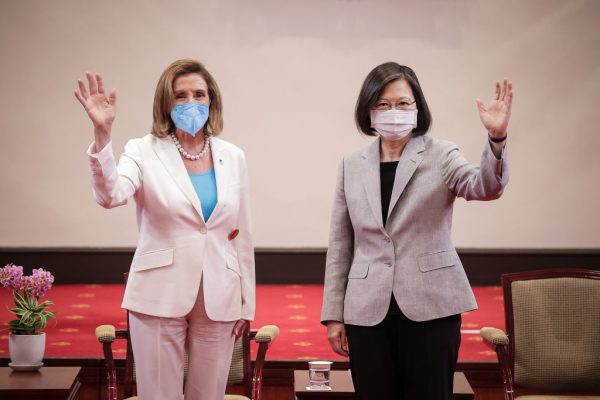
In 2022, then-House Speaker Pelosi’s visit to Taiwan was seen as a key signal of U.S. support. Before her visit, the CCP repeatedly warned the U.S. government, and Chinese forces conducted exercises in the Taiwan Strait to apply pressure. The U.S. deployed the USS Reagan aircraft carrier and the amphibious assault ship USS Tripoli to the east of Taiwan and surrounding Philippine Sea before and after the visit. Following Pelosi’s arrival, several Chinese official agencies issued statements of protest and carried out military exercises against Taiwan.
On Feb. 9, the U.S. House of Representatives overwhelmingly passed the “PROTECT Taiwan Act” by 395 to 2, requiring that if Taiwan’s security is threatened by CCP actions, the U.S. should fully exclude China from international financial systems and organizations. The bill, proposed by Congressman Frank Lucas, stipulates that if CCP actions threaten the safety, society, or economic system of the Taiwanese people, the U.S. should, to the maximum extent possible, exclude CCP representatives from the G20, Bank for International Settlements (BIS), and Financial Stability Board (FSB) mechanisms.
Lucas said the bill aims to clearly signal to the CCP that it will bear consequences if it intends to engage in conflict with Taiwan. He noted that the CCP continues to show aggression in the South China Sea, and Washington should adopt more forward-looking policies to make clear that invasions will not be tolerated. The U.S. response to any invasion of Taiwan should be strong, including multiple sanctions and economic penalties, and excluding the CCP from international organizations.
By Li Jingyao