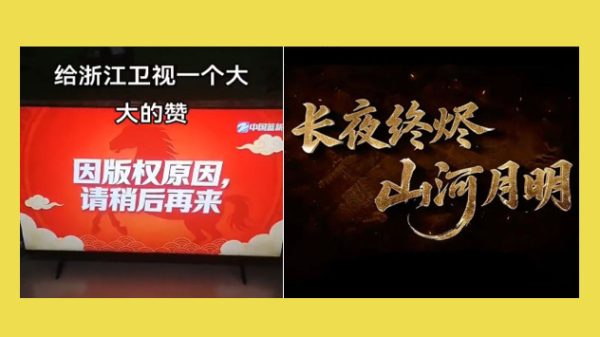
A 16-second clip from Zhejiang Satellite TV became one of the most discussed moments of the 2026 Chinese New Year season across overseas Chinese social media. The clip, which went viral on X (formerly Twitter) and YouTube, showed a static screen reading “Due to copyright reasons, please come back later.” There were no hosts, no programming, and no further explanation.
In China’s Party-controlled media system, provincial satellite television stations have long been compelled to carry the annual Spring Festival Gala produced by CCTV, the CCP’s chief propaganda mouthpiece. The gala, known formally as the Spring Festival Evening Party, is one of the regime’s most important annual propaganda rituals, designed to manufacture an impression of political unity and loyalty to the Party. For a provincial station to decline to broadcast it is virtually unheard of.
Multiple accounts on overseas platforms quickly seized on the Zhejiang footage, sharing it with commentary ranging from “Zhejiang TV is openly rebelling” to “the biggest black swan of the 2026 Spring Festival Gala” to “local stations are waking up” and “the propaganda system is cracking from within.”
Overseas Chinese commentators called it a sign of internal fracture
X user “Liu Min” posted that a well-known mainland media figure had leaked the following assessment: Zhejiang Satellite TV used “copyright” as a pretext to refuse to rebroadcast CCTV’s Spring Festival Gala. Under the CCP’s rigid, top-down media control structure, provincial stations have unconditionally complied with central propaganda directives for decades, making this kind of refusal extremely rare. If true, the incident goes beyond a technical or commercial dispute. It may reflect a complex internal power struggle within the system itself. Given the tightening political atmosphere and the growing number of unusual signals, this kind of event deserves sustained attention.
Another X user, “Noah,” wrote that Zhejiang TV’s blank screen was an act of defiance that echoed Henan Satellite TV’s earlier provocation. Henan’s 2026 New Year broadcast had featured the phrase “The long night’s embers have burned out; the mountains, rivers, and moon shine bright,” a poetic declaration widely interpreted as a veiled expression of hope for the end of CCP rule. Noah argued that Henan TV and Zhejiang TV had together torn open a hole in the CCP’s seamless propaganda facade, and that more propaganda organs would soon turn their guns on the Party itself. “This won’t be the last,” he wrote. “More and more loss of control is on the way, until the burial.”
Success
You are now signed up for our newsletter
Success
Check your email to complete sign up
Reactions poured in from Chinese internet users, many of whom saw the two incidents as part of a connected pattern. “Zhejiang TV would rather go blank than cooperate with the propaganda machine,” one wrote. Others declared: “CCTV’s mouthpiece is turning its guns around. Henan got cut off, Zhejiang went blank. The times are truly changing.” Some drew a broader conclusion: “From Henan to Zhejiang, these local stations’ actions are clearly connected, a chain reaction. This is a signal of nonviolent noncooperation. It suggests the system has already begun to quietly loosen from within.”

The CCP pulled the plug on Henan’s Spring Festival show mid-broadcast
The Zhejiang incident came days after an even more dramatic confrontation. On Feb. 14, Henan Satellite TV’s Spring Festival broadcast was abruptly cut mid-show, immediately igniting a firestorm online. Viewers demanded to know what the CCP was so afraid of. Some pointed to the show’s heavy emphasis on traditional Chinese culture, which they said threatened the CCP’s effort to supplant authentic Chinese civilization with Party ideology. Others speculated the show was shut down simply because it was more popular and more compelling than the CCTV gala, provoking jealousy from central propaganda authorities.
On Feb. 15, a Douyin (the Chinese version of TikTok) blogger known as “Shifangju” posted a video claiming: “Henan’s Spring Festival show was sabotaged. The crew was ready backstage, but the programs couldn’t go to air. The screen filled with wall-to-wall advertisements, and the hosts were pulled off.”
A woman who identified herself as having been present at the taping said in the same video: “As someone who was there in front of the cameras, there are many things I can’t say. I can only hint. But I hope everyone will open their eyes and work hard to discern what is really going on. People need to unite. For our generation, the revival of our culture is our responsibility.”
Another Douyin blogger, “Li Yong LY,” posted a video saying that Henan’s 2026 Spring Festival program had been packed with content celebrating ancient Chinese civilization and cultural revival, but “the live broadcast was cut halfway through, and the screen was flooded with advertisements. The more they try to cover something up, the more it proves that what we suspected and guessed was right all along.”
Viewers rallied around Henan’s show as an act of cultural defiance
Chinese netizens pushed back forcefully. “I watch Henan’s show, and the more they try to ban it, the more I want to see it,” one wrote. Others asked bluntly: “Who did the traditional Han Chinese clothing offend?” Many framed the confrontation in civilizational terms: “Stand together. The revival of Chinese culture is upon us. Henan’s Spring Festival show was full of spirit and vitality.” Some went further: “This is the darkness before dawn. There must be a reckoning.”
On X, several users analyzed the reason behind the CCP’s decision to shut down Henan’s broadcast. One assessment stood out: the show’s style of celebrating pre-communist Chinese civilization through classical dance, traditional costumes, and mythological storytelling bore a close resemblance to Shen Yun Performing Arts, the world-renowned classical Chinese dance company that the CCP has long targeted for suppression. “It imitated Shen Yun’s style, and that crossed the Party’s red line,” one user wrote.
Shen Yun, widely described as the world’s premier Chinese classical dance ensemble, presents a vision of Chinese civilization as it existed before the ravage of communist rule. Its performances feature stories drawn from Chinese history and mythology, richly colored traditional costumes, animated digital backdrops, and original orchestral compositions blending Eastern and Western instruments. The company tours globally each year, drawing world leaders, cultural figures, and enthusiastic audiences in major cities across dozens of countries. The CCP has waged an aggressive, well-documented campaign to pressure foreign governments and theaters into canceling Shen Yun performances, viewing the company’s mission of authentic cultural revival as a direct ideological threat to Party rule.
Others on X echoed this analysis, arguing that “only Falun Dafa practitioners can truly perform this kind of art, because Falun Dafa is the real representative of traditional Chinese culture.” Falun Dafa, also known as Falun Gong, is the spiritual practice rooted in Buddhist and Daoist traditions whose adherents founded Shen Yun as a vehicle for restoring the traditional Chinese culture that the CCP has spent decades trying to eradicate.