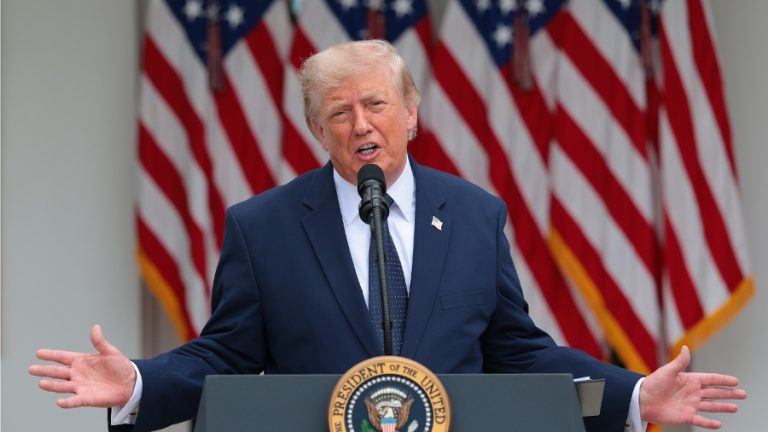
U.S. President Donald Trump announced Saturday, Feb. 21 that he is raising the global tariff rate on goods entering the United States from 10 percent to 15 percent, effective immediately. The move came one day after the U.S. Supreme Court largely overturned his broad tariff measures.
Trump posted on his Truth Social platform that after conducting a comprehensive review of the Court’s “extremely anti-American ruling” on Friday, his administration decided to raise import tariffs to a “fully authorized and legally tested level of 15%.”
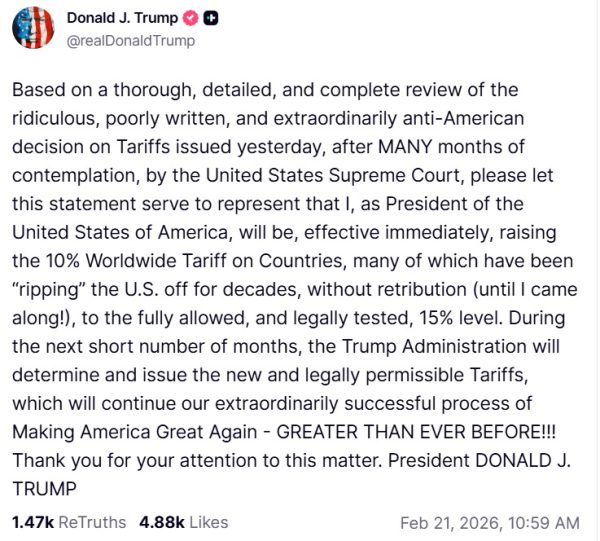
He criticized many countries for having “exploited” the United States for decades without facing consequences before he took office.
“In the coming months,” Trump said, “the Trump Administration will draft and announce new, legally compliant tariff measures to continue advancing our highly successful ‘Make America Great Again’ agenda — greater than ever before!!!”
On Friday, the U.S. Supreme Court ruled 6–3 that the Trump administration lacked proper justification for implementing sweeping tariffs under the International Emergency Economic Powers Act (IEEPA).
Success
You are now signed up for our newsletter
Success
Check your email to complete sign up
Following the ruling, the president announced a 10 percent tariff on goods imported into the United States from around the world. His executive order cited Section 122 of the Trade Act of 1974, which allows tariffs of up to 15 percent for a maximum of 150 days to address “large and serious” trade deficits.
The new tariffs will take effect on Feb. 24. The order excludes several categories of goods, including agricultural products, pharmaceuticals, electronics, and certain critical minerals and metals. Goods from Canada and Mexico are also exempt from the latest tariff increase due to a trade agreement brokered during Trump’s first administration in 2020.
Trump called the ruling “deeply disappointing” and said he felt “ashamed” of certain members of the Court. He added that he would seek “alternative measures” beyond emergency tariff powers.

Tariff refunds
The Supreme Court’s decision left several unresolved questions: Will the government refund the money already collected? And if so, to whom?
According to Fox News, trade experts estimate that the Trump tariffs generated about $133 billion in revenue, and companies have already begun lining up to seek refunds.
Trade attorneys say importers seeking reimbursement are likely to face a lengthy and complex process. Lawyers at the firm Clark Hill noted that the process could involve U.S. Customs and Border Protection, the Court of International Trade in New York, and other lower courts.
U.S. Customs does have mechanisms for issuing refunds when duties are improperly collected, and courts have ordered refunds in trade cases before. However, there has never been a situation involving thousands of importers and tens of billions of dollars simultaneously.
The refund process has yet to be determined, and it remains unclear whether importers must sue the federal government to recover the funds. Trump said Friday, “I guess we’ll be litigating for the next two years.”
If refunds are implemented, TD Securities estimates the repayment process could take 12 to 18 months.
A January report by the Kiel Institute for the World Economy found that the costs of the Trump tariffs were largely borne by U.S. importers and consumers.
However, consumers are unlikely to receive refunds; reimbursements would more likely go to the companies that paid the import duties.
By Gao Yun