On Feb. 20, just days before the National People’s Congress—the CCP’s rubber-stamp legislature—was set to review “representative qualifications and personnel appointments,” a lengthy article appeared on overseas platforms claiming to reveal the inside story of Zhang Youxia’s arrest. For months, Zhang, vice chairman of the Central Military Commission, China’s top military command body, has been involved in a power struggle with CCP general secretary Xi Jinping.
The anonymous author described himself as “a pro-American figure within the CCP’s decision-making apparatus,” someone who “passed through facial-recognition security at the west gate of Zhongnanhai,” the walled compound in central Beijing where China’s top leaders work, “and waited for the elevator in the hallway outside the Politburo meeting room.” He promised to recount “the entire process of Zhang Youxia’s downfall, from start to finish, without omitting a single word.”
The problem is that his account contained far too many words, and far too many conveniently placed details.

The story read like a screenplay, down to facial expressions and handcuff clicks
The article’s self-described goal of leaving out “not a single word” turned out to be an understatement. It presented complete dialogue, physical descriptions, and moment-by-moment action sequences for events that only a handful of people could have witnessed.
The most dramatic passage described how Zhang was intercepted and handcuffed:
Success
You are now signed up for our newsletter
Success
Check your email to complete sign up
“At 5 p.m. on Jan. 19, Zhang Youxia’s black Audi A8L departed his residence in the Xishan military compound en route to the Central Party School, a CCP cadre training facility in Beijing. He was to attend a study session for senior provincial and military officials the following day, where Xi would also be present. This was the optimal arrest window: outside the military restricted zone, with relatively light security, and only four bodyguards at his side.
“The convoy was traveling on the Beijing-Tibet Expressway, roughly three kilometers before the Changping Xiguan roundabout, when three unmarked black SUVs pulled up from behind and forced the vehicles to stop. The lead SUV flashed red and blue lights, signaling the convoy to pull over. The driver braked. Zhang frowned: ‘Who has the nerve?’ The moment his car door opened, a squad of fully armed special operatives surrounded it. The lead officer flashed credentials: ‘Vice Chairman Zhang, Xi Jinping has summoned you urgently. Please step out of the vehicle immediately.’ Zhang went pale: ‘Summoned? Why wasn’t I notified in advance?’ The officer said nothing and moved to grab his arms. Two operatives forcibly dragged him from the back seat. Handcuffs clicked shut. Zhang struggled: ‘What are you doing? I, Zhang Youxia, have been absolutely loyal to the Party!’ The officer replied coldly: ‘Save it for inside.’ He was shoved into a van in the middle of the convoy and disappeared into the night.”
The passage captured Zhang’s frown, his pallor, his exact words, and the sound of the handcuffs. Yet it conspicuously omitted one detail: what happened to his four bodyguards. Did they resist? Comply? Vanish? The story left a telling blank.
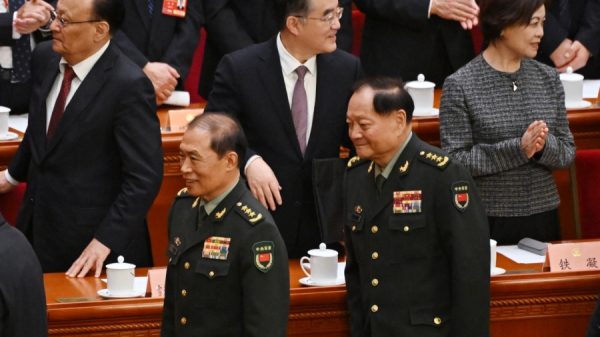
The account included equally implausible details about Zhang’s son’s arrest
The article then described the simultaneous raid on Zhang’s Xishan residence with the same novelistic precision:
“At the same time, a second team stormed the Xishan compound. At 1:12 a.m., special police breached the door and tore through the study, bedroom, and basement. They pried open the safe and removed computer hard drives. Zhang’s son was in the second-floor study reviewing documents when he was handcuffed and taken away. His wife screamed from the living room: ‘On what authority are you arresting people!’ As the son was loaded into a vehicle, he shouted: ‘Where’s my father? Where is he?’ No one answered.”
The author wrote as though he had been standing in the room.
The article then shifted to Xi Jinping’s reaction, again with impossibly specific detail: “After the arrest was complete, Xi watched the recording three times at Zhongnanhai and said: ‘Clean and efficient.'”
If this anonymous source is telling the truth, and if he is a real whistleblower, his knowledge of Xi Jinping’s private actions poses a threat comparable to the insider who helped the United States capture Venezuelan leader Nicolás Maduro and his wife. This person claimed to know exactly how many times Xi watched the footage and precisely what he said.
The article had earlier noted that during the arrests of Zhang Youxia and Liu Zhenli, the former chief of the Joint Staff Department of China’s military, Xi “sat in the command room at Zhongnanhai, watching the operation on a live screen.” Once again, the author placed himself in the room as an eyewitness.
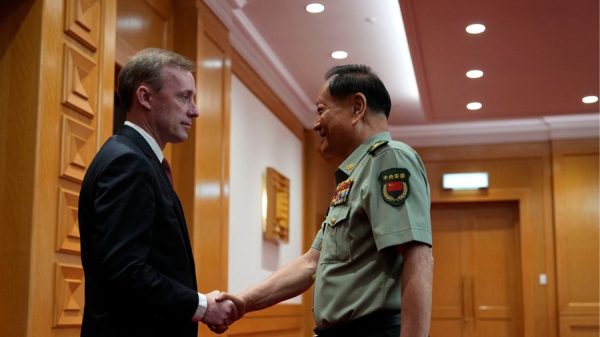
The fake insider account laid out three charges against China’s vice military chief while pretending to criticize Xi
Beneath the thriller-style narrative, the article methodically laid out three accusations against Zhang Youxia, each designed to destroy his reputation among different audiences.
Regarding the nuclear espionage charge, the article claimed that on Jan. 8, 2026, Gu Jun—the head of China National Nuclear Corporation, a state-owned enterprise overseeing the country’s entire civilian and military nuclear infrastructure—was taken from his home by operatives of the Central Commission for Discipline Inspection, the Party body Xi Jinping has reportedly used to target political rivals under the guise of “anti-corruption” enforcement.
According to the account, Gu held access to the entire nuclear weapons chain, from uranium enrichment to warhead miniaturization to missile reentry guidance. The article claimed that on his third day in custody, Gu broke under interrogation and implicated Zhang, saying he had passed nuclear missile parameters to the Americans through intermediaries, including maneuvering algorithms for the Dongfeng-41’s reentry warheads and trigger sequences for miniaturized fusion devices. The article then quoted Xi slamming his hand on the table and shouting: “This is treason!”
The key phrase in the account was that Gu “confessed to everything.” In the CCP’s extralegal detention system, where suspects are held incommunicado with no legal counsel and subjected to physical and psychological torture, “confessions” are manufactured to order. Everything that followed was designed to be accepted as fact by readers swept along by the narrative.
The insubordination charge. The article alleged that beginning in the fall of 2025, Xi began hearing reports that Zhang had privately said “the military cannot be used as a gambling chip,” “Taiwan cannot be taken by a quick strike,” and “if the U.S. military actually intervenes, the consequences would be catastrophic.” It described a circle of like-minded officers forming around Zhang, including Liu Zhenli and former associates of He Weidong, the other Central Military Commission vice chairman, along with a cohort of technically oriented generals in the equipment procurement system.
These officers supposedly voiced dissent at internal military commission meetings, arguing against concentrating all resources on hypersonic weapons and aircraft carriers, and against revealing China’s nuclear capabilities.
Yet this framing struggles to account for the now-famous photograph of Zhang glaring at Xi from the audience during the Third Plenum study session in 2024. That look conveyed something far more personal than a policy disagreement. It conveyed the fury of a man who believed Xi had betrayed him.
The corruption charge. The article alleged that the military equipment procurement system was “a black hole of corruption” with trillions of yuan in annual spending skimmed at every level. It claimed Zhang took massive bribes during his tenure running the former General Armaments Department, one of the four headquarters departments that once oversaw China’s military before Xi restructured them in 2016.
It further alleged that Zhang personally helped Li Shangfu, the former defense minister who was purged in 2023, rise from deputy head of the equipment department all the way to defense minister, collecting enormous “gratitude payments” along the way. The article added that Zhang laundered money through shell companies in Hong Kong and Singapore and purchased luxury properties in London and Vancouver. Internal Party estimates supposedly put the total above 10 billion yuan.

The article claimed to expose Xi Jinping’s dictatorship but spent most of its space prosecuting Zhang Youxia
Viewed as a whole, the article claimed to tell the full story of Zhang Youxia’s downfall while dedicating most of its space to establishing three criminal charges against him. The author signed off as “a person who risks death to expose Xi Jinping’s dictatorship.” A more accurate signature would have been “a person who publicizes the three charges against Zhang Youxia,” since that is what the article actually accomplished.
Online commentators recognized the maneuver. One noted that the article was plainly “Xi Jinping’s side releasing information” and that “on the surface, it criticizes Xi Jinping’s dictatorship, but its real purpose is to establish that Zhang Youxia embezzled 10 billion yuan and committed treason by leaking nuclear secrets to the Americans. The whole thing is designed to clean up Xi Jinping’s image.”
Others pointed to the technique known in Chinese political discourse as “export for domestic consumption,” in which propaganda is first planted in overseas media, then cited back inside China as independent reporting. Commentators argued that if Xi truly had total control of state media and the military, he could simply announce the charges through official channels. The decision to use this roundabout approach exposed a lack of confidence within Xi’s camp.
That lack of confidence tracks with the broader consensus among outside observers. Xi Jinping has struggled to build momentum against Zhang Youxia and Liu Zhenli, and the military establishment has responded with conspicuous indifference. The rank and file have offered little cooperation, and the top brass have watched from the sidelines.
The resort to a planted overseas insider account, complete with cinematic production values and an improbably well-informed narrator, may be the clearest signal yet of how little traction Xi has gained in his effort to purge the last powerful rival in China’s military hierarchy.
By Jian Yi