By Li Muzi, Vision Times
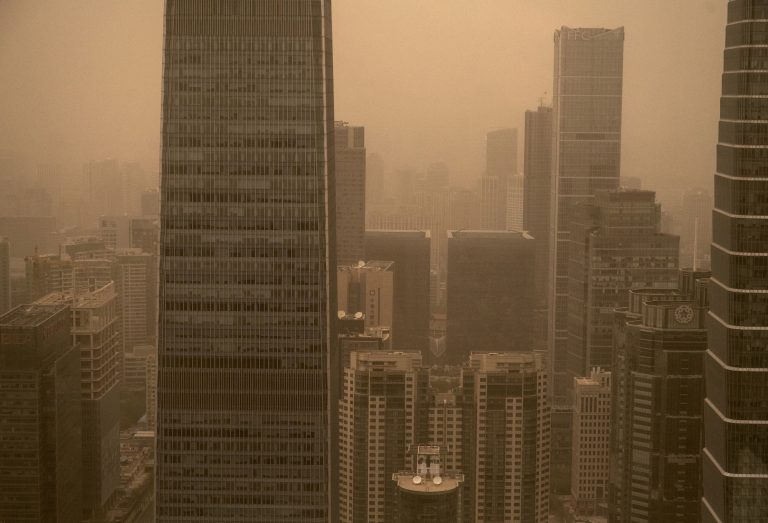
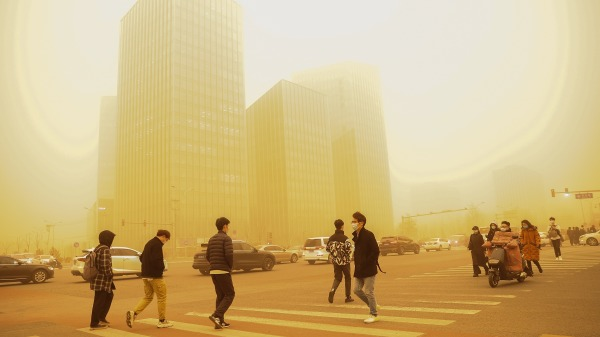
As China rung in the Lunar New Year, massive sandstorm swept across the country’s northern and eastern regions, shrouding cities in thick yellow haze and pushing pollution levels to hazardous extremes.
According to official environmental data, this was the largest and most intense sandstorm to strike the country so far in 2026, affecting more than 130 cities with severe air pollution. Some netizens described the scene as skin to “an apocalyptic landscape.”
RELATED: Deadly Winter Storm Shuts Down the United States, Triggers Mass Power Outages, and Kills at Least 18
130+ cities grappling with severe pollution
Data from the China National Environmental Monitoring Center show that from Feb. 20 to Feb. 22, the powerful sandstorm system impacted large portions of northwest China, North China, and even the Yangtze River Delta. More than 130 prefecture-level and above cities recorded short-term heavy or worse pollution driven primarily by soaring PM10 levels.
Success
You are now signed up for our newsletter
Success
Check your email to complete sign up
Meteorological analysis indicates that on Feb. 20, vast areas of northwest and northern China experienced sand and dust weather under the influence of a broad and strong low-pressure system. From daytime Feb. 20 to daytime Feb. 21, dust spread across northwest China and was transported eastward and southward by prevailing winds. By the morning of Feb. 21, the dust front moved from northern Shaanxi into northwestern Hebei, later passing through Beijing and Tianjin before reaching northeastern Hebei.
At noon on Feb. 21, a reporter traveling through Yangquan in Shanxi Province recorded PM10 levels reaching 402 micrograms per cubic meter. Broken branches and debris littered highways under intense winds, the sky turned pale yellow, and residents reported noticeable nasal discomfort when breathing outdoors. Videos circulating online showed Hebei’s Fulong Ski Resort transformed by the storm, with once-white slopes turning yellow-brown, resembling sandy terrain.
As of 4 p.m. on Feb. 22, official monitoring data showed PM10 concentrations exceeding 250 micrograms per cubic meter in major cities including Shanghai, Suzhou, Wuxi, Nanjing, Hefei, and Huainan.
The Central Meteorological Observatory forecast that from 8 p.m. Feb. 22 to 8 p.m. Feb. 23, parts of Xinjiang, Gansu, Ningxia, Shaanxi, Shanxi, Hebei, Shandong, Henan, Hubei, Jiangxi, Anhui, Jiangsu, Shanghai, Zhejiang, Jilin, and Liaoning would experience blowing sand or floating dust conditions due to strong winds driven by a cold air mass.
Beijing hit by gale-force winds
On Feb. 21, the fifth day of the Lunar New Year, the storm intensified across northern China. According to state media outlet CNR, Beijing experienced strong winds accompanied by sand and dust in the afternoon. Gusts exceeded force 10 in mountainous areas of Yanqing, Fangshan, Mentougou, Changping, and Haidian, with peak wind speeds reaching force 14. Urban areas recorded maximum gusts of force 9. Visibility in western districts dropped to around 2 kilometers.
The Beijing Youth Daily reported that by mid-afternoon, western Beijing skies turned a murky yellow. Observers noted the unusual appearance of a faintly blue-tinted sun, an optical phenomenon sometimes caused by specific atmospheric particle conditions. The capital was placed under a yellow alert for strong winds and a blue alert for sandstorms. By 5 p.m., Beijing’s real-time Air Quality Index (AQI) had reached 500, the maximum reading on the scale, classified as “severe pollution.”
‘The end of the world’
Videos circulating on social media showed fierce winds whipping through streets in the Beijing–Tianjin–Hebei region, with near-zero visibility in some areas. Drivers were heard exclaiming, “I can’t see anything.” In Weihai, Shandong Province, strong winds reportedly contributed to mountain fires.
Online reactions reflected a mix of alarm and symbolism. One user wrote, “The fifth day of the Lunar New Year is when we welcome the God of Wealth. Instead of fortune, we got sand and dust. Does that mean we’ll be ‘eating dirt’ this year?” Another commented, “During the Spring Festival, northern China saw strong winds, sandstorms, and unusually high winter temperatures. The year begins with extraordinary weather. Natural disasters feel like a warning from heaven.”
While meteorological authorities attribute the event to seasonal climatic patterns combined with strong low-pressure systems and cold air activity, the scale and intensity of the storm, impacting regions from the northwest to the Yangtze River Delta, have renewed public concern over environmental vulnerability and air quality management.
As the dust gradually settles, questions remain over whether such extreme events will become more frequent in the years ahead, and how China’s densely populated urban centers will adapt to mounting environmental pressures.