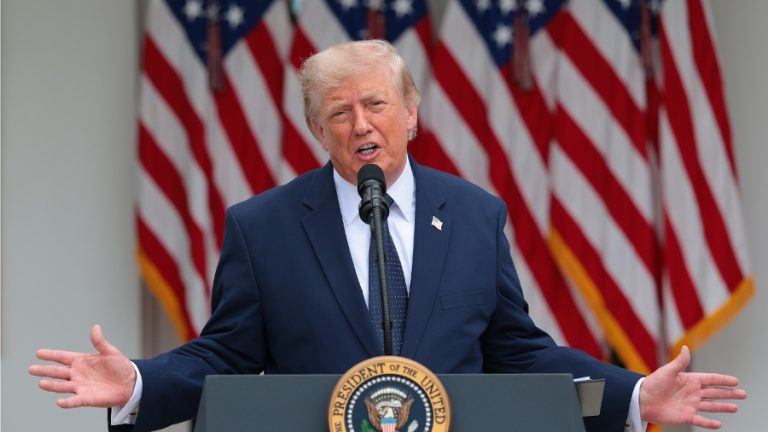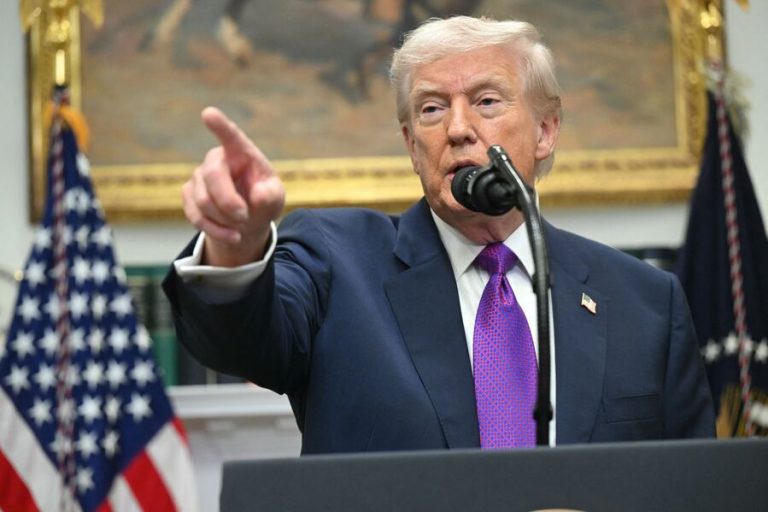
U.S. President Donald Trump on Monday, Feb. 23 warned other countries not to backtrack on trade agreements recently made with the United States after the Supreme Court overturned his emergency tariff measures, saying that otherwise he would impose higher tariffs on those countries under other trade laws.
Trump said in a series of social media posts that, amid pressure on the global economy and falling stock markets due to uncertainty over his next tariff moves, he might also impose licensing fees on trading partners.
On his Truth Social platform, Trump wrote: “Any country that wants to ‘play games’ with this absurd Supreme Court ruling, especially those that have ‘taken advantage of the U.S.’ for years or even decades, will face higher or even worse tariffs than the ones they just recently agreed to. Buyer beware!”
Trump stated that although the court ruled his tariffs under the International Emergency Economic Powers Act (IEEPA) were invalid, the decision also confirmed that he can still impose tariffs under other legal authorities, “and will do so in a stronger, more direct, and legally certain manner, rather than the way originally used.”
He also hinted that the U.S. might impose new licensing fees on trade partners, but did not provide specific details.

Success
You are now signed up for our newsletter
Success
Check your email to complete sign up
European Parliament delays key vote
According to Reuters, in Brussels, the European Parliament on Monday decided to postpone a vote on the trade agreement between the EU and the U.S. This followed Trump’s announcement of a new temporary 15 percent tariff on imports from all countries.
Under the agreement, EU goods in the U.S. would face a 15 percent tariff, but hundreds of food items, airplane parts, key minerals, pharmaceutical raw materials, and other goods would be exempt. Meanwhile, the EU would remove tariffs on various U.S. imports, including industrial products.
NBC News reported that Bernd Lange, chair of the European Parliament’s trade committee, said: “No one knows what will happen next… it’s also unclear whether additional measures will be introduced, or how the U.S. will truly uphold its commitments under the agreement.”
Additionally, multiple media outlets reported that India’s trade negotiators canceled a planned trip to Washington to discuss a pending trade agreement. India’s Ministry of Commerce did not respond to requests for comment.
Last Friday, Trump announced temporary tariffs at 10 percent under Section 122 of the Trade Act of 1974, and on Saturday increased the rate to the maximum allowed under that law, 15 percent.
The new tariffs will take effect at 12:01 a.m. Eastern Time on Tuesday. At the same time, the U.S. Customs and Border Protection said it would stop collecting the IEEPA tariffs ruled unlawful, more than three days after the Supreme Court’s decision.
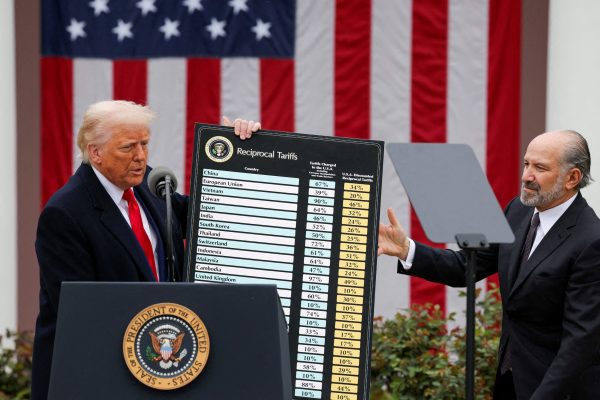
US Trade representative: tariff defeat doesn’t affect existing agreements
U.S. Trade Representative Jamieson Greer said Monday that despite the Supreme Court overturning several presidential tariffs, agreements with the EU, China, and other trade partners remain valid, and no country has indicated plans to renege.
In an interview with CBS’s political program Face the Nation, Greer noted: “We expect our partners to comply with the agreements. So far, no one has come to me saying ‘the agreement is void.’ They are just waiting to see how things unfold.”
He further explained that countries that reached agreements with the U.S. before the Supreme Court ruling did not negotiate based on the court’s decision. “Whether we win or lose in court, we had always intended to maintain the tariff measures.”
“Therefore, even if the Supreme Court overturned tariffs under a certain legal authority, tariffs imposed for national security reasons remain valid,” Greer said. “Also, under what we call Section 301, tariffs on unfair trade practices remain in effect.”
By Gao Yun