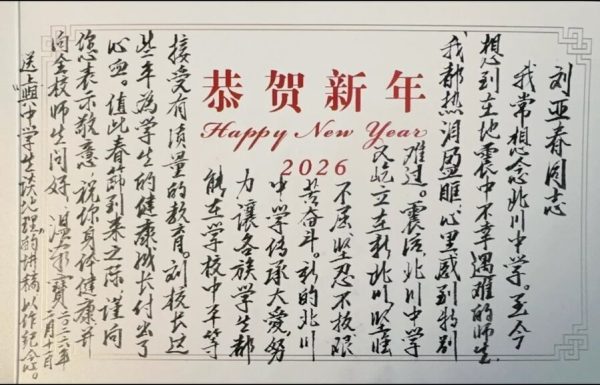
On Feb. 17, the X account “Followers of Premier Wen” posted a handwritten “2026 Happy New Year” card attributed to former Chinese Premier Wen Jiabao. The image quickly circulated online.
Written vertically in black ink in traditional Chinese format, the card refers to teachers and students who died in the 2008 Wenchuan earthquake. “To this day, whenever I think of the teachers and students who tragically lost their lives in the earthquake, my eyes fill with tears, and I feel especially heartbroken,” the text reads.
The card is signed “Wen Jiabao, February 11, 2026,” and addressed to Liu Yachun, principal of Beichuan Middle School.
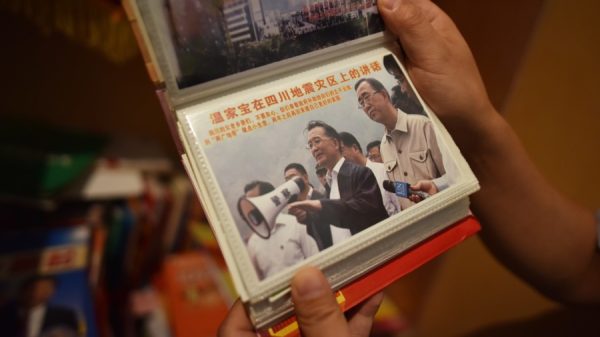
Public records show that Liu has served as principal since the time of the earthquake. During post-disaster reconstruction, Wen visited the school several times, leaving inscriptions and written messages. Wen served as Premier of the State Council from 2003 to 2013. The Wenchuan earthquake was the deadliest natural disaster during his tenure.
The renewed circulation of the card has prompted discussion not only of Wen’s personal connection to Beichuan, but also of the political and administrative decisions made before the earthquake struck.
Success
You are now signed up for our newsletter
Success
Check your email to complete sign up
A compressed timeline
At 14:28 on May 12, 2008, a magnitude 8.0 earthquake struck Wenchuan County in Sichuan Province.
At 16:40, Wen’s special aircraft departed Beijing’s Western Suburb Airport.
At 19:10, the plane landed at Chengdu Taiping Temple Airport.
At 21:42, Wen arrived in Dujiangyan to direct on-site rescue efforts. Around 10 p.m., he told relief personnel: “After learning the news, I rushed here at the first moment. Human life is of paramount importance. My feelings are as sorrowful as everyone’s.”
From the moment of impact to takeoff, 2 hours and 12 minutes elapsed.
During that window, earthquake reports moved through county, prefectural, provincial, and national channels to the State Council. A high-level meeting was convened in Zhongnanhai. Wen and his delegation prepared for departure. The Central Guard Bureau escorted the convoy to the airport, roughly a 30-minute drive. Boarding and takeoff procedures were completed.
Forecasts before May 12
Debate over the handling of earthquake forecasts has persisted for years.
In July 2007, Zhou Rongjun, a senior engineer at the Sichuan Earthquake Administration, and five foreign geophysicists published a paper in the journal Tectonics titled “Active Block Movement of the Beichuan and Pengguan Faults on the Eastern Margin of the Tibetan Plateau.” The study noted that tectonic energy was accumulating in Wenchuan County and that certain nearby faults posed a potential risk of severe earthquake disasters.
In March and April 2008, unusual landslides were reported in Weizhou, Yingxiu, and Mianchi towns in Wenchuan County.
On April 18, 2008, the Wen County Earthquake Administration in Gansu Province reportedly submitted a short-term prediction to the national authority, stating that between April 18 and May 20 a magnitude 6.8 to 7.2 earthquake could occur at 101°E, 35.7°N. Wenchuan County lies at approximately 103°E, 32°N.
On April 30, researchers including Geng Qingguo and Chen Yiwen sent a confidential letter to the National Earthquake Administration predicting a magnitude 7 or above quake in the Aba region within six months, with a risk window centered on May 8, plus or minus ten days.
Materials attributed to Geng state that in November 2006 he wrote to Chen Jianmin, then director of the National Earthquake Administration, predicting a magnitude 7.3 earthquake based on earlier drought conditions near Maerkang. In January 2008, he wrote to Premier Wen Jiabao predicting a magnitude 7.7 quake in Sichuan. Accounts cited in various publications state that the documents were received by officials within the earthquake system.
On May 10, 2008, local media reported a large migration of toads in Mianzhu.
A Baidu Encyclopedia entry states that in early April the Sichuan Earthquake Administration received reports of tremors and abnormal phenomena and conducted internal research. On April 14, Director Wu Yaoqiang reportedly informed provincial leaders that signs pointed to the possibility of a magnitude 5 or greater earthquake in the near future. The matter was reported to Chen Jianmin on April 15.
According to the same account, Chen, who was overseas at the time, asked whether experts were completely certain. It alleges that he stated that without full certainty, no public announcement should be made in order to avoid affecting the Olympic torch relay and social stability. The entry further claims that several provincial officials and experts left Sichuan on overseas trips around April 20 and did not return until after the earthquake.
Other commentaries allege that Chen sought instructions from higher authorities and was told not to publicize predictions during the Olympic period.
The July 2008 issue of Open Magazine cited an unnamed senior insider who claimed that the Politburo discussed whether to issue a warning before the earthquake. According to that report, eight of nine members voted against making a public announcement, with only Wen Jiabao supporting disclosure, citing concerns about the Olympic torch relay and social stability.
An article by Liang Mu titled “Exposing the Black Curtain of the Wenchuan Earthquake Prediction Not Reported” concluded that experts had submitted forecasts but that they were not publicly released.
The official toll
According to China Central Television, at 14:28:04 on May 12, 2008, a magnitude 8.0 earthquake struck Wenchuan County. Official figures list 69,227 dead, 374,643 injured, 17,923 missing, and direct economic losses of 845.2 billion RMB, (approximately USD 118 billion at current exchange rates).
The earthquake remains one of the most destructive disasters in modern Chinese history.
Political context
Some analyses have linked the handling of earthquake forecasts to internal political dynamics at the time, including reported tensions between then–Party chief Hu Jintao and former leader Jiang Zemin, who was widely viewed as retaining influence after stepping down. These accounts argue that concerns about the Olympic torch relay and the country’s international image shaped decision-making.
Within that narrative, Wen Jiabao is described as favoring disclosure but lacking the authority to reverse the final decision.
U.S.-based commentator Cai Shenkun reposted the 2026 greeting card and wrote that Wen is among the few state-level leaders since the 1980s whom he considers worthy of remembrance.
Wen’s handwritten card, recalling the victims of Beichuan Middle School eighteen years later, has brought renewed attention to longstanding allegations about pre-earthquake forecasts and to the debate over how those warnings were handled.
By Dan Fengchen
Editor’s Note: This article is based on publicly available reports, academic publications, online materials, magazine accounts, and commentary sources. Allegations regarding internal deliberations and decision-making before the 2008 Wenchuan earthquake have not been independently verified and are presented as claims attributed to the cited sources.