By Li Deyan, Vision Times
On Feb. 18, netizens on Chinese social media noticed something unusual. A handwritten 2026 Lunar New Year greeting card from former Chinese Premier Wen Jiabao addressed to Liu Yachun, the principal of Beichuan Middle School, began surfacing online. The Beichuan school was devastated in the 2008 Sichuan earthquake that claimed over 87,000 lives.
Some analysts suggest the timing and symbolism of the card’s release may represent a subtle message from party elders amid ongoing tensions within China’s top leadership.
Coincidentally, on the same day, state mouthpiece “Xinhua News” prominently published a headline that embedded the name “Chunhua,” widely interpreted as a reference to former Vice Premier Hu Chunhua, fueling speculation about internal political maneuvering.
RELATED: Xi Jinping’s First Political Purge Began With a Warning to His Predecessors
Suspect timing
Success
You are now signed up for our newsletter
Success
Check your email to complete sign up
On Feb. 17, a social media user identifying as “Follower of Premier Wen” posted an image of Wen’s handwritten card dated Feb. 11, 2026. The card wished a “Happy New Year 2026” and referenced the teachers and students who perished in the Wenchuan earthquake, noting that “even now, recalling them brings tears to my eyes.” It concluded with a line: “Enclosing my lecture notes from speaking with middle school students about geography as a keepsake.”
Commentator Tang Jingyuan observed that the card’s public appearance several days after it was written, and shortly after the official Lunar New Year celebrations, was noteworthy.
On Feb. 14, the Chinese Communist Party (CCP) held its annual Spring Festival reception at the Great Hall of the People in Beijing. As in recent years, retired senior leaders did not attend, while Party leader Xi Jinping appeared prominently in public engagements. Yet two days later, Wen appeared, indirectly, through the circulation of this greeting card.
RELATED: Xi Jinping’s Pre-Holiday Outreach Highlights Beijing’s Push for a ‘United Front’
Feb. 18 also marked 18 years since the May 12, 2008 Wenchuan earthquake. In Chinese numerology, the number “18” can sound like “prosperity.” Moreover, 2026 marks Wen’s zodiac year of the Horse, while 2025 was Xi’s zodiac year of the Snake. Whether coincidence or deliberate symbolism, analysts note that the convergence of dates has fueled speculation.
Beichuan as a political symbol?
Wen’s connection to Beichuan Middle School is deeply personal. Following the 2008 earthquake, he visited the site nearly ten times and famously wrote on a classroom blackboard the phrase “Through hardship, the nation is strengthened.”
Tang argues that Beichuan has become a symbolic extension of Wen’s political identity. By publicly recalling the earthquake and emphasizing resilience, particularly during a period some describe as political “aftershocks” within Zhongnanhai, Wen may be invoking a metaphor: Just as Beichuan endured devastation yet stood firm, so too have certain political figures weathered internal upheaval.
The line, “Enclosing my lecture notes from speaking with middle school students about geography as a keepsake,” also carries layered meaning. Wen delivered geography lectures to students in Hebei in 2014–2015, shortly after Xi came to power. Tang interprets the phrase as signaling the transmission of intellectual and political legacy.
According to Tang, the gesture suggests that “this political earthquake alone will not topple us. We still have the ability to pass on our ideas and path.” While such interpretations remain speculative, the symbolism has drawn attention among observers of elite politics.
Reading between the lines
On the same day Wen’s card circulated, Xinhua News published a front-page political article titled “New Year Grassroots Visits: Centennial Chunhua, Youth Rising Upward.” The report focused on young entrepreneurs in Shanghai’s high-tech sector.
Tang notes that the inclusion of “Chunhua” in the headline appears deliberate. Hu Chunhua, a former vice premier associated with the Communist Youth League faction, shares the same given name. The phrase “youth rising upward” also echoes Hu’s past political positioning through youth-related work.
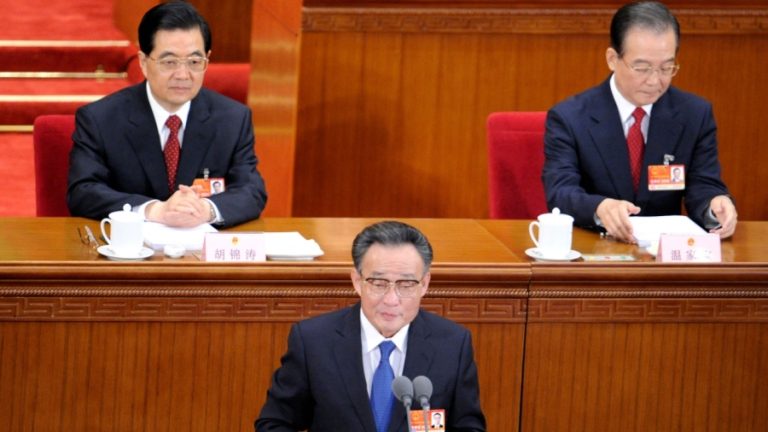
Tang argues that the parallel timing—Wen’s symbolic reappearance and a headline embedding “Chunhua”—could represent a coordinated signal from two generations of political figures, including former President Hu Jintao, Wen Jiabao, and Hu Chunhua.
Broader political context
Tang further claims that factional tensions within the CCP intensified following a 2025 Party plenum, warning that unresolved disputes could trigger instability. In early 2026, reports circulated of high-level investigations involving senior military officials, adding to perceptions of turbulence at the top.
He contends that internal balance between Xi-aligned and opposing factions remains fragile. If that equilibrium were disrupted, confrontation could follow.
Whether these interpretations accurately reflect internal dynamics remains difficult to verify. What is clear, however, is that symbolic gestures, such as handwritten notes, headline phrasing, public appearances, continue to carry outsized significance in China’s opaque political system.
As 2026 unfolds, observers will be watching closely for further signals, subtle or otherwise, from both current and former power centers within the CCP.
Editorial note: Views expressed in this article are the opinions of the author and do not necessarily reflect the views of Vision Times.