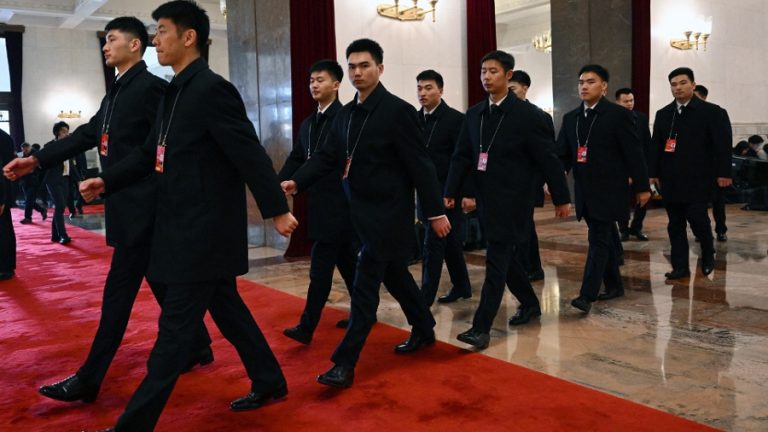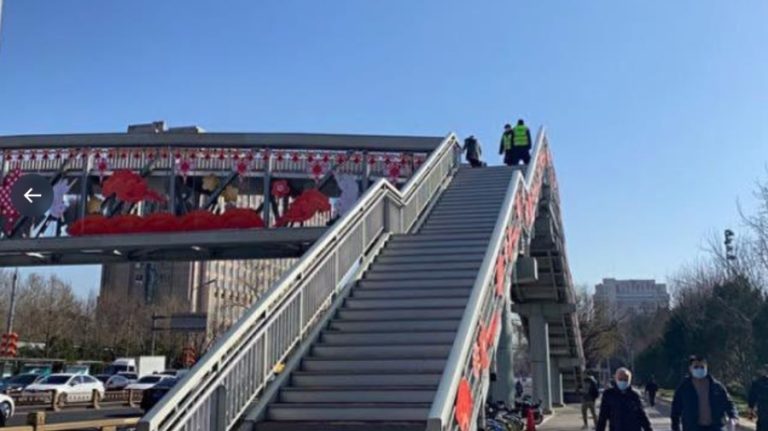
Beijing locked down under an extraordinary security blanket this week as the Chinese Communist Party convened its annual “Two Sessions” legislative meetings, with one of the most visible measures being the return of uniformed “bridge watchers” stationed on every pedestrian overpass across the city. The guards, deployed in pairs around the clock, have the authority to stop any passerby, demand identification, inspect mobile phones, and search bags. Their presence is a direct legacy of the Sitong Bridge protest of October 2022, when a lone demonstrator hung banners calling for the removal of CCP general secretary Xi Jinping just days before the 20th Party Congress.
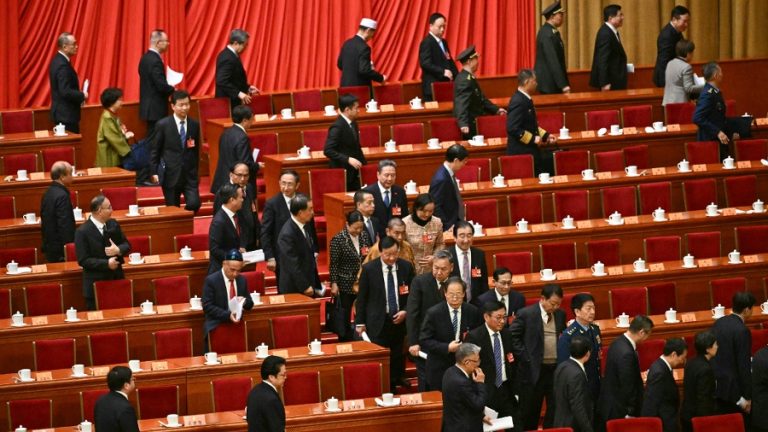
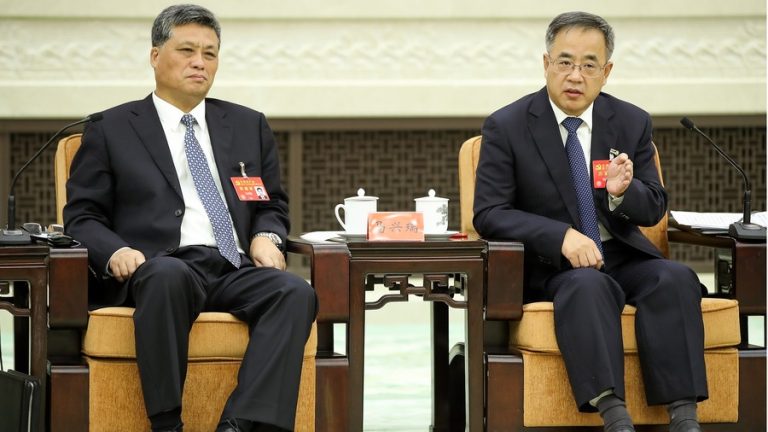
The CCP’s two main political bodies, the Chinese People’s Political Consultative Conference (CPPCC), a Party-controlled advisory body with no legislative power, and the National People’s Congress (NPC), a rubber-stamp legislature that exists to ratify decisions already made by the CCP leadership, opened their annual sessions on March 4 and March 5 respectively. The CPPCC sessions run through March 11; the NPC through March 12.
Hong Kong’s RTHK reported that security in central Beijing had been visibly tightened in the days before the meetings. Multiple police vehicles were parked along Wangfujing Street, the capital’s main commercial thoroughfare, with security personnel carrying shields on patrol and standing guard at fixed positions. Along Chang’an Avenue, the boulevard that runs past Tiananmen Square and the Great Hall of the People, authorities erected checkpoints with tents where they inspected identification documents and personal belongings of residents and tourists. Armed police patrols were visible throughout the area.
Central News Agency reporters who visited Beijing found hotels and restaurants displaying notices from the Beijing Public Security Bureau announcing enhanced airspace restrictions for the duration of the meetings. The order prohibited all unauthorized drone flights and banned the release of balloons, kites, or any other objects that could affect flight safety across all of Beijing’s administrative territory from midnight on March 1 through midnight on March 12.

The ‘Bridge Watchers’ returned to every overpass in the capital
The most striking security deployment, and the one that drew the most public attention, was the reappearance of the “bridge watchers” on Beijing’s pedestrian overpasses. Ren Min Bao reported that the uniformed guards were stationed in pairs on each bridge, maintaining a vigilant watch over every person who crossed. They had the power to stop pedestrians at will, check identity cards and mobile phones, and order people to open their bags for inspection. Whether these practices had any legal basis was a question no one in Beijing dared to raise.
Success
You are now signed up for our newsletter
Success
Check your email to complete sign up
Recruitment videos circulating on Douyin (China’s TikTok) offered a window into the program. A September 2025 posting advertised bridge watcher positions in Beijing’s Dongcheng district: two people per shift, reporting at 8 a.m., two meals provided, a tent and folding stool for overnight duty, permitted to sleep after 11 p.m., 24-hour shifts, 300 yuan per day (roughly $41), applicants must be between 18 and 52 years old with no criminal record. The posting noted that large numbers of watchers were needed.
A viral video shared in recent days showed that every single overpass in Beijing had soldiers stationed in pairs. Beijing residents responded with dark humor online. “We pay taxes so the government can hire people to babysit bridges. What an achievement,” one wrote. “Protecting His Majesty,” another quipped. “Khamenei is dead, so now they’re even more afraid,” a third observed. “Startled by every sound, seeing enemies in every shadow.”

The Bridge Watchers exist because of one man’s act of defiance in 2022
The bridge watcher program traces directly to October 13, 2022, when a Chinese citizen named Peng Lifa (online name Peng Zaizhou) staged a solitary protest on Beijing’s Sitong Bridge, a pedestrian overpass in the Haidian district, just days before the CCP’s 20th Party Congress.
Disguised as a construction worker, Peng hung two large banners from the bridge. The first read: “We don’t want PCR tests, we want food. We don’t want lockdowns, we want freedom. We don’t want lies, we want dignity. We don’t want the Cultural Revolution, we want reform. We don’t want a supreme leader, we want ballots. Don’t be slaves, be citizens.” The second read: “Go on strike from school and work. Remove the dictatorial traitor Xi Jinping.”
Peng set fire to materials on the bridge to create smoke that would attract the attention of motorists and pedestrians below, and used a loudspeaker to broadcast his demands. He was quickly detained by police. His act of defiance, captured on camera and shared globally, became one of the most iconic moments of political protest in Xi Jinping’s China.
Sitong Bridge instantly became a pilgrimage site. Authorities responded by removing the bridge’s name plaque, apparently fearing that petitioners and dissidents from outside Beijing would seek out the location. The regime then deployed bridge watchers on overpasses across the capital. The practice subsequently spread to cities throughout China, creating an entirely new category of security employment: professional overpass surveillance.

The security apparatus reveals a regime that fears its own people
Reactions on the overseas platform X (formerly Twitter) captured the political significance of the spectacle. “The dynasty is already on shaky ground. Keep burning through resources like this, and when the money and grain run out, dawn will break,” one user wrote. “That’s to prevent another Sitong Bridge hero. Safety is just an excuse.” Another observed: “The Sitong Bridge incident was caused by the Communist Party itself. They squeeze every drop of blood from the people, then spend that money on suppression. It’s beyond shameful.”
“Beijing’s main train station has already implemented double security screening, a friend told me,” one commenter reported. Others noted the economic absurdity: “So this is where the farmers’ welfare money goes, into the stability maintenance budget.” “Beijing’s pedestrian overpass ‘bridge watchers’ are another great Chinese innovation with CCP characteristics: they solve the unemployment problem and prevent incidents at the same time.”
The most cutting commentary went to the heart of the matter: “When power is obtained illegitimately, you spend every day terrified that someone will take it from you.”