Freedom House’s China Dissent Monitor recorded 1,392 protest incidents in the third quarter of 2025 alone, driven by laid-off workers, defrauded investors, and farmers whose land was seized by cash-strapped local governments. Rural unrest rose 70 percent. At the lowest levels of the CCP’s bureaucracy, the fiscal resources to pay police and fund stability operations are running out.
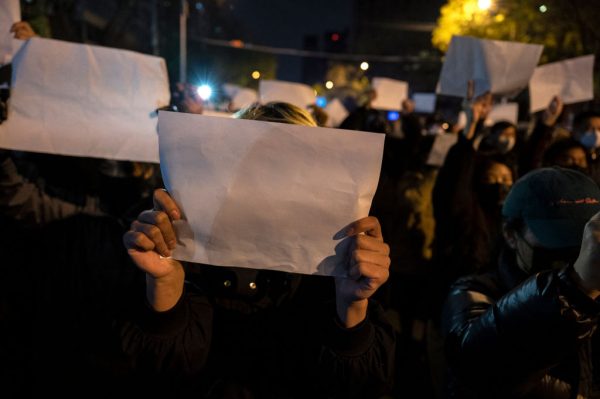
The latest data from China Dissent Monitor, a project operated by Freedom House, shows that 1,392 protest events took place across China during the third quarter of 2025, representing an increase of approximately 50 percent compared with the same period in 2024. The protesters were overwhelmingly workers, owners of small businesses, and residents of villages and small towns. By late 2025, collective protests by food delivery drivers had become particularly frequent.
Rising youth unemployment has forced large numbers of young workers into the gig economy, particularly as food delivery riders. The number of delivery workers in China has exceeded 14 million, creating fierce competition within the sector. This enormous workforce lacks labor protections and faces constant pressure from platform algorithms, property security guards who restrict building access, and traffic enforcement. The combination makes delivery workers highly susceptible to collective action: a single confrontation can quickly escalate into a large-scale protest. Multiple collective delivery worker protests erupted in December 2025 alone.
Rural protests increased 70 percent as farmers lost their last safety net
The China Dissent Monitor report also documented a sharp increase in rural unrest. As China’s economy continues to slow, large numbers of migrant workers have been returning to their home villages after losing urban jobs. Many have discovered that the farmland they once relied on has been expropriated or transferred, meaning the countryside can no longer function as a buffer for workers displaced by the urban economy. Migrant workers have lost their last fallback.
Through the end of November 2025, the monitor recorded 661 rural protest incidents, roughly 70 percent more than in all of 2024. Local governments facing severe fiscal crises have responded by intensifying land seizures, imposing funeral reform mandates, and implementing other revenue-raising measures that frequently generate conflicts with residents.
Success
You are now signed up for our newsletter
Success
Check your email to complete sign up
At the lowest levels of government, below the county tier, fiscal distress has become so acute that civil servant salaries are routinely delayed. Police and other enforcement personnel whose incomes are unreliable, combined with insufficient budgets for stability maintenance operations, have weakened the CCP’s capacity for social control at the system’s outer edges, creating more space for protests to occur.

Defrauded investors surrounded the Putian city government after an investment firm collapsed
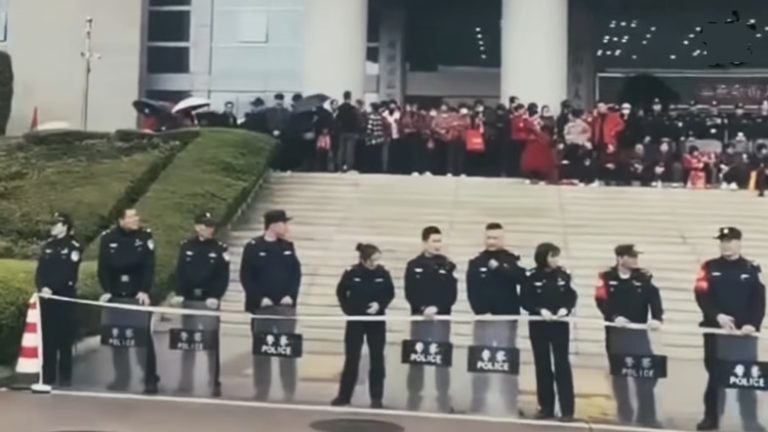
On March 2, more than a thousand investors gathered outside the Putian city government in Fujian province, demanding that the Golden Wharf Group honor its deposit obligations. The scene was tense, with authorities deploying large numbers of police.
The Golden Wharf Group had operated for years by attracting deposits at interest rates of 7.5 percent, far above bank rates, while luring customers with gifts of rice, cooking oil, and small household appliances. Many of the victims were middle-aged and elderly people who had been drawn in by the promise of high returns and the apparent legitimacy of a company that operated physical gold retail stores. Investors poured in their life savings; some committed their retirement funds, and at least one invested money set aside as a daughter’s wedding dowry.
Individual deposits ranged from hundreds of thousands to more than a million yuan. The investors expected to collect monthly interest payments and live comfortably in retirement. After the Lunar New Year, however, the promised returns stopped. Employees became unreachable. Stores across multiple locations began closing. More than 2,000 investors are believed to be affected.
On Feb. 26, the company’s chairman, Lin Guochun, issued a public letter from Singapore. It was his first acknowledgment that the company faced financial difficulties. He blamed the crisis on individual employees who had embezzled funds and conducted unauthorized transactions, causing certain accounts to be frozen. He insisted the company had not deliberately defrauded its customers and promised to return and address the situation.
On March 1, Lin posted a video claiming he had returned from Singapore to China and was willing to accept responsibility and cooperate with investigations. For the investors, the gesture meant nothing. The stores were already closed. The interest payments had already stopped. Empty promises offered no path to recovering their money.
At the March 2 protest, investors chanted for the return of their savings. Several elderly protesters collapsed from exhaustion at the scene. Police maintained a heavy presence throughout.
On March 3, videos appeared online suggesting that some Golden Wharf locations had reopened. According to multiple investors, however, the stores may have shown signs of activity, but deposits remained frozen and inaccessible.
Other protests erupted across China in the same week
The wave of protests extended well beyond Putian.
On March 5, vegetable vendors at the Jinshan Agricultural Market in Wenchang, Hainan province, staged their third consecutive day of strikes to protest rent increases. The vendors disclosed that the market had originally been collectively owned but was subsequently sold by the local government to a private operator.
Also on March 5, in Nafan village, Yacha township, Baisha county, Hainan province, villagers whose betel nut trees had been cut down by the state-run Baisha Farm retaliated by felling both their own and the farm’s betel nut trees. The dispute centered on more than 40 mu (roughly 6.5 acres) of collectively owned village land that the state farm had claimed as its own a decade earlier.
Both sides had been planting betel nut on the contested land. In previous years, the farm had cut down a dozen or so village trees annually, and the villagers had tolerated it. This year, the farm destroyed 460 trees at once, provoking the villagers into action.
On March 4, parents at the 21st Century Kindergarten in Zhuozhou, Hebei province, discovered that the school had been feeding rotten fruit and spoiled food to its 400 students to cut costs. Parents organized collectively to demand refunds.

The CCP’s control apparatus is fraying at the edges
The pattern visible across these incidents is consistent. Economic decline is generating grievances faster than the CCP’s stability maintenance system can contain them. Workers who lose their jobs have no unemployment insurance, defrauded investors have no legal recourse, and farmers whose land is seized have nowhere to appeal.
The CCP’s authoritarian system was built on a bargain: political obedience in exchange for rising living standards. With living standards in decline, the only remaining tool is repression, and the fiscal resources to fund repression are themselves shrinking.
The 50 percent year-over-year increase in protests, combined with the 70 percent surge in rural unrest, signals that the CCP’s social control mechanisms are losing ground. The regime can still deploy police to contain individual incidents. What it cannot do is address the underlying causes: an economy that is failing, a social safety net that does not exist, and a population that is running out of patience
By Cai Siyun