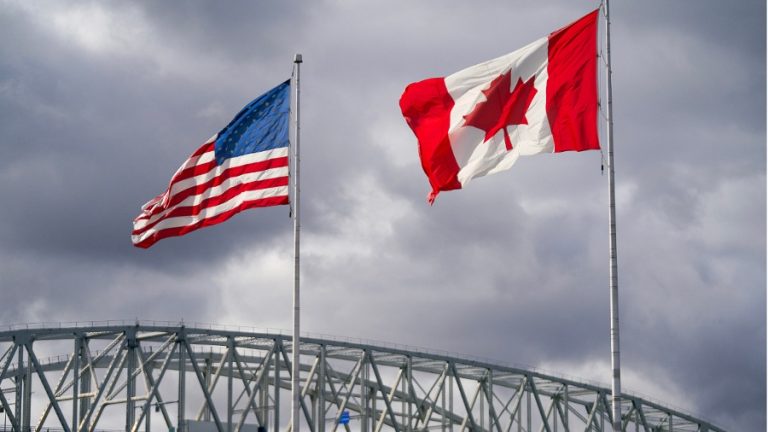
In the early hours of March 10, a drive-by shooting occurred at the U.S. Consulate in downtown Toronto, Canada. The Royal Canadian Mounted Police (RCMP) have classified it as a “national security incident.” All U.S. and Israeli diplomatic missions in Toronto and Ottawa have since heightened security measures.
Currently, Canadian federal law enforcement is working closely with the U.S. Federal Bureau of Investigation (FBI) and intelligence agencies. Toronto police are pursuing two suspects driving a white Honda CR-V, and photos of the vehicle have been released to solicit tips.
Frank Barredo, Deputy Chief of Toronto Police, confirmed that the two suspects got out of the vehicle in the early morning and fired handguns at the front of the U.S. Consulate before fleeing south. RCMP Chief Superintendent Chris Leather stated the case is classified as a national security incident, and whether it involves terrorism remains under investigation. Toronto Mayor Olivia Chow strongly condemned the violence targeting diplomatic and religious institutions (noting a recent shooting at a synagogue) as “absolutely intolerable,” and pledged to fully strengthen security measures.
According to police reports and Global News, the incident occurred around 4:30 in the morning. Deputy Chief Barredo said that although multiple bullet marks were visible on the exterior walls, doors, and windows, the building’s high-level reinforced and bulletproof construction prevented any penetration. Employees were inside at the time, but no one was injured, and it is possible they were unaware of the shooting due to the strong walls.
Success
You are now signed up for our newsletter
Success
Check your email to complete sign up
Ontario premier and public reaction: Concerns about ‘sleeper cells’ and hate crimes
Ontario Premier Doug Ford told CTV News that the attack was “absolutely unacceptable intimidation.” He candidly expressed personal concern, speculating that “sleeper cells” may exist in Canada and suggesting the violence may be linked to the current global turmoil, such as the situation in Iran.
On Tuesday, the U.S.-Iran war entered its 11th day, reaching the highest intensity since the outbreak. U.S. war official Pete Hegseth warned that today would be the “most intense day of strikes” since the start of the war. He stated that the U.S. would not cease operations against Iran until the enemy is “thoroughly and decisively defeated,” and that operations will proceed according to the U.S. timetable.
According to Global News, in the days prior to the shooting, three synagogues in the Greater Toronto Area had been targeted in shootings. Additionally, a boxing gym reportedly linked to an Iranian-Canadian critic of Tehran experienced a separate shooting incident. While police have not established a direct connection between these cases, Toronto police said they are reviewing attacks aimed at specific ethnic or diplomatic targets.
Currently, the southbound lanes of University Avenue (from Dundas Street to Queen Street) remain closed for evidence collection. Security experts note that the suspects’ choice to attack the heavily reinforced front of the building in the early morning appears to be a “political or symbolic” provocation rather than an attempt to cause mass casualties.
Police have released photos of the suspect vehicle and strongly urge any citizens with dashcam footage or related tips to contact Toronto Police or report anonymously through Crime Stoppers.
Signal alert: Possible Iranian ‘sleeper operatives’ activated
On March 9, ABC News reported that a federal alert sent to law enforcement indicated that the U.S. intercepted encrypted communications believed to originate from Iran, potentially containing “action orders” for overseas “dormant assets” (sleeper agents). The alert cited preliminary analysis suggesting the signal was “highly likely” from Iran and was routed through multiple countries shortly after a U.S.-Israeli airstrike on Feb. 28 killed Ayatollah Ali Khamenei.
ABC noted that the encrypted signal appeared intended for “secret recipients” holding the appropriate decryption keys, possibly to communicate instructions to “covert agents or sleeper assets” without using the internet or cellular networks.
This warning aligns with a U.S. Department of Homeland Security (DHS) threat assessment reviewed by Reuters, which stated that although large-scale physical attacks are unlikely, Iran and its proxies “may” pose a long-term threat of targeted attacks on U.S. soil.
Global chain reaction: Security measures expanded to US and Israeli diplomatic missions
RCMP Chief Superintendent Chris Leather said that, given the nature of the attack, all U.S. and Israeli diplomatic missions in Toronto and Ottawa have fully strengthened security measures.
Additionally, because the attack involves a U.S. diplomatic mission, the RCMP is coordinating a joint investigation with the Canadian Security Intelligence Service (CSIS) and the FBI. Although it has not yet been officially classified as “terrorism,” police have stated they are actively assessing motives and will not view this case in isolation from other recent violent incidents.
This pattern is not limited to Canada. Reuters reported that on the morning of March 8, the U.S. Embassy in Oslo, Norway, suffered a violent explosion causing minor damage but no casualties. Norwegian police indicated the attack may have been deliberate and related to the Middle East crisis. Oslo police said terrorism is currently one hypothesis while other possibilities are also being explored.
By Jin Yan