The CCP military budget will climb 7 percent in 2026, reaching approximately 1.9 trillion yuan, even as the communist regime lowered its economic growth target to the slowest pace in roughly three decades. Analysts in Taiwan, Europe, and the United States say the gap between the two figures reveals a regime that prioritizes military power over economic recovery and regime survival over public welfare.
On March 5, the CCP’s finance ministry submitted a budget proposal to the annual session of China’s rubber-stamp legislature showing a 7 percent increase in military spending. The same day, prime minister Li Qiang announced that China’s GDP growth target for 2026 would fall to a range of 4.5 to 5 percent, down from 5 percent the year before. That is the lowest target Beijing has set in approximately thirty years.
Li’s government work report described the military buildup in regime-standard language, calling for efforts to “enhance strategic capabilities for safeguarding national sovereignty, national security, and development interests” and to “advance major defense development projects.”
A draft five-year plan released alongside the report called for “accelerating the development of strategic deterrent capabilities to maintain global strategic balance and stability,” language that refers to nuclear weapons and is primarily aimed at the United States.

Western analysts say China’s published military budget hides the true scale of spending
Western defense establishments have long questioned the credibility of China’s officially reported military spending. The Frankfurter Allgemeine Zeitung reported that Western military analysts believe a substantial “shadow budget” funds programs like nuclear weapons development that are excluded from the headline figure.
Success
You are now signed up for our newsletter
Success
Check your email to complete sign up
China’s nuclear buildup has accelerated. The Stockholm International Peace Research Institute (SIPRI) projects that China will possess more than 1,500 nuclear warheads by 2035.
Although the nominal growth rate dipped 0.2 percentage points compared to prior years, that does not indicate a softer military posture. To the contrary, Beijing’s language on Taiwan has grown sharper. Li Qiang’s 2026 government work report pledged to “resolutely crack down on separatist forces seeking Taiwan independence,” an escalation from the previous year’s formulation, which spoke of “resisting” such activities.
CCP state media framed the seven percent increase as a sign of “responsible restraint by a major power.” The Swiss newspaper Neue Zürcher Zeitung noted, however, that state media omitted the fact that China’s real military spending has more than tripled over the past fifteen years. The International Institute for Strategic Studies (IISS) reported that China’s share of total military spending among Asian nations rose from 37 percent in the 2010 to 2020 period to 44 percent in 2025. China’s military budget is the second largest in the world, behind only the United States.
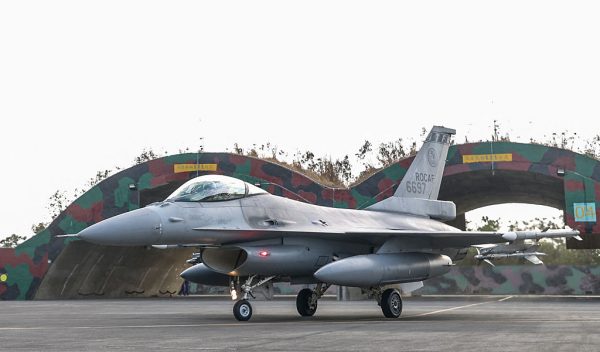
Taiwan defense analyst: the real spending increase is larger than the official number
Shen Mingshi, a researcher at Taiwan’s Institute for National Defense and Security Research, said the gap between China’s 5 percent economic growth and seven percent military spending increase reveals Beijing’s determination to expand its defense capabilities regardless of economic conditions. “Given that China is actively building a fourth aircraft carrier and expanding its nuclear warhead inventory, the actual spending increase is almost certainly larger than the published figure,” Shen said.
Huang Dawei, a U.S.-based economist, said the military budget growing faster than GDP means the CCP is treating arms spending as a higher priority than economic recovery. This amounts to “military-first politics,” he said, and reflects a regime that views political survival as more important than economic development.
Shen Youzhong, deputy minister of Taiwan’s Mainland Affairs Council, warned on March 10 that Beijing’s decision to increase military spending while cutting its growth target signals that the CCP will intensify military exercises and gray-zone coercion directed at the First Island Chain.
Speaking at a forum on the post-“Two Sessions” security outlook, Shen noted that multiple economic warning signs, including destructive internal competition, high unemployment, and severe local government fiscal deficits, confirm that the Chinese economy faces serious structural problems. Yet Beijing allocated 1.9 trillion yuan to the military, maintaining seven percent growth, a sum exceeding Taiwan’s entire defense budget by a factor of eleven.
Shen said this pattern “foreshadows the CCP’s continued military exercises and gray-zone operations targeting the Indo-Pacific region, particularly the First Island Chain, as Beijing attempts to use military pressure to alter the status quo in the Taiwan Strait and the broader region.”
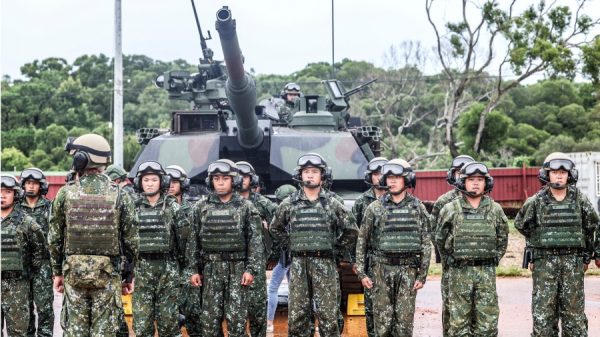
The United States and Indo-Pacific allies have built a shared defense consensus
Shen Youzhong argued that democratic nations across the Indo-Pacific have reached a shared conclusion: unilateral concessions to authoritarian powers do not produce stability. Japan, South Korea, the Philippines, and Australia have all significantly increased their defense budgets. The emerging consensus is that only credible deterrence, backed by multilateral defense cooperation, can counter authoritarian expansion and preserve peace.
“This trend of maintaining peace through strength is a direct response to the CCP’s attempts to unilaterally destroy the status quo and challenge security red lines,” Shen said.
On economic policy, Shen urged Taiwanese businesses to carefully evaluate the risks of investing in mainland China, which now carries both economic and political dangers. On defense, he called on the Taiwanese public to support national defense spending. On diplomacy, he cautioned against the stance of “not choosing sides,” arguing that such positioning weakens international support for Taiwan. “Taiwan stands on the side of freedom and democracy, always,” he said.
Shen Youzhong also warned that the CCP’s insistence on the so-called “1992 Consensus” is, in substance, a demand for the elimination of the Republic of China. He urged all Taiwanese political parties, organizations, and individuals engaged in cross-strait exchanges to recognize the CCP’s intensifying efforts at infiltration and division.
“The government has never given up on dialogue with the CCP on the basis of equality and dignity,” Shen said, “but we will not lower our defenses or hand national sovereignty to others as a gesture of compromise. Only by demonstrating the will to defend ourselves, strengthening national defense, and deepening cooperation with democratic allies can Taiwan secure its footing in a changing world and ensure that future generations continue to enjoy democratic freedom.”
By Li Jingyao