By Li Jingyao, Vision Times
A high-profile espionage case involving Hong Kong’s London Economic and Trade Office has gone to trial in the United Kingdom, with prosecutors alleging that the defendants carried out “shadow police” operations targeting Hong Kong dissidents living in Britain.
The trial began on March 2 at London’s Central Criminal Court, also known as the Old Bailey, one of the UK’s most prominent courts for serious criminal cases. Two defendants, Yuan Songbiao, an administrative manager at the Hong Kong Economic and Trade Office in London, and Wai Chi-leung, a former border officer at Heathrow Airport, have been charged under the UK National Security Act 2023.
Both men face accusations of assisting a foreign intelligence service and engaging in foreign interference, while Wai also faces an additional charge of misconduct in public office. Both defendants have pleaded not guilty.
RELATED: China ‘Outsources’ Transnational Repression, Triggering Calls for Action
Surveillance of Hong Kong activists
Success
You are now signed up for our newsletter
Success
Check your email to complete sign up
According to court proceedings reported by several media outlets, the two men were arrested in the UK in 2024 and are accused of conducting surveillance and gathering intelligence on Hong Kong residents who relocated to Britain. Prosecutors allege the activities took place between 2023 and 2024 and were carried out on behalf of Hong Kong authorities and the Chinese Communist Party (CCP).
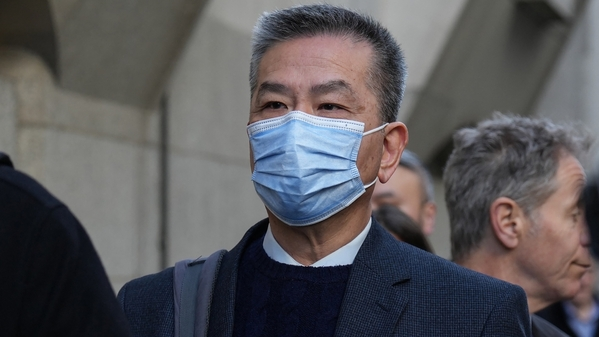
The prosecution argues that the operation functioned as a network of “shadow police” operating on British soil. In his opening statement, lead prosecutor Duncan Atkinson KC told the court that the defendants were involved in monitoring Hong Kong democracy activists living in the UK, including prominent figures such as Nathan Law and Finn Lau.
The alleged operation also sought to infiltrate local Hong Kong diaspora communities in Britain. Atkinson said the activities represented an effort to extend Hong Kong authorities’ influence beyond their jurisdiction.
A sprawling network
Prosecutors also told the court that at least three retired senior Hong Kong police officials were involved in organizing and directing the alleged surveillance network. According to the prosecution, the objective of the operation was to track overseas dissidents and expand Hong Kong’s intelligence reach internationally.
The case is among the first major prosecutions brought under the UK’s National Security Act, legislation introduced to address foreign espionage and political interference. Because of the seriousness of the charges, the trial is being heard at the Old Bailey before a 12-member jury.
The case also initially involved a third defendant, Matthew Trickett, a former immigration officer with the UK Home Office. However, proceedings against him were dropped after he was found dead in a park near his home following his arrest. Authorities have not publicly detailed the circumstances surrounding his death, and the court no longer includes him in the case.
Limited coverage in Hong Kong
Despite the case drawing international attention, coverage in Hong Kong’s mainstream broadcast media has been notably limited. According to monitoring by media watchdog group The Witness, major Hong Kong broadcasters, including TVB News, Cable News, Now News, Radio Television Hong Kong (RTHK), and Commercial Radio, have not reported on the trial since it began.
By comparison, several traditional print outlets such as Ming Pao, Hong Kong Economic Journal, and Oriental Daily News have published coverage of the proceedings. The case is widely considered significant because it involves allegations of espionage by an official linked to Hong Kong’s government institutions.
To Yiu-ming, a former assistant professor in the journalism department at Hong Kong Baptist University, told The Witness that the absence of coverage by major broadcasters raises concerns about media freedom and editorial independence.
He described the trial as a major international news story that should normally receive widespread reporting. According to To, the case sheds light on alleged intelligence-gathering activities targeting overseas dissidents and provides insight into how national security operations may function.
Media silence raises questions
To suggested that deeper reporting could potentially damage the image of the Hong Kong government or its national security apparatus. To criticized what he called the collective silence of the media. “Are you treating the public as if they are unaware? Do you think the public doesn’t know?” he said.
He noted that Hong Kong residents can still obtain information through the internet even if local media outlets decline to report on certain stories. “Just because you don’t report it doesn’t mean Hong Kong people don’t know,” he added.
Journalists are often described as society’s “gatekeepers,” responsible for ensuring the public receives accurate information. Observers say evaluating the performance of the media requires examining not only what news is reported, but also what stories are omitted.
In some cases, critics argue, the absence of coverage can itself raise important questions. The ongoing trial at the Old Bailey is expected to continue in the coming weeks, as prosecutors present evidence regarding the alleged surveillance activities and the defendants mount their legal defense.
Editorial note: Views expressed in this article are the opinions of the author and do not necessarily reflect the views of Vision Times.