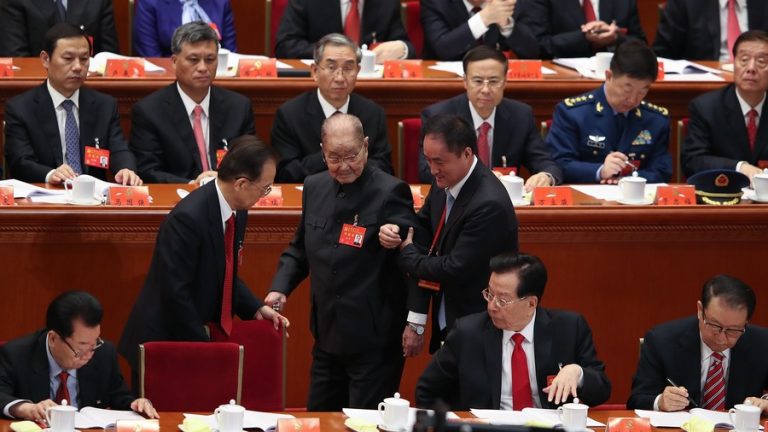
To understand why Song Ping’s death carries political weight beyond the passing of a 109-year-old man, it is necessary to understand what he built.
Song Ping served as head of the CCP’s Central Organization Department, the body that controls personnel appointments across the entire Party and state apparatus, before rising to the Politburo Standing Committee. In that role, he functioned as the patron who identified, promoted, and delivered two of the most consequential figures in post-Mao Chinese governance: Hu Jintao, who would serve as CCP general secretary from 2002 to 2012, and Wen Jiabao, who served as prime minister during the same period.
Song’s connection to Hu Jintao ran deep. When Song was serving as party secretary of Gansu Province, a northwestern region, he took notice of Hu, then a mid-level official in the provincial construction commission, and began pushing his name to the central leadership in Beijing. Song’s wife, Chen Shunyao, who served as a senior administrator at Tsinghua University, had also taken an early interest in Hu during his years there as a political instructor in the hydraulic engineering department. Chen reportedly arranged Hu’s transfer from a lower-level unit directly to a provincial post. Before leaving the Politburo Standing Committee, Song used his position on the personnel committee overseeing the 14th Party Congress to propose Hu for elevation to the Standing Committee itself, persuading Deng Xiaoping, the paramount reformer who shaped post-Mao China, to approve the appointment and allow Hu to bypass the intermediate step of serving as a full Politburo member.
Wen Jiabao received a similar boost. Song identified him as a promising official and, in effect, handed both men to the patronage networks of reformist CCP general secretary Hu Yaobang and Deng Xiaoping, where they were further cultivated and elevated.
That lineage matters now because of what happened at the closing ceremony of the CCP’s 20th National Congress in October 2022. Hu Jintao, seated next to Xi on the presidium, was physically removed from the hall by Party security personnel while cameras broadcast the scene live. The widely accepted interpretation among China watchers is that Hu had attempted to intervene against Xi’s decision to purge officials associated with the Communist Youth League, the internal Party network through which Hu had risen and through which he retained influence. Xi’s response was to have him escorted out in full view of the assembled delegates.
Success
You are now signed up for our newsletter
Success
Check your email to complete sign up
Song Ping’s death arrived against the backdrop of that humiliation. On the day his body was cremated, the man whose career Song had built was absent from the ceremony, represented only by flowers.
The Party announced his death at the exact moment the annual political sessions opened
Song died at 3:36 p.m. on March 4, 2026. The Party’s advisory body, formally called the Chinese People’s Political Consultative Conference, a gathering of handpicked delegates assembled each year alongside the rubber-stamp legislature in the ritual known as the “two sessions,” had opened at 3:00 p.m. the same afternoon.
Guo Jun, a commentator who analyzes CCP factional politics on the program Elite Forum, framed the issue directly: at 109, Song’s death was not surprising. But at that age, she observed, keeping a person alive in a vegetative state through medical intervention is entirely feasible. Within CCP practice, the moment of death is treated as an internal Party decision. As long as a senior elder is kept on life support, his political influence, his institutional associations, and the factions that invoke his legacy all retain a form of operational existence. The decision of when to withdraw that support, and when to announce the death, has historically been an internal Party matter, resolved by those at the top of the hierarchy.
The precedent she cited was the death of former CCP general secretary Jiang Zemin in November 2022. According to accounts that circulated in dissident media at the time, Cai Qi, who then served as director of the CCP’s General Office, the body that manages the Party leadership’s day-to-day operations, and who has since risen to the Politburo Standing Committee overseeing Party affairs, arranged for Jiang’s life support to be withdrawn. The Party announced Jiang’s death on November 30, 2022. The timing, in that account, was chosen to prevent Zeng Qinghong, Jiang’s longtime political enforcer and the most powerful surviving figure of the Jiang-era faction, from continuing to use Jiang’s status as a living former leader to organize resistance inside the Party against Xi.
The commentator known online as “New Highland,” writing on X, put it plainly: everyone familiar with CCP practice understands that elders are kept “alive” until the Party decides otherwise, and that the announcement of a death has never been purely a family matter. The choice to announce Song’s death at the precise moment the political advisory session was convening was, in that reading, too deliberate to be coincidental.
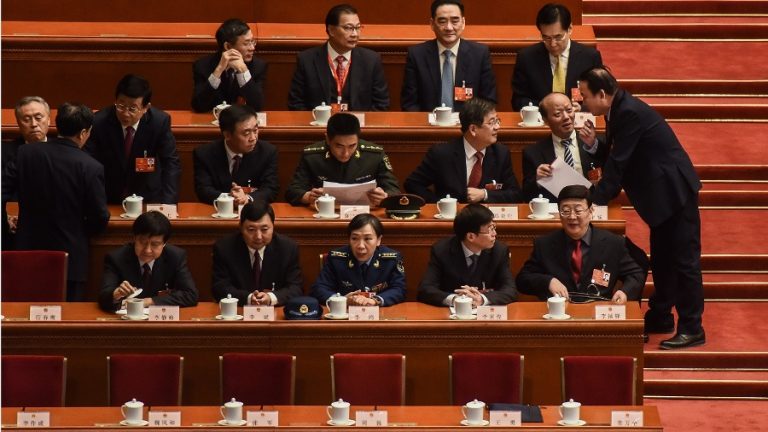
The current sessions are unfolding under considerable strain. The purge of He Weidong and Miao Hua, two of the most senior People’s Liberation Army commanders and long-standing Xi loyalists, was announced in January 2026. Several military delegates have been conspicuously absent from legislative proceedings. The announcement of Song Ping’s death during these sessions, the commentator argued, functions as a warning: whatever residual hope anti-Xi factions might place in Hu Jintao or Wen Jiabao as symbols or rallying points, it should now be abandoned.
The Party’s official obituary for Song Ping
Xinhua, the Party’s official wire service, published a biographical tribute to Song following his death. Among the standard formulations, one sentence drew attention from observers: “He placed great emphasis on discovering, cultivating, and promoting outstanding young cadres. During his tenure as a leading official in Gansu Province, a large group of cadres who were revolutionary, young, knowledgeable, and professionally competent rose to leadership positions.”
The passage refers, in context, to Song’s sponsorship of Hu Jintao and Wen Jiabao. The phrasing sits uncomfortably alongside present political reality: Xi, now in his third term as general secretary with no designated successor and no credible next-generation candidate visible in the Party’s upper ranks, has systematically avoided identifying or cultivating a following generation of leadership. Whether Xinhua’s editors chose that formulation with full awareness of its implied contrast, or whether the contrast is simply an artifact of readers’ heightened sensitivity to the succession question, it has been widely noted in dissident media and among China watchers abroad.
When delegates were asked who comes after Xi
On March 6, 2026, a video began circulating online showing Voice of America journalists pressing delegates to the rubber-stamp legislature at the 2023 sessions with a direct question about who would succeed Xi Jinping.
The reaction was immediate and uniform. Cai Peihui, a delegate to the National People’s Congress, said plainly: “These are things we can’t afford to touch. We have no right to discuss them.” A female delegate named Tang Chunyu went silent and left without responding. A delegate from Shandong Province, Jiang Weidong, paused, then offered: “The whole country is thinking about this,” before retreating into the formulation that “the leadership is very capable” and expressing a wish that “the country will keep getting better.”
The video was recorded in 2023. Its recirculation during the current sessions, alongside Xinhua’s tribute to Song’s legacy of building a successor generation, has reinforced the question the Party will not permit to be asked aloud: Xi is 72, has shown no sign of preparing a successor, and is widely believed within dissident circles to be positioning himself for an unprecedented fourth term at the Party’s next leadership congress, scheduled for 2027.
Song Ping spent his career doing the one thing Xi Jinping refuses to do. That is the political subtext running through every aspect of how his death has been handled, announced, and remembered.
By Li Deyan