On the afternoon of March 17, Chinese coast guard ships again entered the waters around Kinmen. The Ministry of National Defense (MND) also stated that starting from 8:01 a.m., a total of 21 sorties of PLA aircraft crossed the Taiwan Strait median line, intruding into northern, central, southwestern, and eastern Taiwanese airspace, in coordination with PLA ships conducting a so-called “joint combat readiness patrol” to harass surrounding air and sea areas.
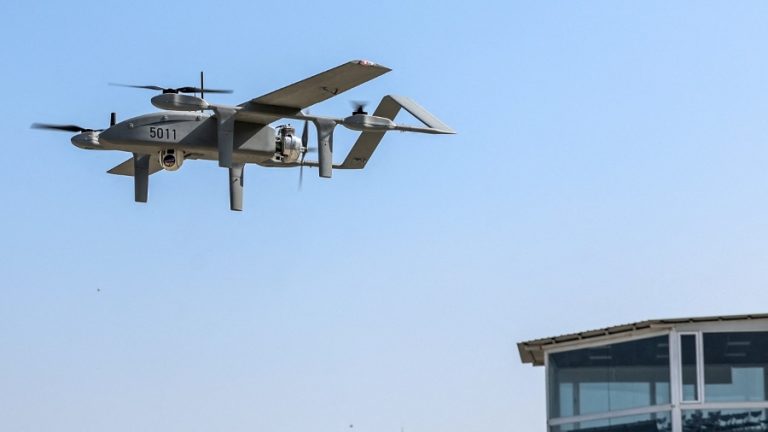
Air Force Chief of Staff Lieutenant General Li Qingran noted on March 16 that the first two MQ-9B drones will arrive in Taiwan in the third quarter of this year. MND Operations and Planning Department Chief Lieutenant General Huang Wenqi also mentioned that the U.S. has confirmed that the 102 Patriot Advanced Capability-3 Missile Segment Enhancement (PAC-3 MSE) missiles procured by Taiwan will not be affected by the current international situation and are still expected to be delivered on schedule this year.
To prevent the PLA from exhausting Taiwan’s air defense missiles with large numbers of low-cost weapons, the National Chung-Shan Institute of Science and Technology (NCSIST) will independently develop low-cost air defense munitions, with live testing expected next year.

PLA frequent harassment of Taiwan
The Kinmen-Matsu-Penghu branch of the Coast Guard Administration (CGA) under the Ocean Affairs Council issued a press release stating that at 2:50 p.m., four Chinese coast guard vessels (“14605,” “14533,” “14603,” and “14531”) were detected entering the restricted waters near Kinmen from the southeast. CGA patrol boats approached using a “one-to-one” monitoring formation, preventing further intrusion, and broadcast instructions in both Chinese and English ordering them to turn back. The Chinese vessels ultimately exited the restricted waters by 4:53 p.m.
The CGA branch noted that with improving sea conditions, Kinmen fishermen have been returning to the waters to work. While the sea areas are orderly under Coast Guard patrol, the Chinese coast guard unnecessarily creates disturbances, causing trouble for fishermen. The CGA stressed that Chinese vessels must cease harassment to help maintain stability in the Kinmen-Xiamen waters.
Success
You are now signed up for our newsletter
Success
Check your email to complete sign up
The branch emphasized that maintaining high-intensity maritime monitoring and deployment is standard Coast Guard practice. Any abnormal activity by Chinese coast guard ships will be immediately countered and expelled to defend Taiwan’s effective jurisdiction. Enforcement will remain firm to ensure national security.
The MND issued a press release stating that starting from 8:01 a.m., it detected a total of 28 PLA aircraft, including J-10s, J-16s, KJ-500s, and drones. Among these, 21 crossed the Taiwan Strait median line and its extensions, entering northern, central, southwestern, and eastern Taiwanese airspace, in coordination with PLA ships’ “joint combat readiness patrol” harassment.
The MND emphasized that the Taiwanese military uses joint intelligence and reconnaissance methods to closely monitor these activities and has dispatched appropriate aircraft, ships, and land-based missile systems to respond.

Legislative Yuan defense report and Q&A
According to reports from the Central News Agency, on the morning of March 16, the Legislative Yuan’s Foreign and National Defense Committee invited the Ministry of National Defense for a special report to “review Taiwan’s air defense missile system performance, low-cost interception methods, and counter-drone capabilities in light of recent U.S.-Iran tensions,” followed by a Q&A session. Defense Minister Gu Lixiong was on leave, so Vice Minister Admiral Zhong Shuming attended.
People First Party legislator Wang Anxiang asked about Taiwan’s military procurement from the U.S. and the progress of the domestically built submarine Hai Kun. Regarding the MQ-9B high-altitude drones, Lieutenant General Li Qingran said delivery is proceeding fully as planned, with the first two units arriving in Taiwan in Q3 of this year. Navy Chief of Staff Lieutenant General Qiu Junrong stated that the domestically built Hai Kun submarine has completed the sixth at-sea test (SAT), including submerged operations, and subsequent tests will proceed with safety as a priority. The commissioning date will be determined after completing the SAT.
Democratic Progressive Party legislator Chen Guanting asked whether international tensions and conflicts could affect the priority of Taiwan’s military procurement. Lieutenant General Huang Wenqi stated that the U.S. confirmed that the 102 PAC-3 MSE missiles purchased using surplus military funds will be delivered on schedule this year.
According to public information, the PAC-3 MSE missiles are larger and have a longer range than Taiwan’s current PAC-3 missiles. A standard PAC-3 launcher carries 16 missiles (4 sets of 4), while the PAC-3 MSE requires a new 12-missile launcher, with only 12 missiles per vehicle.

Taiwan to develop low cost air defense weapons
The MND’s written report also noted that to prevent the enemy from using large numbers of low-cost weapons to deplete air defense missiles, Taiwan will develop low-cost air defense weapons capable of intercepting long-range rockets based on existing missile technology, strengthening defensive resilience and protecting civilians.
According to the Liberty Times, legislator Wang Dingyu pointed out that Iran has recently used low-altitude, low-speed Shahed drones to attack critical civilian and military infrastructure, urging Taiwan’s military to learn from this. He also asked Vice Minister Zhong Shuming about areas in Taiwan’s “Taiwan Shield” defense system that need reinforcement.
Zhong Shuming said Taiwan’s current mid- and high-altitude defenses are adequate against PLA air attacks, and missile reserves will continue to be increased. Wang asked whether Taiwan has countermeasures for PLA’s three long-range rocket battalions in the mid- and low-altitude layers of the Taiwan Shield. Zhong replied that low-cost air defense weapons capable of intercepting long-range rockets are planned, with both domestic development and foreign evaluation underway.
NCSIST Director Li Shiqiang added that specific munitions are already being developed to counter PLA long-range rocket forces, with live testing expected as early as 2027.
Democratic Progressive Party legislator Wang Dingyu also asked about the “silent period” when PLA aircraft almost completely refrained from harassment from late February to early March. Deputy Chief of the Intelligence Staff, Lieutenant General Xie Risheng, replied that, due to multiple international events including the PLA’s Two Sessions, the situation requires ongoing observation, and the military will continue close monitoring.
By Li Zexu