Only a handful of full generals appeared in Beijing this March.
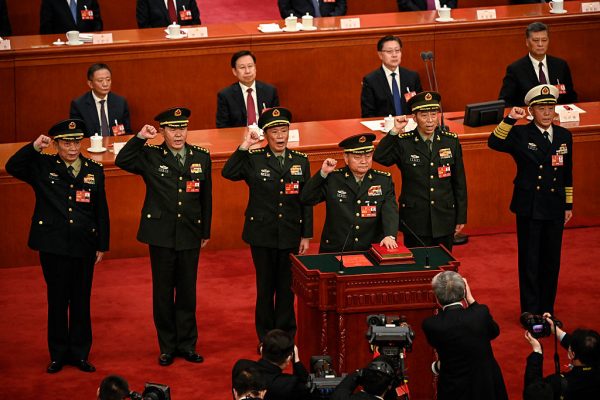
At China’s annual legislative meetings in 2026, six senior officers were reportedly in attendance. Of those, four were still on active duty. A year earlier, the number of active and retired generals present had been around 40.
The drop is stark.
The reduction comes against the backdrop of a decade-long campaign that has repeatedly cut through the upper ranks of the People’s Liberation Army.
Since taking power in 2012, Xi Jinping has overseen an anti-corruption drive that has removed officials across both the political and military system. Within the armed forces, the reach of that campaign has extended into the group he once promoted.
Success
You are now signed up for our newsletter
Success
Check your email to complete sign up
Claims circulating online state that at least 57 full generals elevated during Xi’s tenure have since been brought down. Some were formally dismissed. Others were forced into early retirement or stopped appearing in public reporting.
The names span nearly every branch of the military system, from former defense ministers Wei Fenghe and Li Shangfu to Rocket Force commander Li Yuchao and Central Military Commission political work chief Miao Hua, alongside theater commanders, political commissars, and service heads.
New detention claims
Another layer of uncertainty has emerged in recent days.
Overseas-based commentator Cai Shenkun cited information from contacts saying that five retired generals were taken away for investigation on March 17. The claim has not been independently confirmed.
In a March 19 post on X, Cai wrote that the reported detentions followed earlier developments involving senior figures such as Zhang Youxia and Liu Zhenli, as well as the disappearance of multiple active-duty generals and lieutenant generals.
The pattern he described is cumulative. Senior officers, he said, increasingly see themselves as potential targets.
Inside the system, caution now dominates.
Cai said officials no longer focus on advancing policy or achieving results. Avoiding mistakes has become the primary objective.
He pointed to a structure in which major decisions depend on direction from the top leadership. Without clear signals, lower levels hesitate. Responses to unexpected situations can stall.
In that environment, inaction functions as protection.

Reactions reflect deeper distrust
Online responses have been blunt.
Some commenters describe the situation as an outcome rooted in the political structure established under Mao Zedong. Others question the credibility of the anti-corruption campaign itself, arguing that it leaves deeper systemic issues untouched.
Still others focus on leadership dynamics, suggesting that cycles of internal purges are likely to persist as long as power remains concentrated at the top.
By Li Deyan
Editor’s Note:
This article is based on media reports, publicly shared online videos, blogger statements, and personal testimony cited by overseas media. Allegations related to arrests and internal military developments have not been independently verified and are presented as claims or assertions by the sources.