By Li Deyan, Vision Times
China’s military-industrial complex is facing a sweeping round of purges as senior scientists and executives tied to the country’s defense sector continue to fall in a sprawling “anti-corruption” probe. Most recently, 10 academicians from China’s two most prestigious scientific bodies, the Chinese Academy of Sciences and the Chinese Academy of Engineering, have been removed from their positions, many of whom once held leadership roles within state-owned defense conglomerates.
The developments come as geopolitical tensions intensify and questions emerge about the integrity and reliability of China’s defense research system.
Some observers say the scale of the purge has exposed deep structural problems within the Chinese Communist Party’s (CCP) military-industrial network. As one online commentator put it, “The military-industrial system may collapse just like the Central Military Commission.”
RELATED: China’s Air Defense Failures Could Spell Trouble for Vice Premier Zhang Guoqing
10 senior academics removed
Success
You are now signed up for our newsletter
Success
Check your email to complete sign up
The purge within China’s defense sector appears to be accelerating. According to Chinese media reports, at least 10 academicians have been removed from official rosters since the CCP’s 20th Party Congress in 2022.
On March 17, the Chinese news outlet Caixin reported that Yang Wei, former deputy general manager of the Aviation Industry Corporation of China and chief designer of the J-20 stealth fighter, had been removed from the Chinese Academy of Sciences’ official list of academicians.
One day earlier, financial news outlet Sina Finance reported that three academicians of the Chinese Academy of Engineering, Wu Manqing, Zhao Xiangeng, and Wei Yiyin, had also disappeared from the official academy roster.
Wu Manqing and Zhao Xiangeng had previously served as vice presidents of the Chinese Academy of Engineering. Wei Yiyin formerly served as deputy general manager of the China Aerospace Science and Industry Corporation.
Leaders removed
Hong Kong newspaper Ming Pao reported that many senior figures in China’s defense industry have recently been implicated in corruption investigations. According to the academy’s regulations, academicians may be stripped of their title for “serious academic misconduct” or violations of the law.
A commentator on the social media platform X, using the account name “Finding心归何处,” wrote that the disappearance of the three names from the official list represents more than a routine personnel adjustment. “When the names Wu Manqing, Wei Yiyin, and Zhao Xiangeng vanished from the list of academicians, what disappeared were not just three names—but three pillars of China’s national defense system.”
Wu Manqing is widely regarded as a pioneer of China’s digital phased-array radar systems and a key designer of the airborne radar used in the KJ-500 early-warning aircraft. The commentator questioned whether China’s radar capabilities could be trusted if the leading experts behind them had fallen in corruption probes. “When radar experts fall, can those ‘eagle eyes’ said to detect stealth fighters really work, or are they merely simulated data on a screen?”
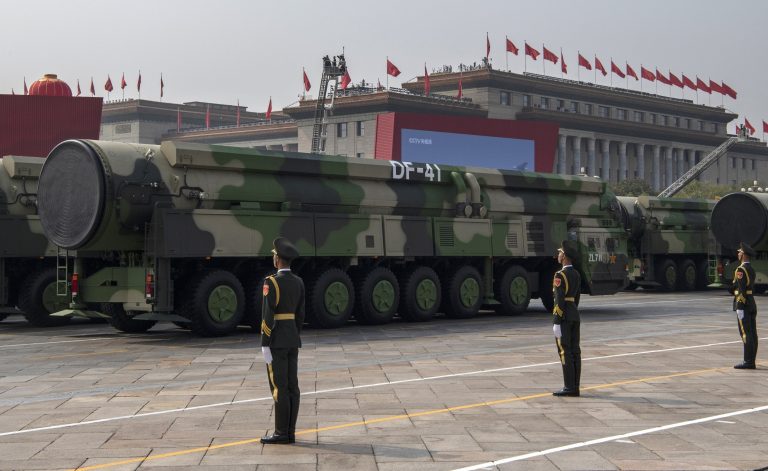
Wei Yiyin, who spent decades working on missile guidance and control systems, also drew scrutiny. “If the leader of missile guidance technology is deeply involved in corruption, does the so-called ‘precision strike’ capability of the ‘Dongfeng Express’ truly lock onto enemy aircraft carriers, or could it lose its way because of falsified chips and algorithms?”
Zhao Xiangeng, a nuclear weapons expert who once oversaw nuclear weapons development, also appeared on the list of removed academicians. According to the same commentary, the removal of experts tied to China’s nuclear deterrent raises questions that go beyond routine disciplinary cases. “When nuclear scientists are purged, the issue is no longer just ‘watered-down’ technology, it directly touches the credibility of the country’s nuclear deterrence.”
Supply chains under siege
Observers say the list of removed academicians in recent years reads almost like a roadmap of China’s defense technology sectors. “The removal list over the past three years resembles a precise ‘destruction roadmap’ of China’s military-industrial system,” the commentator wrote, citing fields such as nuclear propulsion, missile control, advanced materials, engine systems, and defense equipment.
Among the figures removed from official lists are scientists involved in nuclear reactor design, missile technology, defense materials, naval propulsion systems, and aerospace engines.
For example, Luo Qi, a prominent nuclear power expert and academician of the Chinese Academy of Engineering, had long been involved in nuclear reactor design and development. Despite his prominent role in advancing China’s third-generation nuclear technology known as “Hualong One,” he was removed from the academy roster after being stripped of his position as a delegate to China’s National People’s Congress in February 2026.
Other figures whose status has reportedly been revoked include Xiao Longxu, a control theory expert associated with China’s Rocket Force research institute; Jin Donghan, a naval propulsion specialist and former president of Shanghai University; and Cao Jianguo, former chairman of the Aero Engine Corporation of China.
Meanwhile, the whereabouts of Zhou Guotai, once known as the “father of China’s body armor” and chief designer of the PLA’s 07-style military uniform, remain unclear more than a decade after he was first investigated for disciplinary violations. Altogether, the 10 removed academicians were connected to 10 of China’s major state-owned defense conglomerates, including the China National Nuclear Corporation, Aviation Industry Corporation of China, China Aerospace Science and Technology Corporation, China Shipbuilding Group, and China Electronics Technology Group.
Systemic corruption
These companies collectively cover nearly every domain of China’s defense industry, from nuclear weapons and missiles to aircraft engines, naval vessels, and electronic warfare systems. Yet over the past three years, senior officials across these institutions have been swept up in corruption probes. As one online commenter remarked, “The military-industrial complex may end up collapsing just like the Central Military Commission.”
The online commentary also outlined allegations of corruption across multiple levels of the defense industry. At the research level, some academicians were accused of fabricating research data to claim technological breakthroughs. At the procurement level, senior executives were allegedly involved in accepting bribes during equipment approval and purchasing processes. And at the operational level, some grassroots military officers reportedly diverted resources while attempting to compensate for defective equipment.
Netizens responding to the revelations offered pointed criticism. One wrote: “In reality, Xi Jinping shouldn’t blame everyone. The CCP system has no competition and no oversight. Wherever the Party exists, deception, corruption, and unfinished projects follow.” Another commenter suggested that public appearances by senior figures often obscure the real technical experts working behind the scenes. “The people shown on television in mission control aren’t necessarily the real technical backbone; the real experts are the ones working quietly behind the scenes.”
Others questioned the authenticity of China’s military equipment. “Could it really end up like the Beiyang Fleet, where weapons turned out to be fake when the war actually began?”