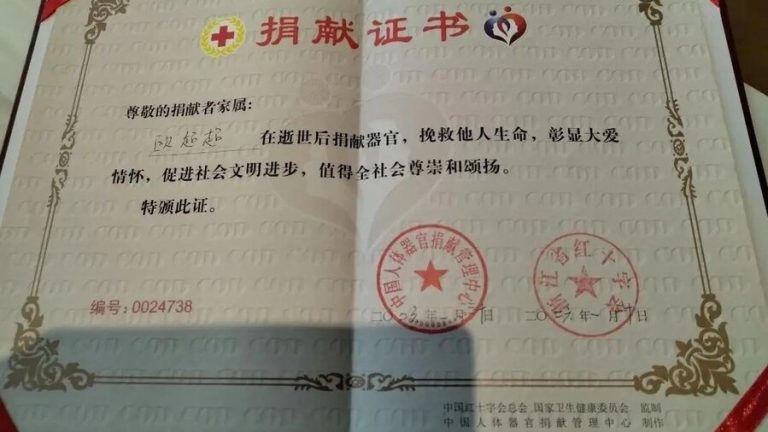
A delivery rider’s sudden death in eastern China was followed, within days, by a series of organ transplants involving multiple recipients, according to official reports.
The case centers on Ou Chaochao, a 34-year-old delivery worker in Yiwu, Zhejiang province. Chinese media reported that he suffered cardiac arrest in the early hours of Jan. 15 while working. He was taken to hospital, could not be revived, and was later declared brain dead.
Five days later, on Jan. 20, doctors at Zhejiang First Hospital carried out organ procurement. Reports state that seven organs and two corneas were removed. Some accounts said seven patients benefited, while others put the number at nine.
The coverage described the case as a final act of generosity, framing it as a “last delivery” that brought life to others. The narrative was widely circulated.
What remains less clear is the sequence of events before Ou reached the hospital.
Success
You are now signed up for our newsletter
Success
Check your email to complete sign up
Reports did not specify where he collapsed, who first found him, or how long it took for emergency services to arrive. There was no detailed account of the interval between the reported cardiac arrest and his admission to hospital. These details have not been clarified in subsequent reporting.
The transplant process itself has also drawn attention.
Organ transplantation requires compatibility testing between donor and recipient. In this case, multiple transplant surgeries were completed within a short period after Ou was declared brain dead. The reports did not explain when recipients were identified, how matching was conducted, or how surgical scheduling was arranged in such a compressed timeframe.
Medical specialists commenting online have focused on the limits imposed by warm ischemia time, the period during which organs are deprived of blood supply before preservation.
For the heart, this window is typically only a few minutes. The liver and kidneys allow slightly longer, but still operate under strict limits. If those thresholds are exceeded, organs are generally no longer viable for transplantation.
RELATED:
- Petition to Halt Non-Relative Organ Transplants in China Sparks Legal Debate
- Viral Post on Forced Organ Harvesting in China Draws 2.7 Million Views in One Day
- US Senators Introduce Bill to Sanction CCP Forced Organ Harvesting
In Ou’s case, the cardiac arrest reportedly occurred outside a hospital setting. The time required for discovery, emergency response, and transport would ordinarily extend beyond those limits. The reports, however, describe multiple organs remaining suitable for transplantation several days later.
No detailed explanation has been provided addressing how these constraints were managed.
Another detail mentioned in coverage was that Ou had previously donated blood several times. The reports presented this as evidence of his willingness to help others.
Some commentators have linked such information to broader questions about how medical data is collected and stored, and whether it could be used in identifying potential organ matches. No direct evidence has been presented connecting those systems to this case.
Discussion of the case has continued online, with attention centered on the absence of a complete timeline, the medical feasibility of the reported procedures, and the limited disclosure in official accounts.
Editor’s Note:
This article is based on media reports, publicly shared online content, and commentary from independent analysts. Allegations related to organ harvesting have not been independently verified and are presented as claims or suspicions raised by the sources.