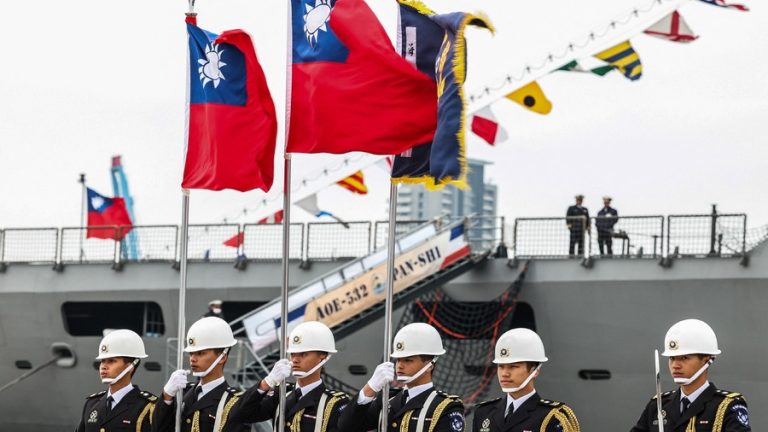
On Friday, March 28, U.S. Central Command announced that the USS Tripoli had arrived in its area of responsibility, delivering approximately 3,500 sailors and Marines from the Tripoli Amphibious Ready Group and the 31st Marine Expeditionary Unit. The USS New Orleans and USS San Diego arrived alongside it, completing the full amphibious ready group. The Pentagon has ordered elements of the 82nd Airborne Division’s headquarters and two infantry battalions to deploy to the region. The USS Boxer, carrying at least 2,200 Marines with the 11th Marine Expeditionary Unit, departed Wednesday and is less than a month from arriving.
The immediate assumption was Kharg Island. CNN reported that “speculation is mounting they may be assigned to take Iran’s Kharg Island.” Fox News, CNBC, and Reuters all ran analysis on a potential seizure. Senator Lindsey Graham wrote that “seldom in warfare does an enemy provide you a single target like Kharg Island that could dramatically alter the outcome of the conflict.”
Kharg Island is a coral outcrop in the northern Persian Gulf, roughly five miles long and half that at its widest point, about a third the size of Manhattan. It sits 16 miles off the Iranian coast and 350 miles past the Strait of Hormuz. Approximately 90 percent of Iran’s crude oil exports pass through its terminals, making it one of the most economically significant pieces of real estate on earth. Seizing it would give the United States enormous leverage over Tehran’s economy. This is why everyone is talking about it.
The problem is that taking Kharg involves three separate operations, each harder than the last: getting there, seizing it, and holding it. The forces deploying to the Middle East could manage the first two. The third requires an entirely different kind of military commitment that nobody has ordered.
Getting to Kharg requires clearing 350 miles of contested water
Before a single Marine sets foot on Kharg, the amphibious ready group has to get there. The island sits at the northern end of the Persian Gulf, roughly 300 miles northwest of the Strait of Hormuz. The ARG’s transit begins at the Strait itself, where Iran has been laying mines and attempting to control shipping traffic since the war began.
Success
You are now signed up for our newsletter
Success
Check your email to complete sign up
The U.S. Navy’s mine countermeasures capability is limited. The Christian Science Monitor reported that demining is “a mission for which the U.S. Navy is ill-prepared.” Mine clearance doctrine for amphibious approaches requires six 165-yard transit lanes cleared to tolerance within 48 hours, extending from the line of departure to the surf zone. Iran’s mine inventory includes bottom mines, moored contact mines, and floating mines that can be deployed from the coast, and reports indicate Iran has been laying them in the approaches to Kharg and along the shoreline.
Former NATO Supreme Allied Commander James Stavridis warned that the ships of the amphibious ready group would have to contend with “Iranian drones, ballistic missiles, and mines in the waterway” during the transit, and that “once in position off Kharg, the Marines would need ironclad air and sea superiority over at least 100 miles around the island.” That is a 200-mile diameter bubble of sustained air dominance over the northern Gulf while the landing force approaches.
No dedicated mine countermeasures ships have been reported deploying to the Gulf.
The Marines can seize Kharg, and the seizure would be fast
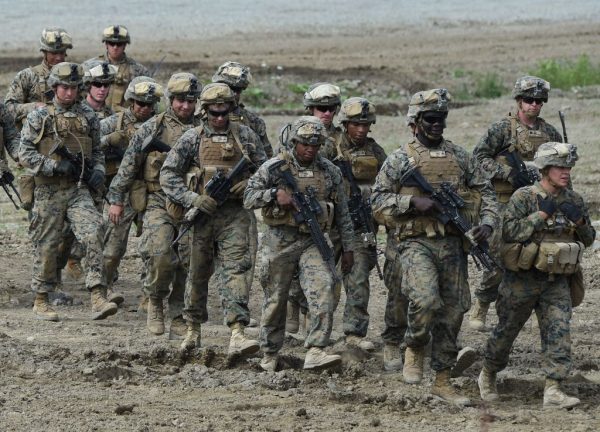
The seizure itself is the part that matches the deployed forces. A Marine Expeditionary Unit is a self-contained combined arms force designed for rapid-response amphibious landings, raids, and assault missions. The 31st MEU carries infantry, attack helicopters, MV-22 Ospreys, F-35B stealth fighters, amphibious landing craft, and its own logistics. It is purpose-built for exactly this kind of operation.
The United States bombed 90 military targets on Kharg on March 13, striking naval mine storage facilities, missile storage bunkers, and other military sites while deliberately avoiding oil infrastructure. The island’s above-ground military defenses have already been degraded.
The Marines would launch from the ARG’s ships, approach by a combination of helicopter assault and surface landing craft, establish a beachhead, and push inland to secure the oil terminals and port facilities. The F-35Bs flying off the Tripoli would provide close air support and local air superiority. Cobra attack helicopters would suppress any remaining defensive positions. The island is five miles long. Against a garrison whose fixed defenses have already been bombed, the clearing operation would take hours.
This is textbook MEU doctrine. If Kharg were the only question, the answer would be straightforward.
Kharg’s defenses have been reinforced since the March 13 strikes
Iran has been preparing for a landing. According to multiple sources familiar with U.S. intelligence, Iran has moved additional military personnel to the island, deployed shoulder-fired surface-to-air missile systems known as MANPADs, and laid anti-personnel and anti-armor mines on the shoreline and across the island, specifically targeting likely amphibious landing zones.
Iran is believed to possess first-person-view drones capable of identifying and targeting individual systems and personnel in real time. Russia may be sharing satellite imagery with Iran, which would allow Tehran to track the ARG’s approach and the landing force’s movements on the island in near real time.
The mines are the particular problem. Anti-personnel mines threaten Marine infantry clearing the island on foot. Anti-armor mines threaten any vehicles brought ashore. Mine clearance on a defended island requires explosive ordnance disposal teams working methodically through every landing zone, road, and approach to the oil terminals. This is slow, dangerous work that continues for days after the initial seizure, and it requires specialized personnel that a MEU carries in limited numbers.
Holding Kharg under fire from 16 miles away is the real problem
The seizure ends. The garrison begins. And this is where the entire concept breaks down against the deployed force package.
Kharg sits 16 miles from the Iranian mainland. Despite four weeks of air campaign, Iran still retains an estimated 40 percent of its original missile launchers, with the status of another third unknown. Iran’s remaining ballistic missiles, cruise missiles, artillery rockets, armed drones, and FPV kamikaze drones can all reach Kharg from the coast. The March 13 strikes destroyed military targets on the island, but they did nothing to eliminate the mainland-based threats that would rain down on any American garrison.
Former U.S. Central Command commander Joseph Votel told The War Zone that while 800 to 1,000 troops might be enough on the island itself, “they would require logistical backup that would need protection as well.” He called a Kharg seizure “kind of an odd thing to do” and doubted it would provide any tactical advantage. An Israeli source told CNN there is concern that “taking control of Kharg would lead to attacks by Iranian drones and shoulder-fired missiles, leading to the deaths of American troops.”
Ryan Brobst and Cameron McMillan of the Foundation for Defense of Democracies wrote that a Kharg seizure “is more likely to expand and extend the war than it is to deliver any sort of decisive victory.” Their core argument: once American troops on the island start taking casualties from the mainland, the political and military pressure to seize coastal areas for force protection creates an escalation trap. The island becomes an anchor that drags the United States into a larger ground war on Iranian soil.
Caitlin Talmadge, a professor in MIT’s security studies program, told NPR that “inserting U.S. forces so close to Iran’s shores would be risky and carry the potential for casualties. And then there’s the question of sustaining that U.S. military presence on the island, which I don’t think would be simple, again, because U.S. forces would be within range of Iranian weapons.”
A garrison under persistent fire from 16 miles away needs dedicated air defense batteries, Patriot or THAAD systems positioned on the island to intercept incoming missiles and drones. It needs armored vehicles for force protection patrols across an island laced with anti-armor mines. It needs combat engineers to clear those mines continuously and to maintain the oil infrastructure that is the entire strategic rationale for holding the island. It needs explosive ordnance disposal teams operating around the clock. It needs a sustainment brigade delivering water, fuel, ammunition, food, and medical supplies by sea, through a logistics line that runs 350 miles past the Strait of Hormuz, the very chokepoint Iran is still blocking. And within days, it needs a rotation force to relieve the Marines, because a MEU is a raid force that sustains itself from its ships for 15 to 30 days and was never designed for indefinite occupation under fire.
That rotation force would be a Stryker Brigade Combat Team, which carries 300 armored vehicles and 4,500 soldiers and can deploy by C-130 transport aircraft within 96 hours, or an Armored Brigade Combat Team with M1 Abrams tanks and Bradley fighting vehicles. Armored brigades require sealift from the continental United States, a process measured in weeks.
The deployed forces match a raid, and Kharg requires an occupation
The 82nd Airborne Division’s Immediate Response Force can deploy anywhere in the world within 18 hours. It is the fastest conventional force in the U.S. military. It is also light infantry that deploys without armored vehicles, carries limited supplies, and is designed for 72 hours of independent operations. The 82nd’s mission profile is to seize an objective, hold it long enough for heavier forces to arrive, and hand off. Its core competency since World War II has been airfield seizure, the operation it executed in Grenada, Panama, and Iraq.
A Marine Expeditionary Unit sustains itself from its ships for 15 to 30 days. It is a raid force designed to go ashore, accomplish the mission, and return to its ships. The MEU’s value is in its self-contained combined arms capability for short-duration operations, with its own aviation, its own logistics, and its own fire support.
If Kharg were the mission, the Pentagon would be deploying the garrison force alongside the seizure force. Doctrine for island seizure operations requires simultaneous preparation of the follow-on force so that the garrison arrives within days of the seizure, before the rapid response forces exhaust their supplies and the enemy regroups. No Stryker brigade has been ordered. No armored brigade is loading onto ships. No air defense batteries have been reported moving to the Gulf. No sustainment brigade has been activated. The 10,000 additional troops the Pentagon is reportedly weighing remain under consideration, not ordered.
The Washington Post reported Saturday night that the Pentagon is preparing for “weeks of ground operations in Iran.” The 82nd Airborne and the MEU are designed for days of operations, with a defined entry and a defined exit. Weeks of sustained ground presence on an island 16 miles from the Iranian coast, under persistent fire, with a sea logistics line running through the Strait of Hormuz, requires a fundamentally different kind of force.

Kharg could be phase two, but the forces arriving this week point elsewhere
A reasonable objection: both operations could happen sequentially. The rapid response forces execute the first mission, and the heavier follow-on forces arrive later for Kharg. The 11th MEU reaches the region in late April. The 10,000 additional troops could include Stryker or armored units. The 82nd’s division headquarters would be well-positioned to coordinate a phased campaign.
This is possible. The force buildup may be designed to give the president options for both missions across multiple weeks.
What the sequencing tells you is which mission comes first. The forces arriving this week are rapid response forces optimized for short-duration operations with a planned extraction. The 82nd Airborne trains for airfield seizure, the operation at the center of the Isfahan concept of operations outlined in earlier Vision Times analysis. The division headquarters deploys for simultaneous operations at multiple sites. Israeli shaping strikes have accelerated over Isfahan and Natanz this week, with strikes on the Arak heavy water reactor and the Ardakan yellowcake production plant. The Joint Special Operations Command maintains counter-weapons-of-mass-destruction units that have trained for decades on hardened, deeply buried target missions. Secretary of State Marco Rubio told Congress that Iran’s enriched uranium would need to be physically secured: “People are going to have to go and get it.”
An inland operation to seize enriched uranium at Isfahan and Natanz has a defined entry, a defined objective, and a defined extraction. The 82nd seizes the airfield. The specialists work underground. The MEU provides close air support and the quick reaction force. The force withdraws once the uranium is secured and loaded onto transport aircraft.
The forces for Kharg are missing because Kharg comes later
On March 13, the United States bombed 90 military targets on Kharg Island and deliberately avoided the oil infrastructure. President Trump said he had chosen “for reasons of decency” to spare the oil terminals, and that he would “immediately reconsider this decision” if Iran interfered with shipping through the Strait of Hormuz. That threat works as long as the oil infrastructure exists and the United States can destroy it from the air at any time. Seizing the island replaces a cost-free threat with a costly occupation.
Kharg Island needs mine countermeasures ships to clear the approaches, air defense batteries to protect against persistent mainland fire, armored vehicles to operate on mined terrain, combat engineers to maintain oil infrastructure under wartime conditions, a sustainment brigade to keep the garrison supplied through 350 miles of contested water, and a rotation force of 4,500 soldiers with armored vehicles to relieve the Marines within weeks.
The Pentagon has sent a Marine Expeditionary Unit, an 82nd Airborne division headquarters, and two airborne infantry battalions. That is a force built to fly to an objective, accomplish a mission measured in hours, and leave. The gap between what Kharg requires and what is actually deploying is visible in every category: no mine countermeasures ships, no air defense batteries, no armored brigades, no Stryker brigades, no sustainment brigades, no combat engineer battalions. The forces for a Kharg garrison have not been ordered because the first operation is 250 miles inland, under the mountains at Isfahan.