On Tuesday, Bloomberg reported that the Trump administration issued verbal orders for approximately 2,000 soldiers from the 82nd Airborne Division to deploy to the Middle East, including two battalions and enabling units. The Intercept confirmed that the deployment includes Maj. Gen. Brandon Tegtmeier, the division’s commanding general, and his full headquarters staff. NPR reported that a brigade combat team of 3,000 soldiers could follow within days. They join two Marine Expeditionary Units already en route: the 31st MEU aboard the USS Tripoli, due to arrive in the region by Friday, and the 11th MEU aboard the USS Boxer, which departed San Diego three weeks ahead of schedule.
The public conversation has coalesced around a single objective: Kharg Island, the coral outcrop in the northern Persian Gulf that handles 90 percent of Iran’s oil exports. Senator Lindsey Graham went on Fox News Sunday and compared a potential Marine landing on Kharg to Iwo Jima. Retired Admiral James Stavridis described an air assault scenario using Ospreys and helicopters. The Guardian reported that U.S. officials have discussed occupying or blockading the island. Every analyst, cable news segment, and think tank assessment is pointing at the same five-mile strip of rock.
There is a problem with this consensus. The force being assembled does not match the mission everyone is describing.
The 82nd Airborne does not seize islands
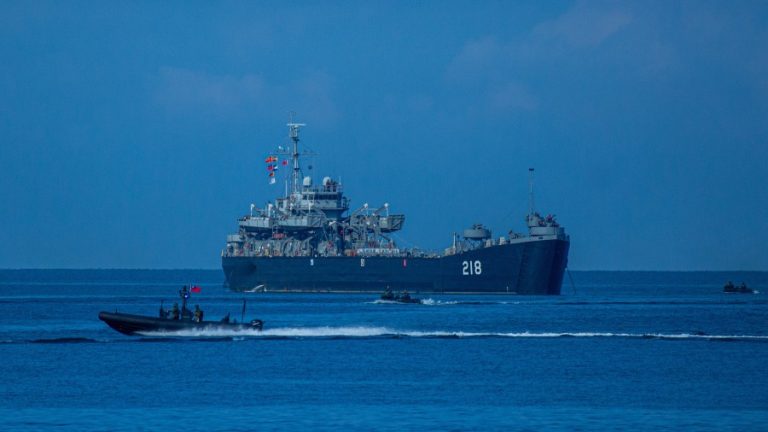
Marine Expeditionary Units exist for exactly one kind of mission: rapid, forcible entry from the sea. An MEU carries a reinforced infantry battalion, a composite aviation squadron with Ospreys, Cobras, and F-35Bs, and a logistics element. It can land Marines on a beach, insert them by helicopter, or conduct a short-duration raid. As one defense expert told TIME, an MEU is “extremely capable, but for limited operations of limited duration.” If the mission were to seize Kharg Island, one MEU could do it. Two MEUs could do it comfortably.
The 82nd Airborne Division is a different instrument entirely. The division, based at Fort Bragg, North Carolina, specializes in seizing contested territory by parachute assault. Its Immediate Response Force, a brigade of 3,000 soldiers, maintains readiness to deploy anywhere in the world within 18 hours. The 82nd’s operational role, as Army Recognition described it, centers on “establishing initial lodgments, such as airfields, ports, or key infrastructure, that enable the introduction of follow-on forces and sustained joint operations.” Paratroopers seize airfields. They drop onto contested ground deep inside enemy territory and hold it until heavier forces arrive.
Success
You are now signed up for our newsletter
Success
Check your email to complete sign up
Paratroopers do not seize islands from the sea. That is what Marines do. Kharg Island does not have a contested airfield that requires airborne seizure. It has an oil terminal you reach by helicopter or amphibious craft. If Kharg were the only objective, the 82nd would be an expensive redundancy.
The deployment of a division-level headquarters is the detail that makes the picture unmistakable. Fox News reported that Maj. Gen. Tegtmeier’s headquarters is deploying to “establish forward command and control for potential joint forcible-entry missions.” A division headquarters does not deploy to manage a single brigade on a single island. A brigade has its own colonel and staff for that. A division headquarters deploys when you need a two-star general coordinating multiple subordinate units across multiple objectives simultaneously, deconflicting Marine operations, Army airborne operations, and special operations forces all happening at the same time. That is a joint forcible entry operation. That is not an island raid.
Former Deputy Assistant Secretary of Defense Mick Mulroy told TIME that adding the 11th MEU to a region that was already receiving the 31st MEU “tells me that there’s something bigger afoot” and that “somebody’s planning to do something with these units, and they need them both.” The force package now converging on the Middle East, two Marine Expeditionary Units with approximately 4,500 Marines and sailors each, plus an 82nd Airborne brigade with a division headquarters, totals roughly 12,000 troops configured for rapid ground operations. That is not an island raid. That is the infrastructure for a multi-objective campaign.
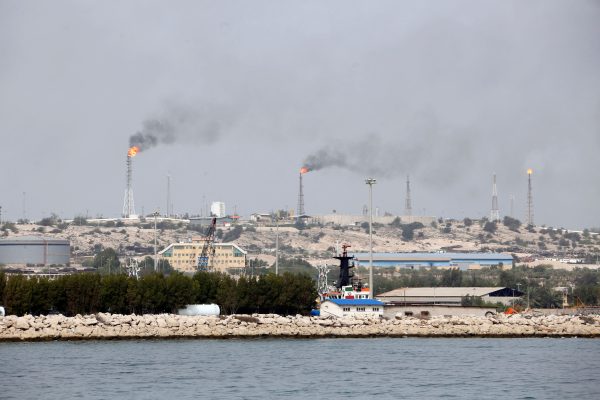
Kharg Island is a fixed target Iran can destroy on its own terms
There is a more fundamental problem with the Kharg thesis. The island makes strategic sense as an objective only if the United States can hold it and keep it functional. Neither condition is guaranteed.
Kharg sits 15 miles off the Iranian coast, well within range of everything Iran has been saving. Iranian ballistic missile launches have fallen 90 percent and drone attacks have dropped 95 percent since the opening day of the war. Those are significant reductions but they are not zero. Israeli officials estimated that approximately 150 Iranian missile launchers remain active. Iran continues to produce cheap Shahed drones in simple factories that do not require the complex launchers targeted by airstrikes. As one analyst at the Doha Institute told Al Jazeera, “It does not matter how many you launch as long as you maintain a credible threat. It takes one successful drone to shatter a sense of security.”
A Marine garrison on Kharg becomes the most predictable target in the theater. You cannot hide an island. Every remaining Iranian gunner knows its exact coordinates. Iran does not need to defeat the Marines in ground combat. It needs to land one missile on the oil terminal’s 50 storage tanks holding over 34 million barrels of crude, and the strategic purpose of the seizure, controlling Iran’s oil revenue to force a reopening of the Strait of Hormuz, goes up in smoke. Iran has already explicitly threatened to turn the island’s oil infrastructure into “a pile of ashes” if it is targeted. There is nothing preventing Tehran from destroying its own terminal to deny it to the Americans. Saddam Hussein set Kuwait’s oil fields on fire in 1991 for exactly this reason.
Admiral Stavridis acknowledged that a Kharg operation carries “significant risks and potential pitfalls,” including the possibility that much of the island could be booby-trapped and the danger that Iran could score a direct hit on an amphibious ship. He noted that a less risky option would be to blockade the island rather than seize it, “which would likely result in fewer casualties and could achieve a similar economic effect.” The fact that the less risky option achieves the same economic effect raises an obvious question: why send 12,000 ground troops to physically seize something you can blockade from the water?
The answer is that Kharg may not be the real mission.
The president said what he wants
On Monday, President Trump told reporters that the United States would insist on taking possession of Iran’s highly enriched uranium as part of any deal. His exact words: “We want the nuclear dust. We’re going to want that, and I think we’re going to get that.” He stated that if a deal is reached, the United States will move to seize Iran’s enriched uranium, the material that is central to Tehran’s disputed nuclear program.
The Associated Press reported that Trump has been “consistent in articulating that a primary objective in joining Israel in the military action is ensuring that Iran will never have a nuclear weapon.” The problem is what consistency requires. The enrichment facilities at Fordow, Natanz, and Isfahan have been bombed repeatedly, first by Israel and the United States in June 2025, and again in this war, with bunker busters striking Natanz as recently as March 21. The enrichment infrastructure is wrecked and Iran is years away from rebuilding its centrifuge cascades.
The uranium itself is a different matter. Before the June 2025 strikes, Iran had stockpiled approximately 440 kilograms of uranium enriched to 60 percent, enough to build as many as 10 nuclear bombs if further enriched to weapons grade. The IAEA has not been able to verify the location or status of this material since the June strikes. Iran notified the IAEA on June 16, 2025, that it had invoked “special measures” to move its nuclear materials, suggesting Tehran had plans for dispersing the stockpile in the event of a military attack. The Bulletin of the Atomic Scientists reported that much of the enriched uranium is believed to be buried deep underneath the Isfahan nuclear complex, too deep for conventional bombing to guarantee destruction.
You cannot bomb uranium canisters you cannot find. You cannot destroy material buried under rubble without putting people on the ground to locate it, assess it, and either extract it or render it unusable. Senator Richard Blumenthal, a member of the Senate Armed Services Committee, stated it plainly: “Some of the objectives that he continues to espouse simply cannot be achieved without a physical presence there. Securing the uranium cannot be done without a physical presence.” Senator Rick Scott, also on the Armed Services Committee, said the same thing from the other side: “No one has given me a briefing on how you would do it without boots on the ground. It doesn’t mean you can’t. But no one’s ever briefed me about it.” Senate Foreign Relations Committee chairman James Risch cited “a number of plans that have been put on the table” and declined to elaborate.
The plans are arriving in the Middle East this week in the form of 12,000 troops.
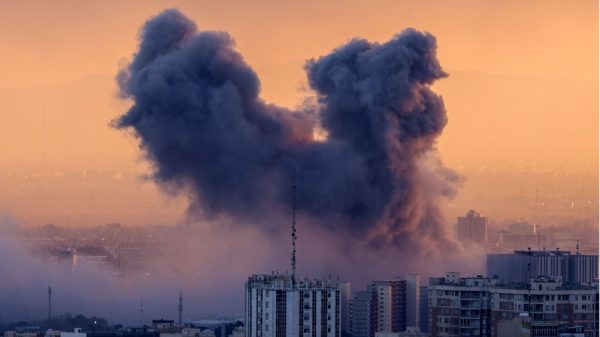
Twenty-five days of air war made a ground operation possible
A counterproliferation ground operation inside Iran would have been suicidal on Feb. 27, but by March 25, the conditions are different.
Trump told reporters on March 3 that Iran had no navy, air force, air detection, or radar after the opening strikes. CENTCOM reported that by March 18, U.S. forces had destroyed over 120 Iranian vessels, struck more than 9,000 targets, and flown upward of 9,000 combat flights. The Pentagon confirmed that Iranian ballistic missile attacks had decreased 90 percent and drone attacks were down 95 percent. Iran’s command and control has been shattered from the top: Supreme Leader Ali Khamenei was killed on Feb. 28; Ali Larijani, the secretary of the Supreme National Security Council, was killed in an Israeli-U.S. strike on March 17; and Mojtaba Khamenei, the new supreme leader, is reportedly wounded and hiding underground.
An Al Jazeera analysis described the campaign as having moved through two distinct phases: the first suppressed air defenses, decapitated command and control, and degraded missile and drone infrastructure; the second, now underway, targets Iran’s defense industrial base to ensure that what was destroyed cannot be rebuilt. A third phase, ground operations to seize objectives that airstrikes cannot eliminate, is the logical next step. The 25-day air campaign is roughly equivalent in duration and purpose to the 38-day air war that preceded the ground phase of Operation Desert Storm in 1991. The air campaign creates a permissive environment that the ground force then exploits
Iran faces a strategic dilemma that tightens every day. If it fires its remaining missiles, it exposes launchers that are promptly destroyed. If it conserves them, it forfeits the ability to impose costs. The airspace over western Iran and Tehran is permissive for U.S. operations in a way that makes special operations insertion feasible. The ground is not undefended, but the layered air defenses, radar networks, and coordinated military response that would have shredded a helicopter assault on Feb. 27 no longer exist in a functional form.
This is the environment that the U.S. military’s counterproliferation mission was designed to operate in. The Joint Special Operations Command has maintained dedicated counterproliferation units since the 1990s. Elements from DEVGRU and Delta Force train on nuclear facility mockups, conduct breaching exercises on hardened sites, and work alongside Department of Energy nuclear specialists who know what to destroy and how to destroy it safely. SOCOM was designated as the lead Pentagon synchronizer for all counter-weapons-of-mass-destruction plans in 2016. JSOC has broken up nuclear proliferation networks and developed contingency plans to safeguard Pakistan’s nuclear weapons in the event of a coup. Seizing or neutralizing nuclear material in a hostile country is the kind of mission these units exist to perform.
The force package makes sense if the MEUs provide the outer security cordon and rapid reaction force; the 82nd seizes an airfield near the nuclear sites to establish an airbridge for follow-on forces and material extraction; and special operations teams, already in theater and invisible by design, conduct the actual counterproliferation mission at the uranium storage sites. One MEU could still handle Kharg as a secondary objective or a visible mission that draws Iranian attention to the coast while the real operation happens inland.
The five-day window is an assembly window
On Saturday, Trump threatened to “obliterate” Iran’s power plants unless Iran reopened the Strait of Hormuz within 48 hours. On Monday, hours before the deadline expired, he postponed the strikes for five days, citing “very good and productive conversations” with Tehran. On Thursday, Trump extended the pause by an additional 10 days to April 6, saying it was at Iran’s request. Iran’s Foreign Ministry denied that any talks had taken place and accused Trump of trying to “reduce energy prices and gain time to implement his military plans.” Al Jazeera reported that Iranian officials accused the United States of “fabricating these claims to manipulate global oil and financial markets, and to buy time as more US troops deploy to the region.”
Iran may be right.
The force package is arriving ahead of the extended deadline. By Friday, March 28, the 31st MEU is due to arrive in the CENTCOM area of operations. The 82nd Airborne’s Immediate Response Force can be anywhere in the world within 18 hours of orders. The division headquarters is deploying now, meaning the command and control architecture for a multi-objective operation will be stood up in theater before the weekend. The 82nd’s Combat Aviation Brigade is also expected to deploy, providing helicopter support for any ground operation.
The deployment of a forward division headquarters eliminates the objection that a complex ground operation cannot launch on a weekend. The command authority is in theater, not at the Pentagon. Maj. Gen. Tegtmeier does not need Washington’s Monday morning staff meeting to execute. This war itself started on a Saturday, Feb. 28, with the decapitation strike that killed the Supreme Leader. This administration does not observe a weekday-only doctrine.
When the five-day window closes, either there is a deal or there is an operation. The force assembled to execute that operation reaches full capability this week.

A deal could preempt it, but this president does not bluff
The strongest counterargument is that a negotiated handover of the uranium remains possible. Trump himself said Monday that the United States and Iran have “major points of agreement,” and he explicitly listed Iran surrendering its enriched uranium as a condition. If Tehran agrees, the raid becomes unnecessary, and the president has indicated he would prefer that outcome.
This administration has demonstrated a consistent pattern: it assembles the force to act, offers the adversary one chance to comply, and executes if the answer is no. Trump told Nicolás Maduro’s government what was coming, and then U.S. forces seized Maduro from his residence. Trump’s administration launched the opening strikes of Operation Epic Fury during active negotiations, killing Supreme Leader Khamenei on the same day that talks were expected to resume. The troops moving to the Middle East this week are not a negotiating tactic or a bluff. The US is laying out a timeline with a diplomatic exit attached.
The pause on energy strikes now extends to April 6. The force assembled to take the uranium is arriving this week. When the window closes, either Iran has agreed to surrender 440 kilograms of enriched uranium, or the force that was built to take it will be in position to do so.
The views expressed in this article are the author’s own and do not necessarily reflect the editorial position of Vision Times.
By Andrew Jensen