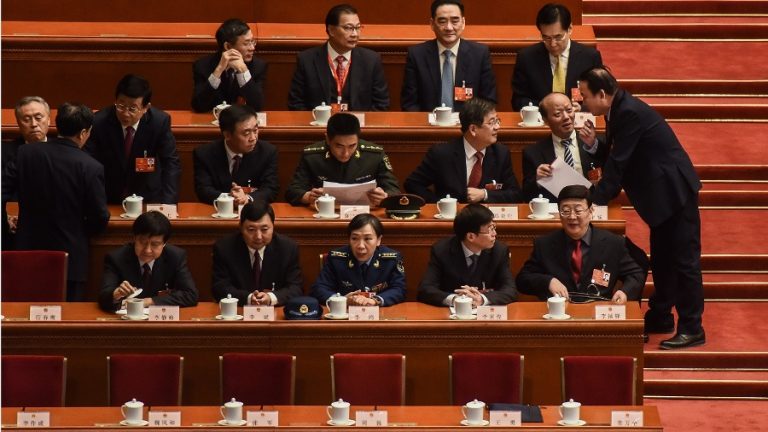
In March 2026, the National People’s Congress, Beijing’s rubber-stamp legislature, opened its annual session inside the Great Hall of the People. The military delegation’s roster was conspicuously thin. Over a hundred senior officers in the Chinese Communist Party’s armed forces have been purged or have vanished since Xi Jinping began his current wave of military consolidation in 2022.
At the military delegation’s session, Xi Jinping, the CCP’s general secretary and China’s top leader, declared: “The military carries guns. There must be no one in its ranks who is disloyal or dishonest toward the Party.”
The statement answers its own question. The military did not malfunction. One man lost the capacity to trust anyone around him.
Thirteen years ago, Xi struck a very different tone. In 2013, he pledged to “lock power inside the cage of institutions.” In 2019, he instructed commanders to look at their subordinates with “trusting eyes, appreciating eyes, developmental eyes.” By 2026, the man who demanded others extend trust is incapable of extending it himself.
The Central Military Commission, the body that exercises supreme command over all of China’s armed forces, had seven members when Xi consolidated power. It now has two. Xi assumed the cage of institutions would only ever hold other people. The Chinese Communist Party itself, however, is a larger cage, and every communist dictator in history who reached this stage of consolidation ended up locked inside the system he thought he controlled. The pattern holds all the more for a leader who may prove to be the Party’s last.

Success
You are now signed up for our newsletter
Success
Check your email to complete sign up
Xi Jinping’s sworn brother Zhang Youxia now faces accusations of leaking nuclear weapons data
The most telling case in Xi Jinping’s military purge belongs to Zhang Youxia, who until recently served as first vice chairman of the Central Military Commission, making him the second most powerful military figure in China. According to the South China Morning Post, Zhang was Xi’s sworn brother. Their families had maintained close ties for decades, a bond rooted in the revolutionary generation that fought alongside Mao Zedong.
In 2022, Xi broke with established precedent to retain Zhang in his post. According to CNN reporting from January 2026, this sworn brother now faces accusations that include passing core nuclear weapons technical data to the United States. Decades of family loyalty proved no match for a few years of mounting suspicion. The Chinese Communist Party always ensures that its own people consume each other. That is the script the Party was written with.
According to The Diplomat, of the 35 lieutenant generals and full generals that Xi Jinping personally promoted since 2020, 29 have been purged. He is not rooting out a rival faction’s appointees. He is destroying officers he selected himself.
When 29 out of 35 of a leader’s handpicked generals turn out to be “disloyal,” the problem has moved beyond personnel. The problem is the system that shaped them.
Xi has warned repeatedly against “two-faced people,” a term in Chinese political vocabulary for officials who perform loyalty in public while harboring different intentions in private. He has never stopped to consider what is manufacturing them at scale.
From the day it seized power, the Chinese Communist Party has operated on fear and fabrication. The Yan’an Rectification Movement of the 1940s used forced confessions to break independent thought and enforce ideological conformity. The Great Leap Forward of the late 1950s required every level of government to falsify production numbers, creating a pyramid of lies that contributed to a famine killing tens of millions. The Anti-Rightist Campaign of 1957 invited citizens to offer honest criticism of the Party, then systematically destroyed everyone who accepted the invitation.
Each campaign delivered the same lesson: honesty is fatal, and performed loyalty is the price of survival. A party built on falsehood, coercion, and internal struggle cannot produce honest people. Xi presides over an institution whose core operating method is deception, then rages at the discovery that he is surrounded by deceivers. From the moment he stood before the Party flag and swore his oath, his path led to a dead end.

China’s military has shrunk from 26 generals to six. This is self-destruction
In 2017, Xi Jinping announced his ambition to build a “world-class military.” Full generals have since fallen from 26 to six. The Central Military Commission has gone from seven members to two. This trajectory is the opposite of military modernization. It is institutional self-destruction.
Xi’s accusation that Zhang Youxia leaked nuclear weapons data carries an unintended confession: the person to whom Xi personally entrusted command authority over China’s nuclear arsenal was, by Xi’s own telling, the last person who should have held it. With the command chain fractured at this level, whether those nuclear secrets remain secure is a question Xi himself may be unable to answer.
History offers a consistent pattern. Stalin’s most paranoid phase was followed immediately by the political thaw that dismantled his cult of personality. Mao Zedong’s Cultural Revolution, a decade of ideological terror, was followed by the forced pragmatism of Reform and Opening Up. Extreme consolidation does not stabilize authoritarian systems. It destabilizes them.
This time, the Chinese Communist Party’s accumulated record of persecution, deception, and violence has filled the historical ledger. There may be no further cycle of tightening and loosening. History may simply be done with the Party altogether.
In 2012, Xi said he had “deeply absorbed the painful lessons” of the Cultural Revolution. What he absorbed was a single operational takeaway: grip power more tightly. For every person still inside the system, the most important decision at this moment in history is not how to perfect their performance of loyalty to the Party. It is whether to step outside the Party’s ideological prison, recover their own conscience, and preserve something of themselves before the structure collapses around them.
The names vanishing batch after batch from the delegate roster at the Great Hall of the People are not evidence of Xi Jinping’s strength. They are markers along the road toward the Chinese Communist Party’s end.
By Xinye