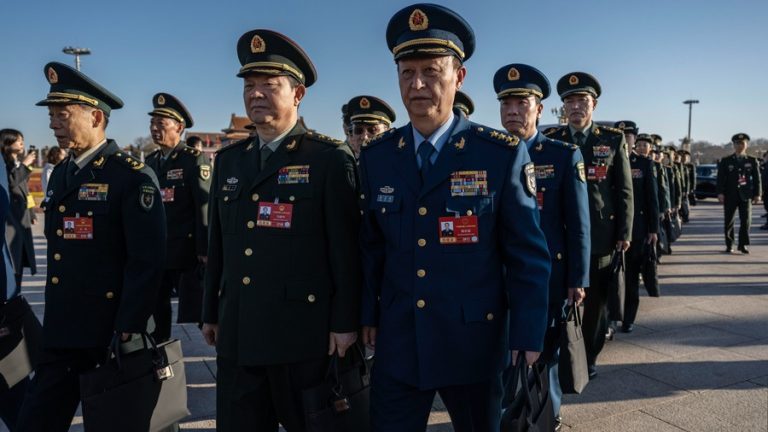
A retired Chinese general with longstanding ties to senior military leader Zhang Youxia died in late February, but authorities disclosed the news only weeks later, an unusual delay that has drawn attention amid ongoing uncertainty inside China’s military leadership.
Li Guangju, former political commissar of the Hebei Provincial Military District, died in Beijing on Feb. 23, 2026, at age 70. The People’s Liberation Army Daily published his obituary on March 28.
Li held the rank of major general and served as a military delegate to the National People’s Congress, China’s legislature. Born in May 1955 in Jinan, Shandong province, he spent most of his career in the former Beijing Military Region and its subordinate units.
His positions included political commissar of a brigade under the 65th Group Army, director of a division-level political department, and later political commissar at the division level. He also headed the Organization Department under the Beijing Military Region’s political department and served as deputy political commissar of the Hebei Provincial Military District.
In March 2012, Li became political commissar of the Hebei Provincial Military District. He was later appointed to the Hebei provincial Party Standing Committee before stepping down in November 2015 upon reaching retirement age.

Success
You are now signed up for our newsletter
Success
Check your email to complete sign up
Li’s career overlapped with that of Zhang Youxia, now a vice chairman of the Central Military Commission, China’s top military body. Zhang served as deputy commander of the Beijing Military Region from late 2005 to 2007, placing Li within the same command structure.
Another senior officer, Liu Zhenli, chief of staff of the Central Military Commission’s Joint Staff Department, also served in the Beijing Military Region and in the 65th Group Army. Liu was chief of staff of the unit from 2009 to 2012 and later its commander until 2014.
Chinese authorities announced on Jan. 24, 2026, that both Zhang and Liu had been removed from their posts. Since then, unverified reports about Zhang’s situation have circulated, including claims that he was detained and mistreated.
Li’s death occurred roughly one month after those developments. The gap between his passing and the official obituary stands out. Announcements for retired officers of similar rank are typically released more promptly, particularly for individuals with access to high-level medical care.
The timing has led to speculation about whether factors beyond illness may have influenced either the delay or the handling of the announcement.
Other military figures linked to Zhang have also had their deaths disclosed after delays.

In late January, state news agency Xinhua reported on consecutive days the deaths of two senior officers. Liao Xilong, a former member of the Central Military Commission and head of the General Logistics Department, was said to have died on Jan. 23 at age 85. The following day, Xinhua reported the death of Wei Fulin, a former deputy chief of the General Staff, who died on Jan. 15 at age 88.
Both men had professional ties to Zhang. Wei served as commander of the Chengdu Military Region in the mid-1990s, while Liao held senior command roles in the same region from the 1980s through the early 2000s. During that period, Zhang Youxia served as deputy commander and later commander of the 13th Group Army under the Chengdu Military Region.
Liao and Zhang also shared combat experience during the Sino-Vietnamese War.
Additional claims, not independently verified, have been raised by U.S.-based commentator Cai Shenkun. Cai said Zhang Youxia was detained on Jan. 19, 2026. The following day, Liao’s son and brother were reportedly taken into custody. According to the same account, Liao was unable to determine who had detained them, despite making inquiries. He died three days later, on Jan. 23.
Sources cited by Cai suggested Liao’s death was not due to illness but followed extreme emotional distress.
The sequence of delayed announcements, personnel removals, and circulating claims has left key aspects of recent developments within China’s military unclear, as official information has been released only in limited form.
Editor’s Note: This article is based on media reports, publicly shared online information, and commentary from overseas analysts. Certain claims, including alleged detentions and internal developments within China’s military, have not been independently verified.