On March 30, 2026, Miles Yu, the director of the China Center at the Hudson Institute and a leading U.S. expert on CCP military strategy, published an article in the Washington Times titled “Shock and Purge: How American Military Superiority Is Dismantling the CCP’s War Machine.”
Yu’s central argument is direct: from the 1991 Gulf War to the recent military conflicts involving Iran and Venezuela, America’s overwhelming battlefield superiority has repeatedly exposed systemic weaknesses in the Chinese Communist Party’s military-industrial complex. The Chinese-made air defense networks, radar systems, and missile platforms deployed in Venezuela and Iran proved limited in effectiveness or completely useless against America’s advanced stealth and electronic warfare capabilities. The failures have shattered the credibility of CCP-manufactured weapons and laid bare the enormous gap between Beijing’s propaganda about its military hardware and its actual performance on the battlefield.
The CCP leadership’s response to these humiliations has followed a consistent pattern. Instead of pursuing institutional reform, the Party assigns blame to individuals and launches mass purges through the military’s senior ranks and defense research establishment.
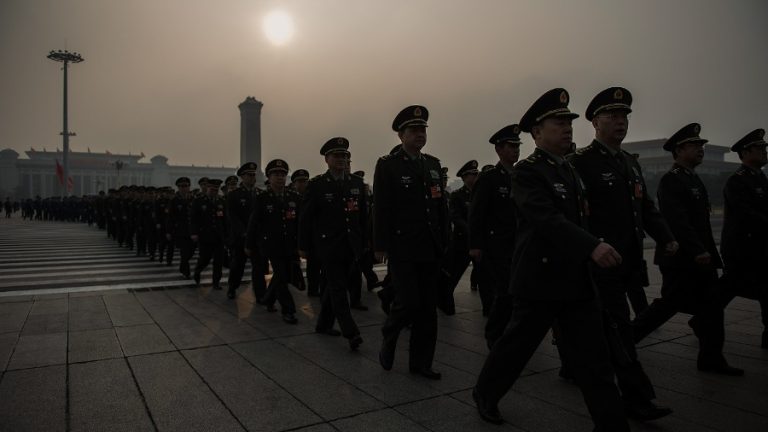
The scale of the current purge cycle is staggering. Since the U.S. military operation in early January 2026 to capture Venezuelan president Nicolás Maduro, a wave of senior CCP generals have been “disappeared” from public life. During the Party’s annual “Two Sessions” legislative meetings in early March 2026, a carefully choreographed political ritual held by China’s rubber-stamp legislature, only 6 of the CCP’s 26 full generals appeared publicly. Of the six military members on the Central Military Commission, the CCP’s top military command body, four have been purged in recent months.
The purge has spread well beyond the uniformed military. It has reached deep into the scientific research and industrial core of the CCP’s weapons development apparatus.
Success
You are now signed up for our newsletter
Success
Check your email to complete sign up
The scientists behind China’s top weapons programs are being eliminated
Yu catalogues dozens of cases in which experts tied to China’s most sensitive defense programs have vanished from public life or been stripped of their positions. The affected programs span the full range of the CCP’s military ambitions: aircraft carrier construction, advanced fighter jet design, radar systems, strategic weapons, and air defense missiles.
The most dramatic case came on March 25, 2026, when Tan Ruisong, the former chairman of the Aviation Industry Corporation of China (AVIC), the state-owned conglomerate responsible for virtually all of China’s military aircraft production, was sentenced to a suspended death penalty on charges of embezzlement, bribery, insider trading, and leaking insider information. Tan was accused of accepting bribes exceeding 600 million yuan, roughly $82 million.
Yu also draws attention to the mysterious deaths of several top Chinese defense researchers. Two CCP hypersonic weapons experts have died in quick succession: Fang Daining, aged 68, a key scientist in China’s hypersonic weapons program who led the development of ultra-high-temperature testing instruments for national defense materials, died suddenly on Feb. 27, 2026. Yan Hong, aged 57, a professor specializing in supersonic and hypersonic propulsion research in China’s aviation engine sector, died suddenly on March 24, 2026. The timing of both deaths, in the middle of the most sweeping defense purge in years, has fueled intense speculation.
China’s most prestigious scientific bodies have been purged of defense experts
The purge has ripped through the Chinese Academy of Sciences and the Chinese Academy of Engineering, the two most prestigious scientific bodies in China, where membership signals the highest level of state recognition for a researcher’s contributions.
On March 18, 2026, the Chinese Academy of Sciences quietly updated its official roster of academicians. The name and biography of Yang Wei, the chief designer of the J-20 stealth fighter, China’s most advanced combat aircraft, and a former vice president of AVIC, had been removed. Yang’s biography had already been scrubbed from AVIC’s own “Leadership Team” page as early as Jan. 18, 2025, alongside that of Hao Zhaoping, the corporation’s general manager.
In March 2026, the Chinese Academy of Engineering also purged three names from its roster. Wu Manqing was the former general manager of the China Electronics Technology Group Corporation (CETC), the state enterprise that has long dominated China’s electronic warfare and radar technology programs. Zhao Xiangeng is a condensed matter physicist and nuclear weapons engineering expert. Wei Yiyin was the former deputy general manager of the China Aerospace Science and Industry Corporation (CASIC), a missile technology specialist at the heart of the CCP’s strategic weapons programs.
On Feb. 4, 2026, China’s rubber-stamp legislature, the Standing Committee of the National People’s Congress, announced the removal of three individuals from their positions as legislative deputies: Zhou Xinmin, the former chairman of AVIC; Luo Qi, the chief engineer of the China National Nuclear Corporation; and Liu Cangli, a weapons physicist who served as president of the China Academy of Engineering Physics, the institution at the center of China’s nuclear weapons research.

Political purges replace technical reform, and the technology gap keeps growing
Yu’s analysis identifies the deeper structural problem. The CCP system is incapable of openly acknowledging its own failures. Whenever defects are exposed by battlefield reality, the authorities assign blame to individuals instead of pursuing institutional reform. Political purges replace technical reform. Each wave of purges then further undermines the system’s capacity to learn and adapt, because the very people with the expertise to diagnose and fix problems are the ones being eliminated. The technology gap between the United States and China continues to widen.
The consequences cascade. Researchers and engineers throughout the defense sector see that their colleagues are being punished for failures that are systemic, and their willingness to take risks, report problems honestly, or pursue unconventional solutions collapses. The cycle is self-reinforcing: failure leads to purges, purges lead to institutional paralysis, and paralysis leads to the next generation of weapons failures.
Four structural flaws that no amount of purging can fix
Yu identifies four structural flaws embedded in the CCP system that no purge campaign can resolve.
First, the CCP has immense difficulty producing genuine military innovation. Its defense sector relies heavily on reverse engineering and the theft of foreign technology, which provides a starting blueprint but cannot substitute for the deep institutional knowledge needed to iterate and improve.
Second, even when Chinese defense firms obtain foreign designs, they consistently struggle to replicate the engineering precision and materials science required for reliable performance. Copying a blueprint and building a system that works under combat conditions are fundamentally different challenges.
Third, the military-civil fusion strategy that CCP general secretary Xi Jinping championed as a shortcut to technological parity has instead bred staggering corruption and inefficiency across the defense sector. The blending of military and civilian industrial networks created vast new opportunities for graft while doing little to accelerate genuine capability.
Fourth, a political system built on exaggerated propaganda fuels institutional “self-deception.” When every level of the bureaucracy is incentivized to report success and conceal failure, critical defects in weapons systems go undetected until they are exposed by actual combat, at which point it is too late to fix them quietly.

From the Gulf War to Venezuela and Iran, Beijing only reacts after it loses
Yu places the current purge in historical context. The pattern has repeated for over three decades. After the 1991 Gulf War, in which American precision-guided munitions and stealth aircraft obliterated an Iraqi military equipped with Soviet and Chinese weapons, Beijing launched a crash military modernization drive. The same reactive cycle has played out after every subsequent American military success.
“Each incident confirms a pattern,” Yu writes. “Progress on the CCP’s side does not come from sustained internal innovation. It is a reactive acceleration triggered by the shock of American military victories.”
The current round is the most severe yet. As CCP-manufactured weapons in Venezuela and Iran were exposed as, in the words of Chinese internet commentators, “unresponsive scrap metal,” Xi Jinping appears to have been infuriated by the revelation that his military hardware was, as a Chinese expression puts it, “impressive to look at but useless in practice.” The earthquake-level purge of the military-industrial system is the result of Xi venting that fury by eliminating the experts who built the weapons that failed, rather than confronting the system that produced them.
As Yu observes: “This pattern reflects more than strategic competition. It reveals deeper structural flaws within the Chinese Communist Party system itself.”