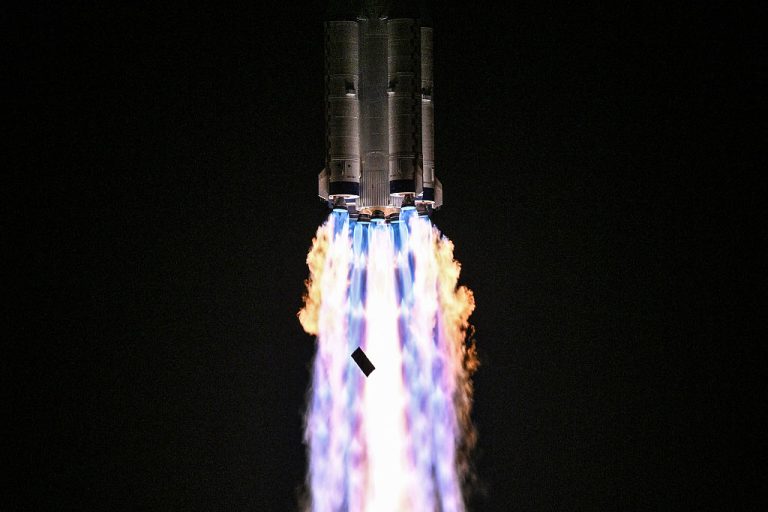
After several weeks of delays, NASA successfully launched the Artemis II mission on Wednesday, April 1 at 6:35 p.m., marking a key step in humanity’s return to the Moon.
The launch proceeded smoothly overall. According to Yahoo News, two solid rocket boosters provided about 80 percent of the thrust and separated successfully at 6:37 p.m. Eastern Time. The spacecraft entered Earth orbit at 6:44 p.m., nine minutes after launch. Subsequently, all four solar panels were fully deployed and locked by 6:59 p.m., and the perigee-raising maneuver was completed successfully at 7:26 p.m., with all flight stages operating normally.
Charlie Blackwell-Thompson, NASA’s Launch Director for the Exploration Ground Systems project, told the crew during the launch that this mission carries “the hopes and dreams of a new generation.”
NBC News reported that she noted this historic flight not only reflects the hard work of the Artemis team but also embodies the American spirit of exploration and the contributions of global partners.
Artemis II mission commander Reid Wiseman told the ground control center, “We just saw a beautiful Moonrise, and we’re heading right there.”
Success
You are now signed up for our newsletter
Success
Check your email to complete sign up
There was a minor hiccup before launch. The launch control team detected an abnormal battery reading, but the issue was quickly resolved without affecting the launch schedule.
On launch day, the weather at Kennedy Space Center in Cape Canaveral, Florida, was generally favorable. NASA initially assessed an 80 percent chance of success, with main risks from clouds and strong winds. Conditions later improved to 90 percent, meeting launch standards. The launch window opened at 6:24 p.m. and lasted two hours, with backup opportunities available through April 6.
The countdown began on Monday prior to launch. After saying goodbye to their families, the astronauts entered launch preparation, and the rocket was fully fueled. Blackwell-Thompson said before launch that all preparations were complete.
The launch had been previously delayed due to technical issues. Last month, NASA rolled back the 11-million-pound Space Launch System (SLS) rocket from the launch pad to the hangar to repair a fault affecting fuel flow to the engines. The problem was discovered less than 24 hours after a “wet dress rehearsal,” which involved loading over 700,000 gallons of cryogenic propellant and simulating the full launch sequence. After repairs, the 322-foot rocket was returned to the pad on March 20, a 12-hour transport over about four miles.

The Artemis program is NASA’s long-term strategy to return humans to the Moon, with the goal of establishing a sustainable human presence at the lunar south pole. Scientists believe this region is rich in water ice, which can be used for drinking, oxygen, and rocket fuel. The program also lays the foundation for future crewed Mars missions, building on the legacy of the 20th-century Apollo program.
As a key part of the program, Artemis II is the first crewed lunar flyby mission by the U.S. in over 50 years and the first time the SLS rocket and Orion spacecraft carry astronauts on a mission. NASA stated this mission represents an important step toward sustained lunar exploration and eventual Mars missions.
According to mission design, the spacecraft will not land on the Moon. The four astronauts will fly about 600,000 miles around the Moon and return to Earth at approximately 30 times the speed of sound. The mission is expected to last around 10 days. During the flight, the crew will primarily test Orion’s life support systems and conduct multiple experiments to gather crucial data for future lunar landings. NASA plans to achieve an actual lunar landing with Artemis III, targeted for 2027.
During the mission, the astronauts will serve as both “scientists” and “test subjects,” collecting data on the effects of long-duration deep-space travel on the human body. NASA says this information will provide essential reference for future Moon and Mars missions.
The crew includes NASA astronauts Reid Wiseman, Victor Glover, and Christina Koch, along with Canadian Space Agency astronaut Jeremy Hansen. Koch will become the first woman to enter lunar orbit, and Glover will be the first person of color to carry out this mission.
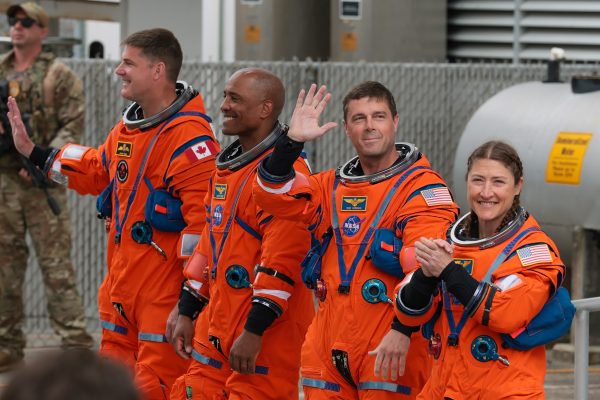
The crew arrived at Kennedy Space Center on March 27 and entered isolation before launch to ensure they were fit for flight. NASA said the astronauts strictly followed sleep and nutrition plans while receiving real-time updates on rocket status and weather.
Before launch, Wiseman said in an interview, “Let’s go to the Moon! I believe the whole country, even the world, has been waiting for this moment for a long time.”
Nature magazine noted that although this mission does not involve landing, it will conduct multiple observations and life sciences experiments near the Moon, providing important scientific and engineering data for subsequent crewed lunar landings and advancing human deep-space exploration into a new phase.