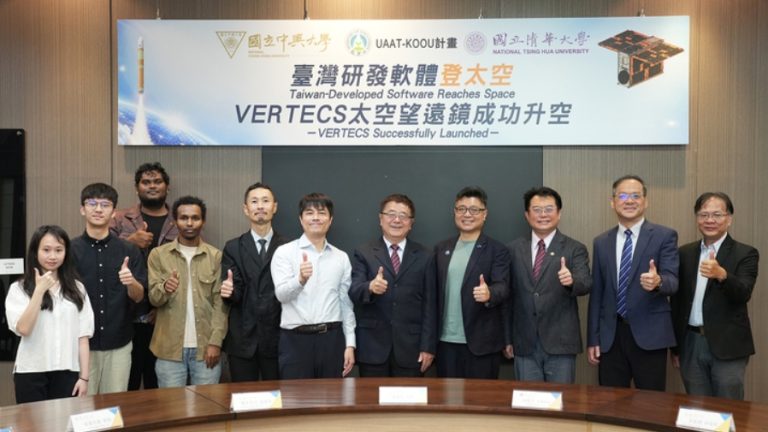
Taiwan’s space technology has taken another major step forward. According to the Central News Agency, the Cosmic Observation System independently developed by Taiwan’s National Applied Research Laboratories’ National Space Organization (TASA) was recently launched aboard a Japanese rocket and successfully reached space to begin its mission. This not only verifies Taiwan’s domestically developed space payload and observational technologies, but also marks a new stage in Taiwan–Japan space cooperation.
A milestone in Taiwan’s space technology innovation
The cube satellite space telescope “VERTECS (Visible Extragalactic background RadiaTion Exploration by CubeSat),” jointly developed with participation from Taiwan’s National Chung Hsing University and National Tsing Hua University, was successfully launched on the 12th aboard Japan’s latest H3 launch vehicle Flight No. 6, beginning its space observation mission. This marks a new milestone in Taiwan’s participation in international space cooperation and demonstrates the country’s capability in independently developing space data systems.
The VERTECS project is led by Kyushu Institute of Technology in Japan, in collaboration with the Japan Aerospace Exploration Agency (JAXA) and 13 academic, industry, and research institutions from Japan and Taiwan. It is also the first space mission under the Ministry of Education’s UAAT-KOOU integrated program “Space Technology Exploration and Data Science Applications.” On launch day, Chung Hsing University Vice President for Research Song Zhenming, Ministry of Education Higher Education Department Deputy Director Zeng Xinyuan, Associate Professor Hashimoto Tetsuya from Chung Hsing University’s Department of Physics, and Professor Goto Tomotsugu from National Tsing Hua University’s Institute of Astronomy either joined remotely or attended in person in Japan to witness the launch. Chung Hsing University also held a results press conference on the 25th.
The research team noted that VERTECS carries an important mission to explore the source of “Excess Light” in the universe. Scientists have long observed that cosmic background radiation contains a mysterious background glow whose brightness far exceeds the total known light from galaxies. The cause of this phenomenon remains unexplained and is considered a major unsolved problem in modern astronomy.
Because Earth’s atmosphere is much brighter than the faint cosmic background radiation, high-precision observations must be conducted using space telescopes. VERTECS has a wide field of view of 36 square degrees and will conduct the world’s highest-precision observations of cosmic background radiation in the visible light spectrum over the next year, aiming to provide important scientific evidence for the evolution of the universe and the origin of background light.
Success
You are now signed up for our newsletter
Success
Check your email to complete sign up
Another highlight of the mission is that the satellite’s data reception, processing, and calibration systems were independently developed by Taiwanese research teams and successfully deployed in space alongside the satellite. This demonstrates Taiwan’s R&D capabilities in space data science, satellite payloads, and software system integration.
Training a new generation of space technology talent
The UAAT-KOOU program is led by Professor Lin Jianhong of National Cheng Kung University, in collaboration with Chung Hsing University, National Tsing Hua University, Kyushu Institute of Technology, Kyushu University, and other institutions. It promotes three cube satellite science missions while cultivating a new generation of Taiwanese space technology talent.
Chung Hsing University President Zhan Fuzhi stated that the greatest value of the program is providing students and faculty with opportunities to participate in international space missions, allowing students to gain valuable research and practical experience through cross-border collaboration. He also noted that Taiwan’s independently developed data reception and processing system has been successfully applied in a space mission, fully demonstrating the country’s achievements in space data science.
Project lead Professor Hashimoto Tetsuya said it is very encouraging to see young Taiwanese students directly participating in international space science missions and contributing to cutting-edge research. This is not only a scientific achievement but also an important advancement in space talent development in Taiwan.
Co-lead Professor Goto Tomotsugu from National Tsing Hua University stated that VERTECS will conduct the world’s most precise observations of cosmic background radiation and is expected to become an important first step in unraveling the mystery of extragalactic background light sources, further advancing humanity’s understanding of the formation and evolution of the universe.
Deputy Director Zeng Xinyuan of the Ministry of Education’s Higher Education Department said the VERTECS mission demonstrates the results of Taiwan’s higher education and international research collaboration. The ministry will continue to support space technology and key talent development, helping more young people participate in international space research and enhancing Taiwan’s competitiveness and visibility in the global space technology field.
The research team stated that after launch, VERTECS will undergo satellite function verification and preliminary observations. Over the next year, it will continue collecting cosmic background radiation data, moving toward solving the mystery of the origin of “Excess Light” in the universe.