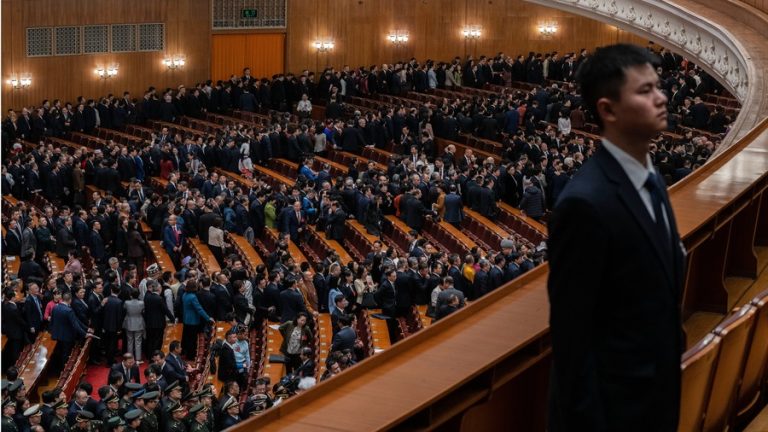
A short video broadcast by Japan’s TBS Television has circulated widely online, offering an unusually detailed look at preparations inside the Great Hall of the People ahead of the closing session of China’s annual “Two Sessions” on March 12.
The gathering, which brings together the National People’s Congress and the Chinese People’s Political Consultative Conference, assembles thousands of delegates each year and is widely viewed as a formal setting where decisions already made by the Chinese Communist Party are approved.
The camera lingers on Xi Jinping’s seat.
Before the session begins, a man identified by observers as a senior security supervisor wipes his forehead. A security officer, described online as resembling personnel assigned to Zhongnanhai protection, sits in Xi’s chair and runs his hands across the seat, the armrests and the desk surface. Several uniformed military personnel stand nearby, watching.
The sequence unfolds step by step.
Success
You are now signed up for our newsletter
Success
Check your email to complete sign up
A staff member opens a sealed plastic bag, removes three pens, and places them on the desk with careful alignment. Another worker wipes down the desk, the chair, and the voting button. When she finishes, two assistants stand on either side, fanning the surface with sheets of paper as if to ensure it is completely dry.
Two men step forward with a ruler and measure the distance between Xi’s seat and that of Premier Li Qiang. They exchange a few words with a colleague, then step back.
Elsewhere, staff move in synchronized steps to pour water. Two women approach the desk carrying teacups, one holding a tray, the other receiving it before standing aside. A male supervisor watches closely as each movement is completed.
At one point, a staff member lifts a teacup lid and shakes it lightly, apparently to remove water collected underneath.
More than twenty separate actions are carried out to prepare a single seat.

Two teacups draw attention and speculation
One detail stands out.
Xi’s desk holds two teacups. Other delegates have one.
Online speculation has suggested that one cup contains tea while the other may hold traditional Chinese herbal medicine. Those claims have not been independently verified.
The video prompted a wave of reaction on social media, where users focused on both the number of steps involved and the level of control visible in the process.
“Three soldiers and twenty steps just to prepare one seat,” one comment read. Another suggested the scene may have been intentional, writing that the cameras were allowed in deliberately.
Some responses focused on the contrast between the scale of the preparations and the setting itself. Wang Dan, a U.S.-based pro-democracy activist and a former student leader in the 1989 Tiananmen Square protests, noted the detail of the three pens arranged on the desk, calling it unexpectedly amusing.
Heightened security seen at new year military event
Similar patterns were visible in other recent appearances.
On Feb. 6, 2026, Xi attended a Lunar New Year performance in Beijing honoring retired military officers. Video released by state media shows multiple bodyguards positioned close to him throughout the event.
As Xi moves along the line greeting elderly veterans and their families, the guards remain within arm’s reach. Their posture is controlled but alert. The people being greeted are, in many cases, in their seventies and eighties.
The moment passes without incident, but the proximity is difficult to miss.
Zhongnanhai removed from mapping platforms
Security sensitivity appears to extend beyond physical proximity.
On Jan. 3, 2026, U.S. forces carried out an operation targeting Venezuelan leader Nicolás Maduro. In the days that followed, Chinese users reported that Zhongnanhai, the central leadership compound in Beijing where Xi and other senior officials live and work, could no longer be located on major domestic mapping platforms.
Searches for “Zhongnanhai” on Amap, Baidu Maps and Tencent Maps returned no results. Some users reported that their searches were redirected to other locations.
Online responses questioned the move, noting that the compound’s location is widely known within the city.
Security measures extend into infrastructure and daily life
Accounts from individuals familiar with security arrangements describe a system that extends far beyond what is visible in public footage.
Du Wen, a former Inner Mongolia official now living in Europe, has described earlier protocols in which manhole covers along motorcade routes were welded shut. According to sources cited in online discussions, more recent measures involve coordinated patrols of underground tunnels and sewage systems by police, armed police and military units.
Those practices, according to the same accounts, have affected drainage systems in some areas, with consequences during periods of heavy rainfall.
When Xi travels near bodies of water, additional layers of security are said to be deployed. At Wuliangsuhai Lake in Inner Mongolia, divers patrol underwater while monitoring equipment scans the lakebed. Local fishermen are barred from operating during such visits.
Airspace is also tightly controlled. Police helicopters and drones circle above, while electronic jamming systems block wireless signals in the surrounding area. These measures are intended to reduce the risk of remotely triggered threats, though they also interfere with ordinary communications.
Hospitals and emergency services in affected areas have reported disruptions to their communication systems.
On the ground, roads along Xi’s route are cleared in advance. Vehicles are removed if left parked, and residents in designated areas are required to remain indoors during visits. In some cases, residential compounds are temporarily sealed, limiting movement and access to daily necessities.
In those areas, daily routines stop.
Editor’s Note: This article is based on media reports, publicly shared online videos, blogger statements, and personal testimony cited by overseas media. Certain details, including interpretations of security procedures and claims regarding health conditions, have not been independently verified.