This is the second part of a two-part series on Zhang Guotao, one of the founders of the Chinese Communist Party, who publicly resigned from the Party in 1938. Part One covered his early life, the founding of the CCP in 1921, and the Nanchang Uprising of 1927. This part picks up where that left off.
By 1928, Zhang Guotao had already spent seven years inside the Chinese Communist Party’s highest leadership. He had watched Moscow override the CCP’s own judgment on nearly every major decision. He had seen the Party infiltrate and betray its Nationalist partners. He had witnessed the Nanchang Uprising turn Chinese soldiers against their own classmates in a military failure the Party was already repackaging as a glorious founding myth.
He was not done yet. The decade ahead would show him things that made those early doubts seem mild.
Moscow, again: watching Stalin eat his own
Zhang arrived in Moscow in mid-1928 and spent two and a half years there. It finished whatever idealism he had left.
Stalin was eliminating rivals throughout the Soviet Communist Party and the Communist International. Figures who had been prominent in international communist circles were vanishing without explanation. A layer of informers and opportunists operated freely, denouncing whoever stood in their way. Zhang held the Order of Lenin, which at the time conferred real practical benefits across the Soviet Union: free transport, lodging, meals. He quietly removed the medal and threw it away. He did not want to wear it anymore.
Success
You are now signed up for our newsletter
Success
Check your email to complete sign up
He wrote about his feelings toward the Party he had co-founded with characteristic honesty: “I had always thought of the CCP as something I cared for with deep feeling, as a father cares for a son. At first I thought the child was developing well. Through so many upheavals, my expectations shrank. I began to feel the child was not measuring up. But as any father would, I still thought: difficult as he is, he is still my son.”
That attachment would take another ten years to fully break.
Life inside the base areas: kidnapping, plunder, and what the Red Army actually did
Zhang entered the communist base area straddling Hubei, Henan, and Anhui provinces in March 1931, taking command of its military commission. He later served as deputy chairman of the “Chinese Soviet Republic,” the parallel government the CCP had declared on territory it controlled in central China.
On his way there, he overheard passengers on the same vehicle discussing how a nearby town’s commerce had collapsed because “communist bandits” were raiding regularly. A local shopkeeper had been abducted just days before. Kidnapping for ransom was how the Party’s guerrilla units financed operations. Zhang found it both politically damaging and morally indefensible.
The base area’s food supply depended on raiding villages outside communist control. Red Army units and local farmers went together, splitting whatever they seized. In practice, there was no reliable way to identify “landlords” in a strange village. Grain went to whoever had it. Waste was routine. As nearby areas were stripped, raids ranged further. Zhang recorded that the Red Army’s discipline was poor, bandit behavior was common, and the sexual assault of women happened regularly.
Zhou Enlai’s special operations apparatus disturbed Zhang most. When the CCP’s intelligence chief Gu Shunzhang was captured and agreed to cooperate with the Nationalist government, Zhou’s agents killed every member of Gu’s family. Separately, a Whampoa Military Academy graduate who had worked directly under Zhou approached Chiang Kai-shek wanting to defect. When persuasion failed, Zhou had him executed as a traitor. Zhang told Zhou the Party’s highest disciplinary sanction was supposed to be expulsion from the Party, not death. Zhou’s apparatus went on killing regardless.
The long march was nearly a final defeat
When Chiang Kai-shek’s fifth major encirclement campaign destroyed the Jiangxi Soviet zone in 1934, the results were stark. Mao’s Central Red Army left Jiangxi with roughly ninety thousand men. By June 1935, when it reached Maogong in western Sichuan and converged with Zhang’s Fourth Front Army, it had fewer than ten thousand survivors.
Zhu De, the Red Army’s commander in chief, told Zhang plainly: “Without the Fourth Army here to receive us, this would have been a complete dead end. The First Front Army can no longer fight. It was once a giant. Now there is nothing left but bone.”
Zhang’s force numbered around eighty thousand men, better trained and better armed than anything Mao had left. Zhang was, by any practical military measure, the most powerful communist commander in China. He was also the most credible challenge to Mao’s political authority. The months of maneuvering that followed, over the army’s direction of march, the choice of future base areas, and control of the combined forces, formed the sharpest internal conflict in the CCP’s entire pre-1949 history.
Moscow settled it, not through military judgment but through a change of political line. In July 1935, the Communist International’s Seventh Congress in Moscow abandoned the “Chinese Soviet movement” strategy and ordered communist parties worldwide to form anti-Japanese united fronts. The instruction was driven by Soviet self-interest: Japan and Germany were both threats to the Soviet Union, and China was needed to absorb Japanese attention. The CCP adopted the slogan “March North to Resist Japan,” using it to persuade Nationalist garrisons to stand aside. The Red Army reached northern Shaanxi. It survived, not because of its own strength, but because Stalin needed it to.
The Xi’an incident: Stalin rescued the man the CCP had spent years trying to kill
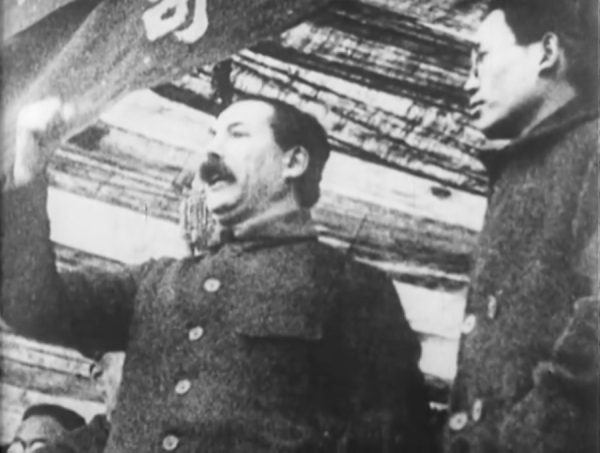
By late 1936, Chiang Kai-shek’s encirclement campaigns were closing in on the Red Army’s remaining positions in the northwest. The CCP, meanwhile, had cultivated Zhang Xueliang, the warlord commanding the region’s Manchurian forces after Japan had seized their home territory. Zhang Xueliang wanted Soviet backing and a path to retake Manchuria. The CCP offered connections to Moscow. On December 12, 1936, Zhang Xueliang and General Yang Hucheng seized Chiang Kai-shek at Xi’an.
Moscow’s response arrived the following evening. It had three parts. The first blamed Japan, claiming Japanese agents had manipulated Zhang Xueliang into manufacturing Chinese chaos from which Tokyo would benefit. The second declared Chiang Kai-shek the only figure capable of leading Chinese resistance to Japan. The third ordered the CCP to work for a peaceful resolution, negotiate with Chiang, and arrange his release.
The calculation was straightforward. A prolonged Chinese civil war served Japanese interests and threatened the Soviet eastern border. Chiang alive and leading a unified Chinese war effort was worth more to Moscow than Chiang dead and China fragmented. The CCP, which had spent a decade trying to destroy Chiang, now worked to free him.
Nationalist encirclement campaigns had come within roughly a month of eliminating the Red Army entirely. The Xi’an Incident ended that process. The CCP survived, consolidated, and within twelve years conquered the mainland. Whatever Zhang Xueliang’s personal grievances about Japan, his kidnapping rescued the organization that would go on to kill millions of Chinese civilians in the decades that followed.
He watched Yan’an become Moscow
After the Xi’an Incident, the CCP’s armies were redesignated the Eighth Route Army and nominally placed under Nationalist command. Nothing inside them changed. The CCP permitted no Nationalist penetration of its military structure. Its guerrilla base areas operated entirely on instructions from Yan’an, building a state within a state.
In August 1937, with full-scale war against Japan underway following Japan’s assault on Beijing on July 7, the CCP held its Luochuan Conference to set the Party’s priorities. What emerged from that meeting was not a war plan. General secretary Zhang Wentian declared the mission to be both fighting Japan and opposing the Nationalist government in Nanjing. Mao Zedong told those assembled not to be misled by patriotism, to avoid direct combat with Japanese forces, and to focus on expanding the Party’s military and territorial power behind Japanese lines.
Zhang Guotao was the only person in the room who objected openly. He argued that the CCP had always been wrecked by leftist posturing, and that refusing genuine anti-Japanese work at a moment of national crisis risked making the Party a criminal against the Chinese nation. The conference had to be adjourned.
Then, in March 1938, Stalin executed Nikolai Bukharin, one of the founders of the Soviet Communist Party, along with other early Party figures. Zhang saw the parallel immediately. He had watched the CCP travel the same arc as the Soviet party: idealistic founding, growing internal violence, systematic terror directed at its own members. Yan’an and Moscow were operating by the same logic. He had no intention of waiting to become a Chinese Bukharin.
The resignation, and the warning he left on the record
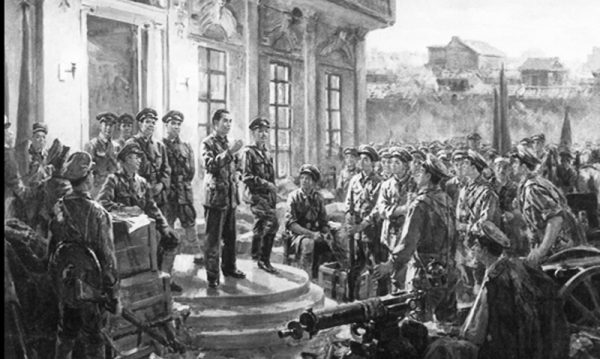
Zhang attended a national ceremony at the Yellow Emperor’s Mausoleum on April 4, 1938, and did not return to Yan’an. In Hankou, Zhou Enlai, Wang Ming, and other senior Party figures tried to stop him, using the Party’s Wuhan liaison office as an improvised detention facility. Zhang got out anyway. Two months later his wife, Yang Zilie, brought their children out of Yan’an. The family reunited.
On May 20, 1938, Zhang issued his public resignation and an open letter to the Chinese people. The charges were specific. The CCP’s Soviet-style program had proven “completely counter to the interests of the Chinese nation.” The Party had abandoned China’s industrial zones and working class long ago, lost its claimed social base, and was now engaged in “endless military conspiracy and violent uprising, obstructing both internal unification and external resistance to aggression.”
He defended the Nationalist government in terms that went beyond tactical calculation. The Nationalist Party had overthrown the Qing dynasty, established the Republic, completed national unification after the Northern Expedition, and was now conducting a war of resistance that had already cost more than five hundred thousand military lives. Chiang Kai-shek, Zhang wrote, had earned the genuine respect of the Chinese people and the world as the nation’s leader in its gravest hour.
In 1948, Zhang founded a weekly magazine in Shanghai called Chuangjin, or “Advance,” which argued that the CCP was the direct cause of China’s deepening crisis. Its articles charged that the Party pursued power with “no regard for morality, ethics, or the survival of the nation,” treated ordinary people as “expendable chattels,” and had spent “twenty long years soaked in killing, destruction, and subversion.” His prediction, published the year before the CCP seized power, proved accurate in every particular: if the Party’s armed revolution succeeded, “what would follow military conquest would inevitably be a dictatorship.”
It did.
The life he built on the other side
Zhang moved his family to Taipei in late 1948, then to Hong Kong in 1949. He directed the magazine Voice of China through the early 1950s. Beginning in 1966 he wrote his memoirs, comprising more than a million Chinese characters of first-hand testimony about the CCP’s founding and its early decades, published in both Chinese and English. When communist-organized riots convulsed Hong Kong in 1968, he relocated the family to Canada, where he died on December 3, 1979.
His personal life stood quietly at odds with the habits of many former comrades. Zhang and his wife Yang Zilie, married in 1924, stayed together until he died, a notable exception among CCP leaders of his generation for whom successive wives were unremarkable. Their three sons pursued scientific careers and earned advanced degrees. He had eight grandchildren.
In their final years, the couple watched from Canada as China sank deeper under CCP rule, as former comrades were purged and destroyed one by one, as the machine they had helped build consumed generation after generation. They had chosen to leave when leaving was still possible.
They had time to understand what that choice had been worth.
Why the memoir stays banned
The Chinese Communist Party has suppressed Zhang Guotao’s memoir since the People’s Republic was founded. The reason is not complicated. The book offers a detailed, first-hand account of the CCP’s founding and early decades written by a man who was present at every major decision, remembered everything, and had nothing left to protect.
His account contradicts the Party’s founding mythology on nearly every point that matters. The CCP was founded under Moscow’s direction by men who doubted their own judgment and deferred to Communist International instructions they did not fully understand. Its early operations included kidnapping for ransom, systematic grain seizure from ordinary farmers, and the killing of members who tried to leave. Its anti-Japanese credentials were a slogan adopted on Moscow’s order, not a principle the Party had ever held. Its internal politics replicated Stalin’s Soviet Union: loyalty enforced through terror, dissent answered with destruction.
Zhang Guotao lived long enough to see the full arc of what he had helped start in a Shanghai meeting room in 1921. His verdict, first delivered publicly in 1938 and recorded across a million words of memoir thirty years later, was consistent throughout: the Chinese Communist Party was, from its earliest days, an organization incapable of just governance and unwilling to tolerate anyone who said so.
The book that makes that case in the most detail, written by the man most qualified to write it, cannot be legally read in China today. The Party banned it. It has never lifted that ban.
Zhang Guotao’s memoir, “My Recollections,” was published in Chinese and in English translation. It remains unavailable inside mainland China. Part One of this series covers Zhang’s early life, the founding of the CCP, and the events leading to 1927.