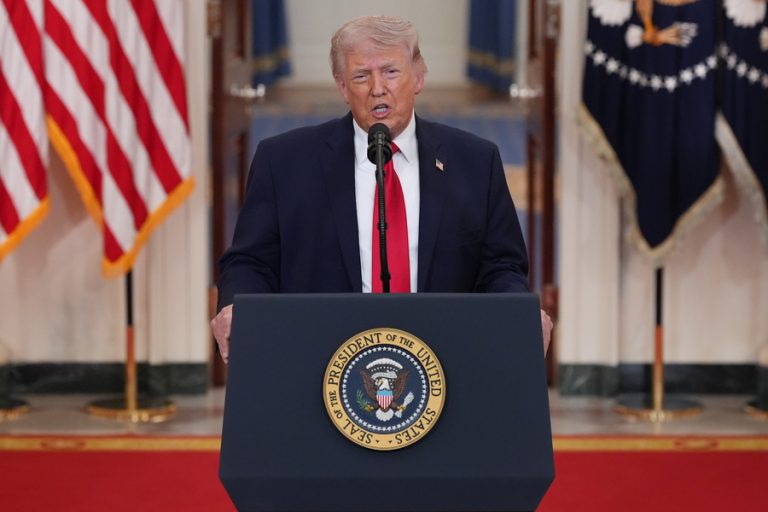
U.S. President Donald Trump said on Thursday, April 9 that Iran has failed to fulfill key commitments under the recent U.S.–Iran ceasefire agreement, particularly regarding allowing free oil transit through the Strait of Hormuz, and accused Tehran of acting “very badly.”
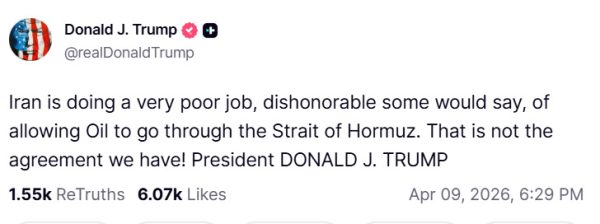
Trump posted on Truth Social: “Iran is going a very poor job, dishonorable some would say, of allowing Oil to go through the Strait of Hormuz. That is not the agreement we have!”
Earlier, Trump also warned that if Iran charges fees on oil tankers passing through the strait, “they had better stop now,” stressing that any restrictions or tolls are not part of the agreement.
The Strait of Hormuz is one of the world’s most critical energy transport routes, handling about one-fifth of global oil and liquefied natural gas shipments. During previous conflicts with the United States, Iran effectively closed the strait at one point, causing global oil prices to surge sharply. Trump has repeatedly emphasized that restoring free passage through the strait is a core condition of the ceasefire agreement.
However, recent developments show that Iran has not fully reopened the waterway. Reports suggest that Tehran is not only restricting passage for some vessels but is also considering imposing transit fees. At the same time, Iranian officials have signaled a “limited reopening,” saying that transit may gradually resume under Iranian control. A senior Iranian official told Reuters that restricted passage could begin within days.
Success
You are now signed up for our newsletter
Success
Check your email to complete sign up
Against this backdrop, a new round of U.S.–Iran negotiations scheduled for this weekend in Pakistan faces greater uncertainty. Analysts believe that if oil transit through the strait is not restored as agreed, the fragile ceasefire could quickly collapse.
Iran re-closes Strait of Hormuz, proposes alternative route
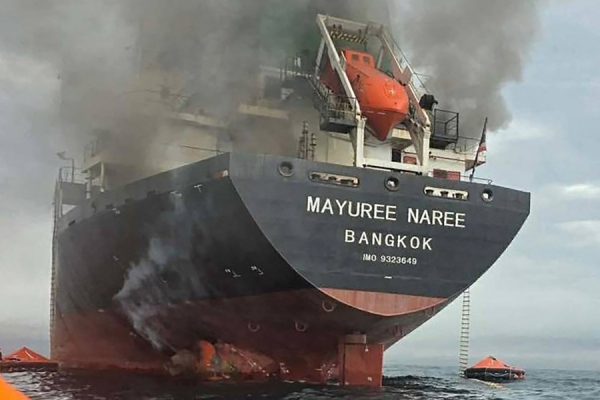
Just as Trump issued criticism, Iran further escalated its actions. Iranian authorities announced on Thursday that, due to continued Israeli airstrikes on Lebanon and alleged ceasefire violations, they have once again closed the Strait of Hormuz shipping lane and released an alternative route map.
The route map was published by Iranian semi-official media outlets the Iranian Students News Agency (ISNA) and Tasnim News Agency. Observers widely believe the move suggests that Iran’s Islamic Revolutionary Guard Corps may have laid naval mines in the strait during the conflict, as a means of pressuring the United States.
According to a statement from the Revolutionary Guard, ships are advised to use alternative routes to avoid potential mines. The new route runs near Iranian territorial waters close to Larak Island. Reports indicate that some vessels used this passage during the conflict period. However, it is unclear whether mine-clearing operations have been completed in the area.
Iranian Deputy Foreign Minister Saeed Khatibzadeh said in an interview with the BBC that Israel had “deliberately and seriously violated the ceasefire,” and therefore Iran decided to close the strait. He added that Iran would resume transit in accordance with “international norms and international law” if the United States stops its “aggressive actions” in the Middle East and Israel halts military strikes on Lebanon.
In response, White House Press Secretary Karoline Leavitt said Iran’s actions are “completely unacceptable,” and reiterated that the Trump administration demands the strait be reopened “immediately, rapidly, and safely.”

Strait has been significantly disrupted
Shipping data also shows that transit through the strait has been significantly disrupted. Energy analytics firm Kpler noted that on the first day of the ceasefire, only four ships with active AIS tracking passed through the strait, not including “shadow fleet” vessels with tracking systems turned off. Due to uncertainty over the ceasefire, international oil prices rose above $97 per barrel on April 9. CNN, citing MarineTraffic data, reported that as of the morning of April 9, a large number of ships remained stranded in the Persian Gulf, including more than 400 oil tankers, 34 liquefied petroleum gas carriers, and 19 liquefied natural gas carriers.
Meanwhile, Bloomberg reported that the United States has asked NATO European allies to propose concrete plans within days to secure the waterway. This request followed meetings between Trump and NATO Secretary General Mark Rutte, as well as discussions involving the Pentagon and the State Department. Previously, an international coalition led by the United Kingdom and involving more than 40 countries had pledged to help restore the key shipping lane after the conflict ends.
French Foreign Minister Stéphane Séjourné said countries are working quickly to finalize escort plans. French President Emmanuel Macron said around 15 countries are prepared to participate. Italian Prime Minister Giorgia Meloni warned that if Iran imposes fees on shipping, it could trigger unpredictable economic consequences, stressing that full restoration of freedom of navigation is necessary.
Additionally, Russia’s TASS news agency cited a senior Iranian source as saying that under the ceasefire agreement, Iran agreed to allow up to 15 ships per day to pass through the Strait of Hormuz. However, since the ceasefire was announced on the night of April 7, actual transit numbers have been far below that limit, indicating that normal operations have not yet resumed.
By Gao Yun